Deutsche Bank has started keeping crypto for its corporate clients. Its digital asset custody page, read on November 12, 2026, offers storage and transfers of bitcoin, ether and three stablecoins, USDC, EURC and EURAU, to clients of its Corporate Bank.
The Deutsche Bank crypto custody service runs under the EU’s MiCA rules. ESMA’s register of crypto service providers lists Deutsche Bank AG, supervised by Germany’s BaFin, for two services, custody and transfers, with a notification dated October 12, 2026.
What Deutsche Bank crypto custody covers
The page names four client groups: institutional investors, multinational companies, governments and wealth managers. Private customers aren’t among them.
| What | Deutsche Bank’s page, November 12 |
|---|---|
| Assets | Bitcoin, ether, USDC, EURC, EURAU |
| Key storage | Hardware security modules, warm and cold options |
| Access | Autobahn and the Corporate Bank Portal |
| Where | Germany, with cross-border service across Europe |
| Services now | Custody and transfers; more “planned” |
All three stablecoins on the list are MiCA compliant stablecoins, with an issuer in ESMA’s e-money token file, so a bank can hold them for EU clients without the problem that tokens such as USDT now face.
How a bank gets in
Banks don’t need a separate crypto license. Under Article 60 of MiCA, a credit institution may provide crypto services once it has told its home supervisor, at least 40 working days ahead of the first service, as ESMA’s rulebook sets out. Deutsche Bank’s row also lists 29 other countries of the European Economic Area where it may serve clients.
Other firms reached MiCA custody first. In ESMA’s file on November 12, 42 firms had notified under Article 60 and listed crypto custody among their services. Deutsche Bank was the 38th by date.
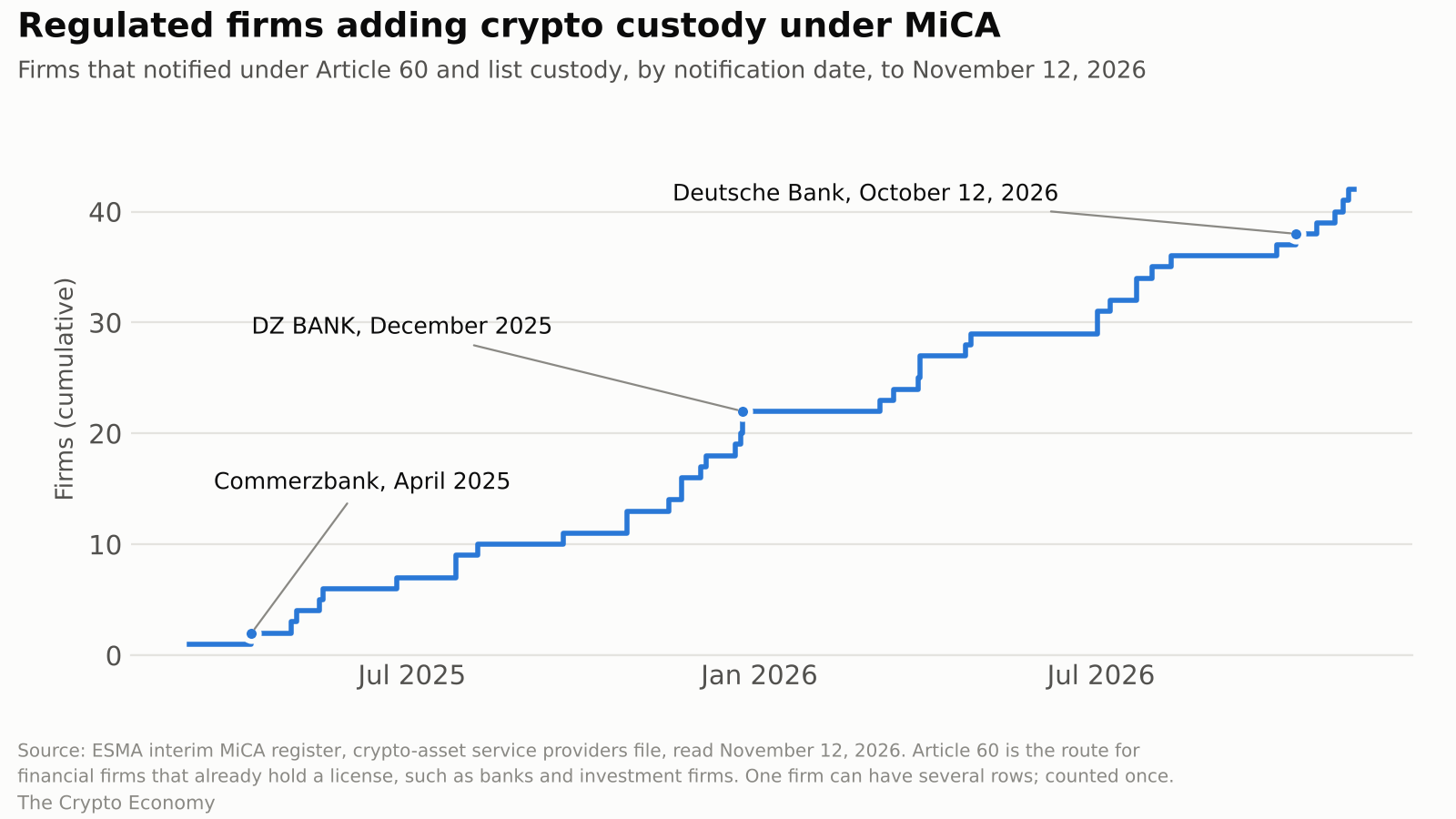
Spain’s BBVA came first, in March 2025, and Commerzbank followed in April. DZ BANK and DekaBank notified in December 2025, and CaixaBank in March 2026. Germany has the most such firms, 10 of the 42, ahead of Spain with seven and France with six.
Article 60 covers investment firms and e-money institutions as well as banks, so not every firm in that count is a bank. Across all routes, 199 of the 404 firms in the file offer custody.
What it changes
For a company that holds crypto, the choice of custodian now includes its own house bank in several EU countries. Most of the other custodians in ESMA’s file are crypto firms with the full license under Article 63, the route behind most of the MiCA-licensed crypto firms we counted earlier this month.
What any of them may hold is narrowing too. ESMA’s opinion of October 8, 2026 tells licensed firms to stop custody of stablecoins that don’t comply with MiCA, which is why a bank’s list starts with USDC and EURC.