The Bank of England, the Monetary Authority of Singapore (MAS) and the Bank of Thailand published the results of Project Meridian FX APAC on November 13, 2026. In test environments, a coordinating service settled both currency legs of a trade across three central bank systems built on different technology, so that either both payments went through or neither did.
Nothing went live. The trial ran on simulated systems and on the non-production version of Singapore’s wholesale digital currency network. The Bank of England plans to launch a live synchronization interface in 2028, according to the joint release.
The risk it targets
A currency trade settles as two payments, one in each currency. If one bank pays and the other fails before paying its side, the first can lose the full amount it paid. The textbook case is Bankhaus Herstatt, which German authorities ordered into liquidation on June 26, 1974.
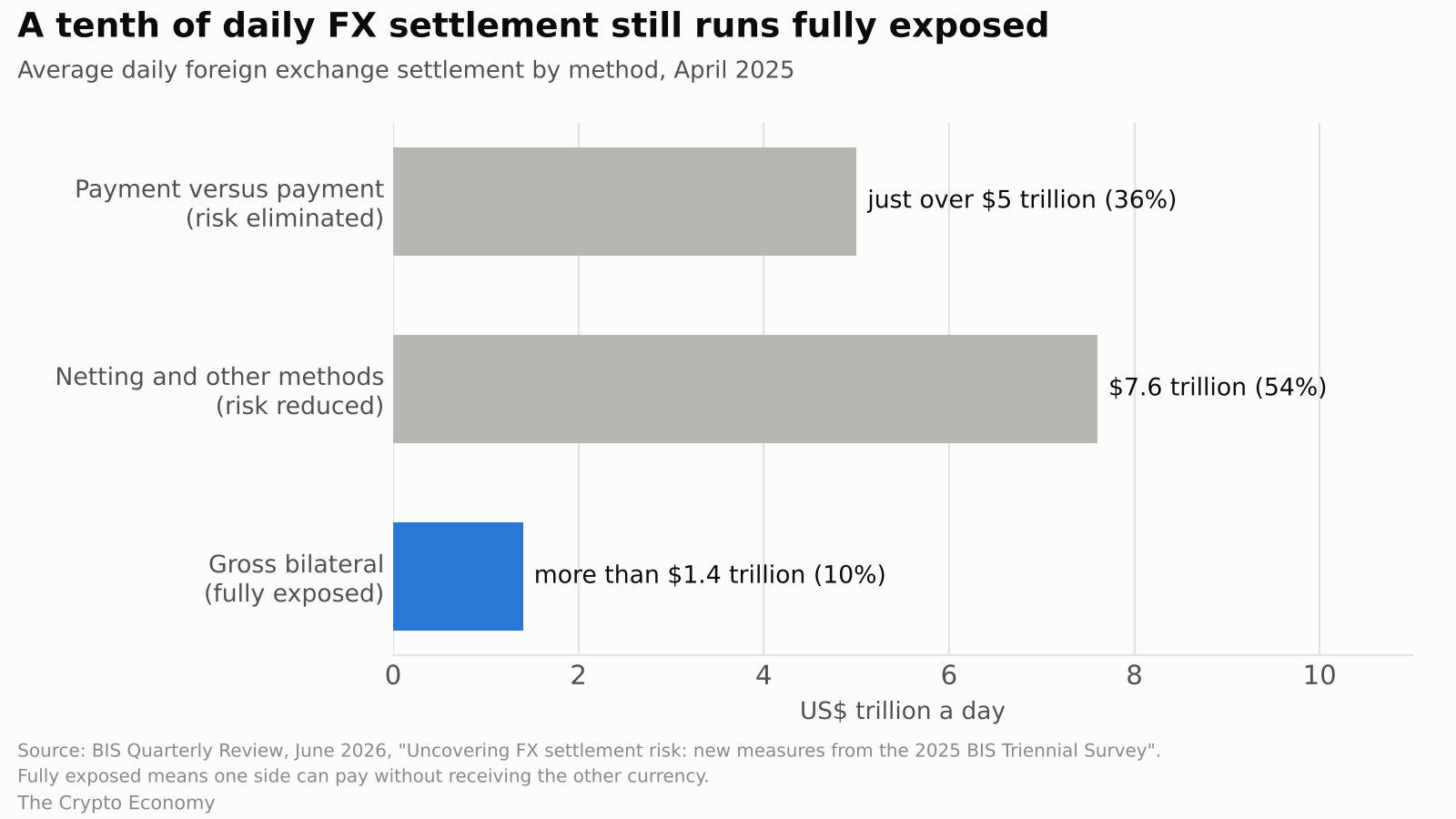
The risk hasn’t gone away. In April 2025 more than $1.4 trillion a day, 10% of all FX settlement, was settled on a gross bilateral basis “which is fully exposed to settlement risk”, the BIS Quarterly Review reported in June 2026. Just over $5 trillion settled through payment versus payment (PvP), which removes the risk.
PvP needs both currencies’ settlement systems to act together. Project Meridian FX APAC tested whether that still works when the systems look nothing alike.
Three different systems
Each central bank brought a test environment with its own design, as the technical report describes them.
| Central bank | Test environment | Design |
|---|---|---|
| Bank of England | Synchronisation Lab | Simulated account-based real-time gross settlement (RTGS) system with a prototype for reserving cash |
| Bank of Thailand | Project SAN | Prototype tokenized payment system with an interoperability layer |
| Monetary Authority of Singapore | SGD Testnet, non-production | Shared ledger for wholesale Singapore dollar CBDC, held in banks’ own wallets |
Partior, the project’s delivery partner, built the prototype “Synchronisation Operator” that linked them. It tested single PvP trades and multilateral netting across all three systems, where banks settle one net amount instead of every trade.
The project also ran failure cases: insufficient funds, invalid account identifiers and temporary outages. In each one, the executive summary says, the operator “was able either to complete settlement or fully unwind the transaction” without letting one leg go through alone.
The workaround in Singapore
The design worked most cleanly where a system lets an authorized third party set funds aside and trigger settlement. SGD Testnet couldn’t do that for the operator, so in the test it ran a dedicated escrow account to copy the effect.
The central banks say this “is not an inherent feature of synchronisation or a proposed model for a future SO”. It matters because an operator that holds banks’ money takes on more than a coordinator that never touches it. The executive summary says such adaptations “could expand the operator’s responsibilities”, and that how an operator should be regulated depends on the functions it performs.
What wasn’t tested
The trial left out the full trade lifecycle, live banks and production conditions. The executive summary adds that “non-overlapping operating hours, time-zone differences, earmark expiry and prolonged outages” were not fully tested.
For businesses that pay across borders in stablecoins or bank transfers, nothing changes yet, because this is plumbing between central banks. The finding to watch is that “cross-border interoperability does not necessarily require central banks to converge on a single infrastructure design.” In the trial, one account-based system and two tokenized ones settled cross-border payments against each other, and none of them had to be replaced.
The Reserve Bank of Australia and Bangko Sentral ng Pilipinas took part as observers. Future work could add more jurisdictions and currencies and work out the legal arrangements a live service would need, the release says.