Key takeaways:
- Tax-year-2026 forms are due to customers by February 16, 2027.
- Brokers must report cost basis in box 1g only for covered coins, bought at that broker from January 1, 2026 and never moved, so an empty box on older or transferred-in coins means you supply the figure on Form 8949 (box H or K), not that your basis is zero.
- Under the optional stablecoin method, a broker can leave qualifying stablecoin sales off the form while they total $10,000 or less for the year.
Form 1099-DA is the return a US crypto broker files with the IRS, with a copy to you, for the digital asset sales it handles for you. It reports gross proceeds on sales from January 1, 2025. For sales from January 1, 2026 it also carries cost basis on covered coins, according to the 2026 IRS instructions.
That second date is why the form matters now. Forms for 2026 sales, due to customers by February 16, 2027, are the first with mandatory basis reporting, and any lot the rules leave out still arrives with the basis box empty. This guide explains the reporting rules and is not personal tax advice.
What Form 1099-DA is and who sends it
Under the instructions, a broker is anyone who, in the ordinary course of a trade or business, “stands ready to effect sales of digital assets to be made by others.” For most people that means the exchange or app that holds their coins. The definition also covers kiosk operators and processors of digital asset payments, and the IRS broker-reporting FAQ confirms that a kiosk “must file a Form 1099-DA” for sales at its terminals.
Only US brokers have to file. “Generally, only a U.S. digital asset broker is required to report,” according to the instructions, and the IRS explainer Understanding your Form 1099-DA warns that customers of foreign brokers “may not receive a Form 1099-DA” but must still report those transactions. The same page says a form follows when you sell, exchange or otherwise dispose of a digital asset in one of these ways:
- for another digital asset
- for US dollars or another currency
- for property, goods or services, in any amount
- to pay the broker’s transaction costs
Exchange Kraken’s tax forms FAQ adds that sending coins to another person through its Krak app counts as a reportable disposition, while its DeFi apps, Kraken Wallet and Ink, are outside the form. Rewards are outside it too. “Do not report rewards and staking payments on Form 1099-DA,” the instructions say, and Kraken and brokerage Robinhood both put rewards of $600 or more on Form 1099-MISC instead.
From the 2024 rules to the first forms with cost basis
The duty arrived in stages, and the stage a sale falls into decides what its form shows.
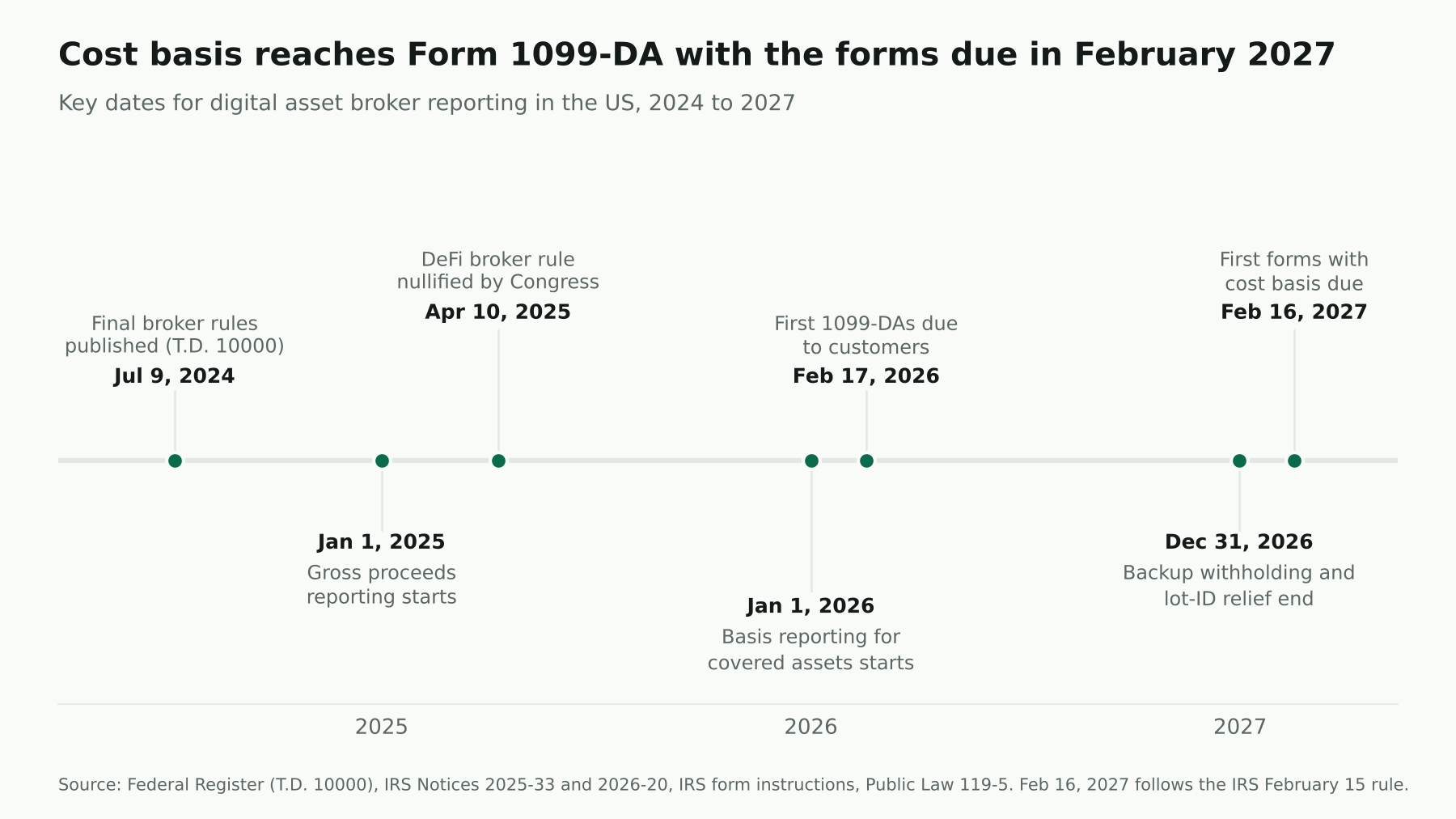
| Date | What happened | Source |
|---|---|---|
| July 9, 2024 | Final broker regulations, T.D. 10000, published at 89 FR 56480 | Federal Register |
| September 9, 2024 | Regulations take effect | Federal Register |
| January 1, 2025 | Gross proceeds reporting starts | Notice 2025-33 |
| April 10, 2025 | Public Law 119-5 voids the December 2024 DeFi broker rule | govinfo |
| January 1, 2026 | Basis reporting starts for covered assets | Notice 2025-33 |
| February 17, 2026 | Tax-year-2025 forms due to customers | IRS general instructions |
| December 31, 2026 | Last day of backup withholding relief under Notice 2025-33 | Notice 2025-33 |
| December 31, 2026 | Notice 2026-20 relief for identifying lots ends | Notice 2026-20 |
| February 16, 2027 | Tax-year-2026 forms due to customers (derived) | Pub. 1099 |
The last date is a calculation. Pub. 1099 sets the deadline at “February 15 of the year following the calendar year,” moved to the next business day when that date falls on a weekend or holiday, and February 15, 2027 is Presidents’ Day.
The DeFi row matters for anyone trading without an intermediary. Public Law 119-5 says the December 30, 2024 rule on brokers that “Regularly Provide Services Effectuating Digital Asset Sales” shall “have no force or effect.” It names only that rule, so the July 2024 regulations for custodial brokers still apply.
Both relief notices extended earlier ones by a year, so their December 2026 end dates could still move if the IRS issues another one.
What each box on Form 1099-DA means
The 2026 instructions run from box 1a to box 16, but several boxes are reserved or apply only to tokenized securities and debt. These are the ones an ordinary crypto sale turns on.
| Box | What the 2026 instructions say it shows |
|---|---|
| Applicable checkbox on Form 8949 | One letter, G or J if basis is reported to the IRS (short-term, long-term), H or K if not, Y if the holding period is unknown |
| 1a | Nine-character token identifier issued by the Digital Token Identifier Foundation, or “999999999” if the asset is not registered |
| 1b and 1c | Name of the asset, and units sold to 18 decimal places |
| 1d and 1e | Date acquired (blank for units bought on various dates) and date sold |
| 1f | Proceeds, reduced by transaction fees, commissions and transfer taxes |
| 1g | Cost or other basis, with “-0-” only if the basis really was zero |
| 2 | Checked when basis is reported to the IRS |
| 3a | “Gross proceeds” or “Net proceeds,” where net means reduced by option premiums |
| 4 | Federal income tax withheld, which is backup withholding |
| 6 | Gain or loss, short-term or long-term, plus “Ordinary” where relevant |
| 7 | Checked when only cash was paid |
| 9 | Checked for a noncovered security |
| 11a-11c | Used with the optional stablecoin and NFT methods, showing the reason, the number of transactions and a creator’s or minter’s first-sale proceeds |
| 12a-12b | Units transferred in and the transfer-in date, blank if they arrived on several dates |
Box 3a is easy to misread. The Form 1099-DA instructions tie “Net proceeds” to option premiums only, while the broker “must reduce” box 1f by transaction costs, “including transaction fees, commissions, and transfer taxes.” A tick next to “Gross proceeds” does not mean fees were left in.
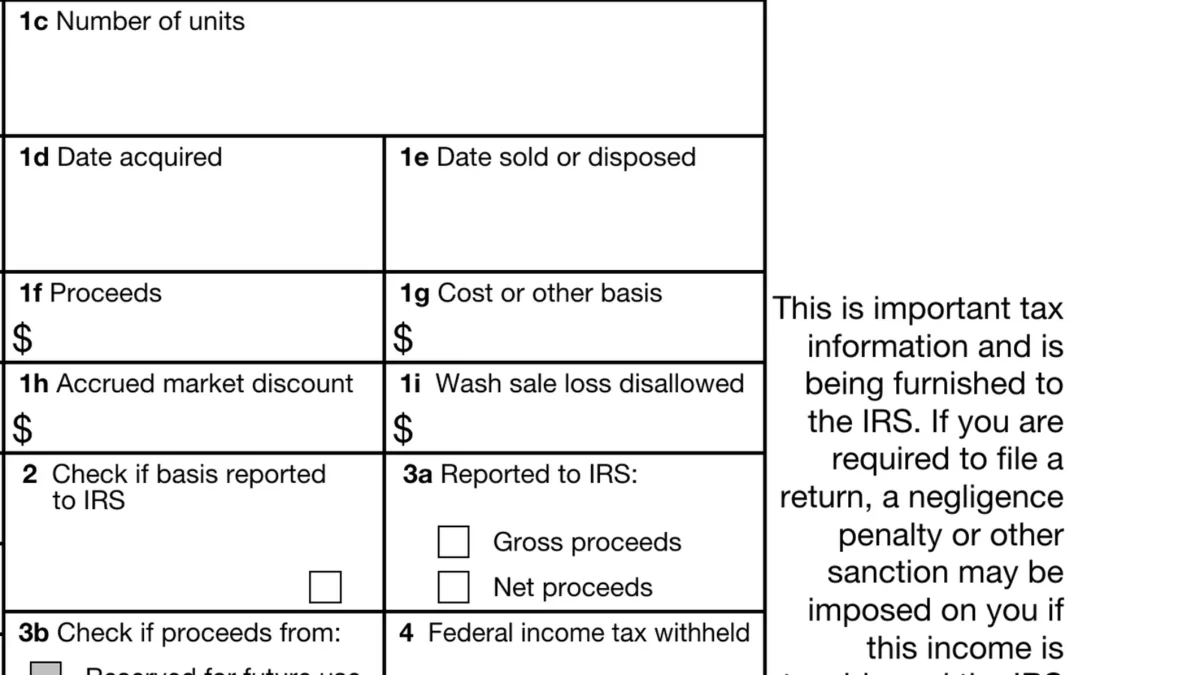
Copy B, the one sent to customers, looks like this in the 2026 revision. Boxes 1f, 1g, 2 and 9 sit in the middle column, and the transfer-in boxes 12a and 12b are near the bottom.
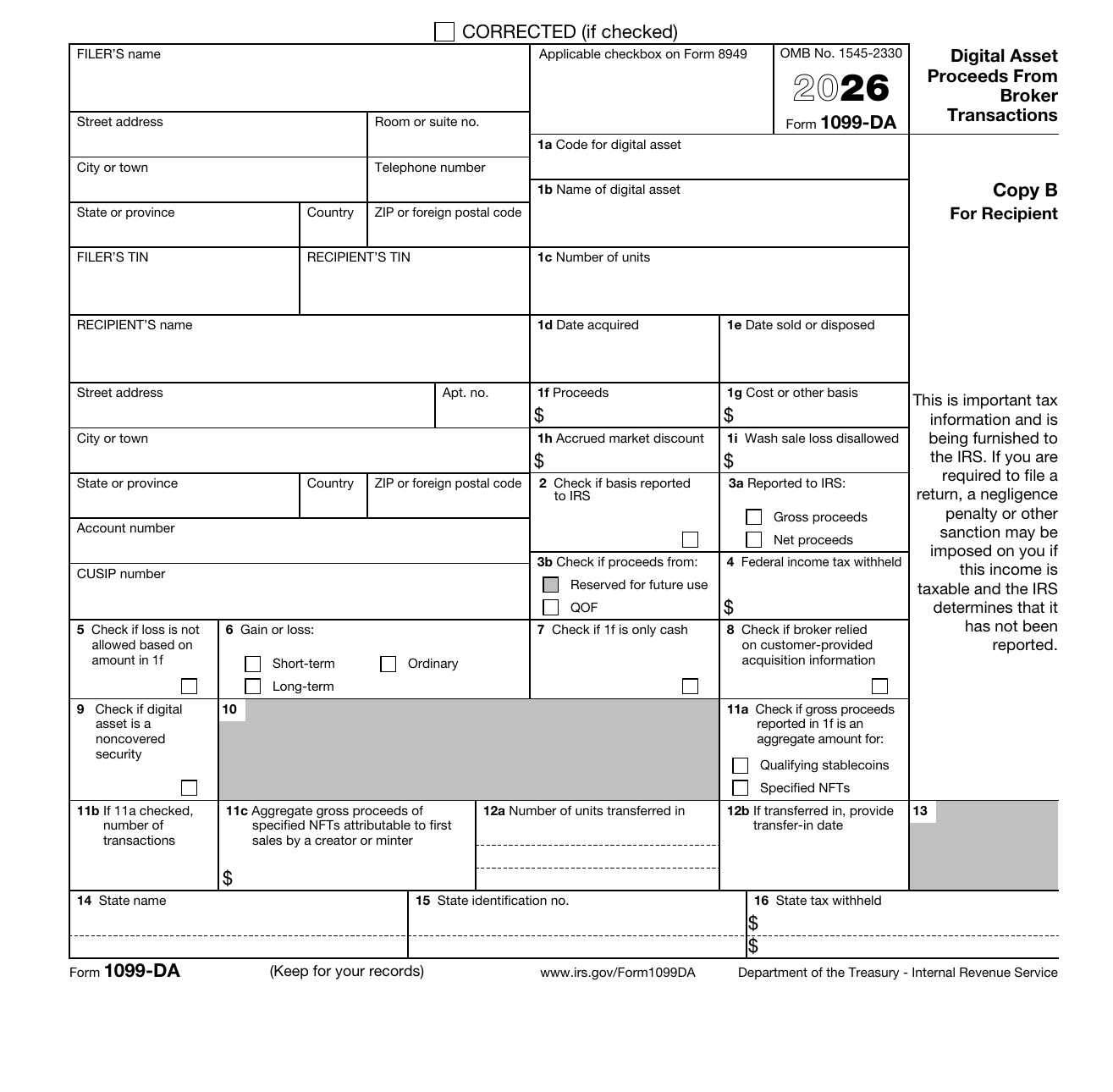
The letter in the Form 8949 box follows from boxes 2 and 9, and both depend on whether each coin is covered.
Covered and noncovered assets: why your form may show no cost basis
A covered security is “a digital asset acquired after 2025” in an account where the broker provided custodial services, and it stays covered only if it “was held in that account until the broker effects the disposition,” the 2026 instructions say. Everything else is noncovered. Brokers must report basis for covered coins and may report it for noncovered ones, with no penalty for errors in that voluntary basis if they check box 9.
The table shows where common situations land and whether a 1099-DA cost basis figure appears.
| Your situation | Covered or noncovered | Basis on the form? |
|---|---|---|
| Bought at this broker in 2026 or later and never moved | Covered | Yes, in box 1g, with box 2 checked |
| Bought before 2026 | Noncovered | Only if the broker reports it voluntarily |
| Transferred in from another platform or wallet | Noncovered | Generally no (see the IRS FAQ below) |
| Held in a self-custody wallet or used in DeFi | No broker reports it | No form at all |
| Bought through a foreign platform | Foreign brokers generally do not file | A form may not arrive, and the sale is still reportable |
A blank box 1g is not a zero. Brokers may enter “-0-” only when the coin “actually had a basis of zero,” so an empty box means the cost basis figure is yours to supply, and the IRS explainer says “You must calculate basis before you file your tax return.”
Coins you transferred in from another platform or wallet
Coins moved into a custodial account are noncovered, since the instructions list “a digital asset that was transferred in to the broker providing custodial services” among noncovered securities. The move still shows, with transferred-in units in box 12a and the transfer-in date in box 12b.
Basis does not travel with the coins. In answer 3 of its broker-reporting FAQ, the IRS lets a receiving broker use the sending broker’s records to pick which units were sold, but says “You are not permitted to use this information from the transferring custodial broker to report the basis of the transferred-in units on Form 1099-DA.”
Box 8 is a separate signal. The broker checks it when it relied on acquisition information the customer supplied to work out which units were sold.
Robinhood describes its approach differently. Its help page says that in 2026 “Cost basis reporting will include transfers of crypto assets,” without saying how that fits the IRS answer, so Robinhood customers with transferred coins should check boxes 2 and 9 before assuming the basis went to the IRS.
Coins you bought before 2026
Coins acquired before 2026 are noncovered even if they never left the broker. For 2025 sales, the 2025 instructions said “Brokers are not required to report basis information,” and Kraken says its new basis reporting covers “positions acquired in 2026 or thereafter.”
How Form 1099-DA flows into Form 8949 and Schedule D
The 1099-DA instructions say the one-letter code helps you report each sale “on Form 8949 and/or Schedule D (Form 1040).” The Form 8949 instructions now give digital assets their own boxes, G through I for short-term sales and J through L for long-term ones, and rule out boxes C and F for them.
- Sort the forms by letter, keeping short-term and long-term sales apart.
- Enter code G and J sales in box G or J, with proceeds from box 1f and basis from box 1g.
- Enter code H and K sales in box H or K, with proceeds from box 1f and basis from your own records.
- For code Y, work out the holding period from your purchase dates, then pick the short-term or long-term box as in steps 2 and 3.
- Put sales with no Form 1099-DA, such as DeFi swaps, spending from a self-custody wallet or trades on a foreign platform, in box I or L.
- Answer the digital asset question on page 1 of Form 1040.
Box 2 decides between steps 2 and 3. The Form 8949 instructions give “box 2 on Form 1099-DA isn’t checked” as their example of unreported basis.
For tax year 2025, the Form 1040 instructions say to check “Yes” if you received a digital asset as a reward, award or payment, or “sold, exchanged, or otherwise disposed of” one, so any sale on the form means a “Yes.”
A worked example: one sale with covered and noncovered units
Bill is the customer in the IRS’s own example. Using one custodial broker, he bought units of digital asset ABC in April 2022, April 2026 and August 2026, then sold all of them in one transaction in June 2027, according to the 2026 instructions. The 2026 units are covered and the 2022 units are not.
One sale becomes three 2027 forms. The broker reports the August 2026 units as a short-term sale, the April 2026 units as long-term and the April 2022 units as noncovered, checking box 9 on the third. Folding the 2022 units into the long-term form is allowed if the broker reports their basis, but then it “may not check box 9” and faces penalties if that basis is wrong.
No dollar amounts appear in the IRS version, so these figures are an illustration only. Say Bill paid $2,000 for 10 units in April 2022, $1,500 for 5 units in April 2026 and $2,500 for 5 units in August 2026, then sold all 20 for $8,000 after fees, or $400 a unit.
| Form (illustration) | Units | Term | Box 1f proceeds | Box 1g basis | Gain or loss | Form 8949 box |
|---|---|---|---|---|---|---|
| August 2026 lot, covered | 5 | Short-term | $2,000 | $2,500 | $500 loss | G |
| April 2026 lot, covered | 5 | Long-term | $2,000 | $1,500 | $500 gain | J |
| April 2022 lot, noncovered, box 9 checked | 10 | Long-term | $4,000 | Blank if not reported | $2,000 gain, using Bill’s $2,000 basis | K |
Bill’s net gain is $2,000, which matches $8,000 of proceeds less $6,000 of basis. The trap is the third row. Read the blank box 1g as zero and the 2022 lot shows a $4,000 gain, overstating it by the $2,000 Bill paid in 2022.
The last column follows the instructions’ code definitions, not the IRS example. Had the broker reported the 2022 basis and checked box 2, that row would carry J.
Stablecoins, NFTs and payment processors: the de minimis rules
Under the 2026 instructions, brokers may use lighter reporting for qualifying stablecoins, which are designed to track a single government-issued currency such as the US dollar one to one, use an effective stabilization mechanism and are generally accepted as payment by people other than the issuer. One stabilization test in the IRS broker-reporting FAQ requires the coin to stay within 3% of its currency over any consecutive 10-day period.
The relief covers designated sales, meaning any sale of a qualifying stablecoin except a swap for coins that are not qualifying stablecoins. A broker using the optional method need not report them while a customer’s aggregate gross proceeds “do not exceed $10,000 for the year,” and above that each stablecoin goes on its own form. Robinhood’s help page describes the same $10,000 trigger.
NFTs and payments have a lower bar. A broker using the NFT method can skip a customer’s specified NFT sales up to $600 a year, and a payment processor need not report payment sales of $600 or less, though “if a customer’s PDAP sales exceed $600 for the year, all of that customer’s sales must be reported.”
The stablecoin and NFT methods are optional. Under either one, the broker “is not required to report acquisition dates or basis amounts, even if the digital assets are covered securities,” and box 2 stays unchecked.
What changes in 2027: backup withholding and lot identification
Backup withholding is tax a broker holds back when a customer’s taxpayer identification number is missing or, according to the IRS, wrong. Notice 2025-33 puts the rate at “currently 24 percent” and says it “will not be required on any digital asset sale effected by a broker during calendar year 2025 or calendar year 2026.”
Some relief carries into 2027. Brokers may rely on an uncertified number from a customer whose account opened before January 1, 2026 if the IRS TIN Matching Program confirms it, and withholding on crypto-for-crypto trades is capped at what the broker gets from immediately selling 24% of the coins received. Payees generally certify their number on Form W-9, the notice says, and any amount withheld would appear in box 4.
Lot identification changes on January 1, 2027 as well. Under the regulation that Notice 2026-20 describes, you pick which units a custodial broker sells by telling the broker no later than the sale, or through a standing order you give it, and otherwise the earliest units acquired there count as sold first.
Some custodial brokers told the Treasury and the IRS that their systems for taking those instructions would only be ready in 2026, so the notice lets taxpayers record the choice in their own books instead, from January 1, 2025 to December 31, 2026. Section 5 says they “may not rely on the temporary relief” for sales “made after the relief period ends,” and the notice describes no further relief.
The same notice warns that for 2026 sales the basis a broker reports “may not match” your own lot records, while units properly identified in your books count as the ones sold for tax purposes.
When your 1099-DA does not match your records
The IRS is blunt about errors. Its explainer says to “Request a corrected form from the issuer,” adds “Don’t contact the IRS. We can’t correct your Form 1099-DA,” and says “Don’t wait to file your taxes.”
Brokers set their own limits. Robinhood says that because 2025 basis was not reported to the IRS, it “will not issue any corrections for any changes.”
Dates can shift too. In a June 2026 thread on Reddit, a Kraken customer said the exchange used UTC, so trades made on December 31, 2024 showed as January 1, 2025 sales and inflated 2025 proceeds. That is one user’s experience, not confirmed by Kraken or the IRS.
Before filing, compare each form with your own records on these points:
- box 1f proceeds for each coin against your sales on the same dates
- units in boxes 1c and 12a against the coins you sold and moved in
- trades within a few hours of midnight on December 31, in case of a time-zone shift
- boxes 2 and 9, which decide whether the basis is yours to supply
- sales missing from every form, such as DeFi swaps or foreign trades
That last group still goes on your return, in box I or L of Form 8949. A broker’s form covers only the sales that broker handled.
Two checks come next. Confirm that each broker holds a certified Form W-9 before backup withholding relief ends on December 31, 2026, and gather purchase records for every coin bought before 2026 or moved between platforms, because those are the lots most likely to arrive in February 2027 with box 1g empty.
Frequently asked questions
Do I have to report crypto if I don’t get a Form 1099-DA?
Yes. The IRS says that “Whether or not you receive a Form 1099-DA, you must report all income, gains and losses from digital asset transactions” on your federal return. Sales with no form, such as DeFi trades, go on Form 8949 in box I (short-term) or box L (long-term).
When will I get my Form 1099-DA for 2026?
Brokers must furnish tax-year-2026 forms by February 16, 2027. We worked that date out from the IRS rule of “February 15 of the year following,” which shifts to the next business day because February 15 falls on Presidents’ Day that year. The 2025 forms were due by February 17, 2026.
Why is the cost basis box blank on my 1099-DA?
Usually the coins are noncovered. Coins bought before 2026, coins transferred in and every 2025 sale fall outside mandatory basis reporting, and the optional stablecoin and NFT methods can leave box 1g blank too. Blank is not zero, so enter your own figure.
Are stablecoin payments reported on Form 1099-DA?
They can be. A broker using the optional stablecoin method skips a customer’s designated sales while they total $10,000 or less for the year and reports them in aggregate above that. Processors also get a separate $600 yearly threshold for payment sales, which they test only after applying the stablecoin and NFT rules.
Are staking rewards on Form 1099-DA?
No. The 2026 instructions tell brokers to leave rewards and staking payments off the form. Kraken and Robinhood both report rewards of $600 or more for the year on Form 1099-MISC instead, and a later sale of those rewards through a broker is reported like any other sale.