The euro stablecoin that 37 European banks are building now has a white paper on file with the EU’s securities regulator. ESMA’s update of November 11, 2026 added Qivalis B.V. of Amsterdam to its register of e-money token issuers, with a row headed “EURqi white paper” and a notification date of October 21.
The Qivalis stablecoin isn’t out yet. The company said on October 14 that issuance is “planned to begin within the next months”, and its website says the company “does not currently issue electronic money or provide payment services to the public.”
What the register shows
The new row sits in ESMA’s interim MiCA register, which the regulator’s MiCA page dates to November 11. We read it on November 12.
| Field in ESMA’s file | Entry |
|---|---|
| Issuer | Qivalis B.V., Amsterdam |
| Supervisor | De Nederlandsche Bank (DNB) |
| License | Electronic money institution |
| White paper | “EURqi white paper”, notified October 21, 2026 |
| Digital token identifier | V456JNMB3 |
| White paper link | qivalis.eu/trust-center/white-paper, which returned a 404 error on November 12 |
With this row the file holds 51 white papers from 26 issuers, and Qivalis has the newest notification date in it. Most of the other entries are tiny, and only 15 of the MiCA compliant stablecoins in the file had any supply tracked by DefiLlama on November 10.
Who is behind the Qivalis stablecoin
Qivalis was founded in September 2025, and by May 2026 it had twelve member banks, among them BNP Paribas, ING, UniCredit, BBVA and CaixaBank. On May 20, 2026 it announced 25 more members, including ABN AMRO, Nordea, Rabobank and Intesa Sanpaolo, for 37 banks in 15 countries.
DNB authorized it as an electronic money institution on October 14, the company said in its release that day. The same release names Jan-Oliver Sell as chief executive and Sir Howard Davies, a former chairman of NatWest Group and of the UK’s Financial Services Authority, as chair of the supervisory board.
Ordinary users won’t buy it from Qivalis. The company describes a “B2B2X” model, with the token handed out through banks, exchanges, payment firms and market infrastructure operators, and it plans a full reserve, one euro held for each token.
The market it would join
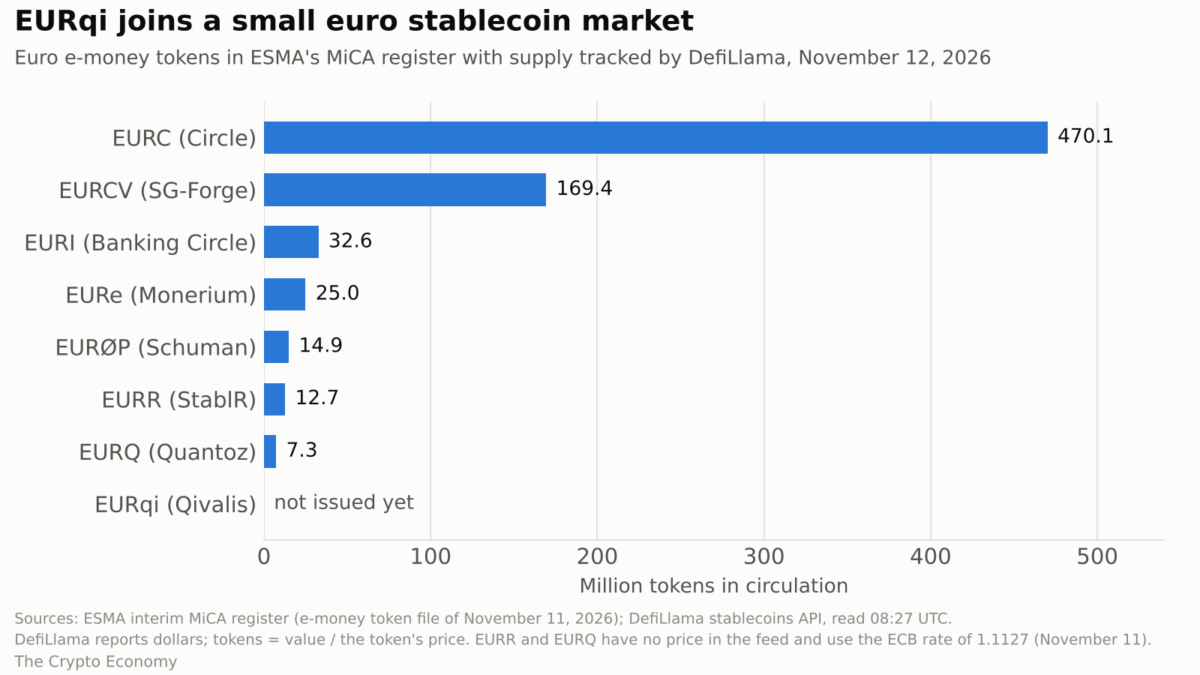
Euro stablecoins are still small. On November 12 at 08:27 UTC, data site DefiLlama tracked about 767 million euro-pegged tokens in all, worth about $850 million, while USDC alone stood at $69.8 billion.
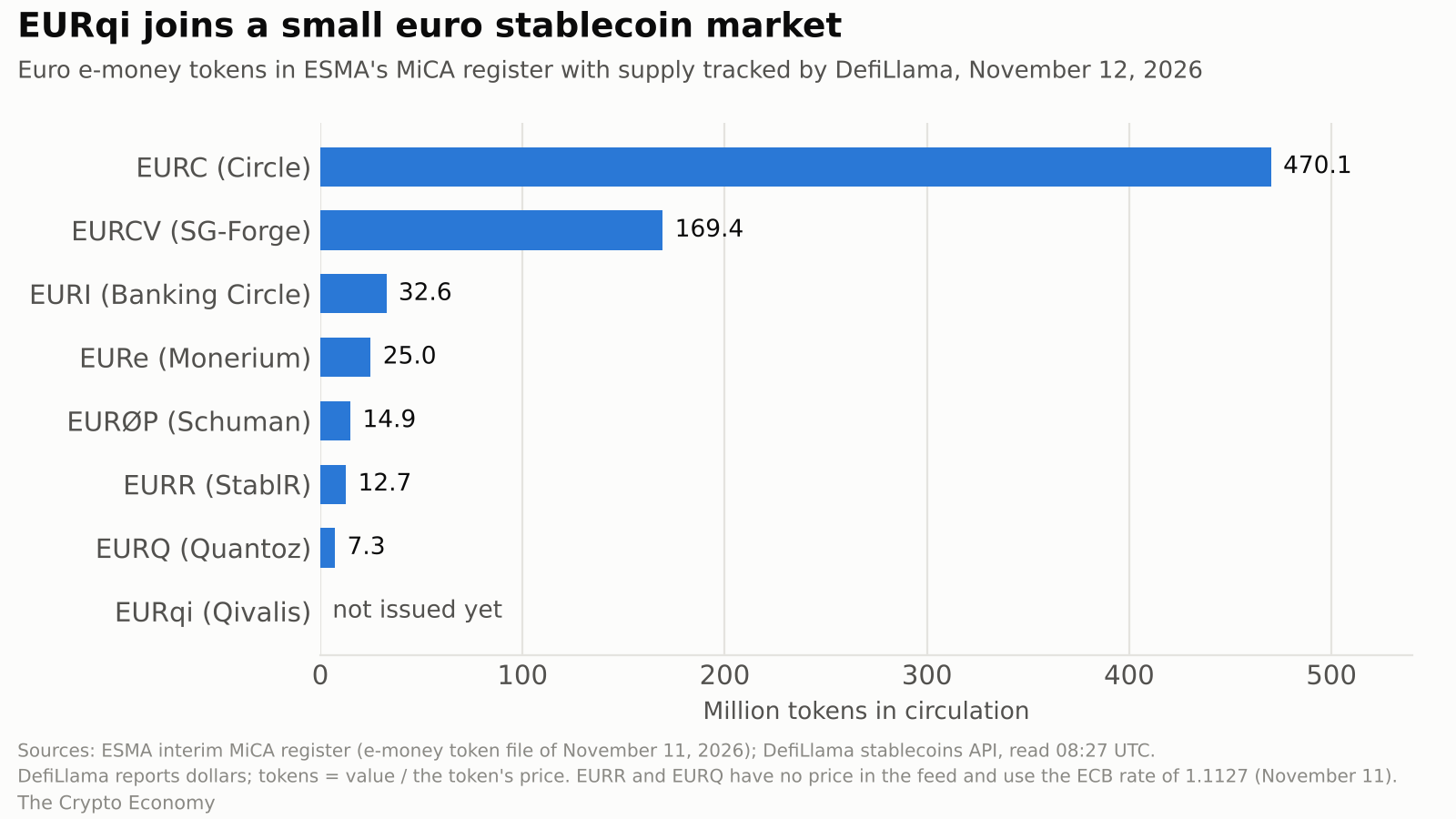
Circle’s EURC leads with 470.1 million tokens, and Société Générale’s EURCV follows with 169.4 million. DefiLlama reports every token in dollars, so we divided each figure by the token’s own price in the same feed.
Regulators are also clearing room. An ESMA opinion of October 8, 2026 tells licensed crypto firms to stop serving EU clients in stablecoins that don’t comply with MiCA and to clear remaining holdings within three months. No Tether company is in the register, so USDT is one of them.
What to watch
MiCA lets an issuer offer an e-money token to the public only after it has notified its white paper and published it. Qivalis has done the first. The document wasn’t at the address ESMA gives on November 12, and the company tied the launch to “publication of the White Paper” in its October release, so the published paper is the next sign that the Qivalis stablecoin is close to launch.