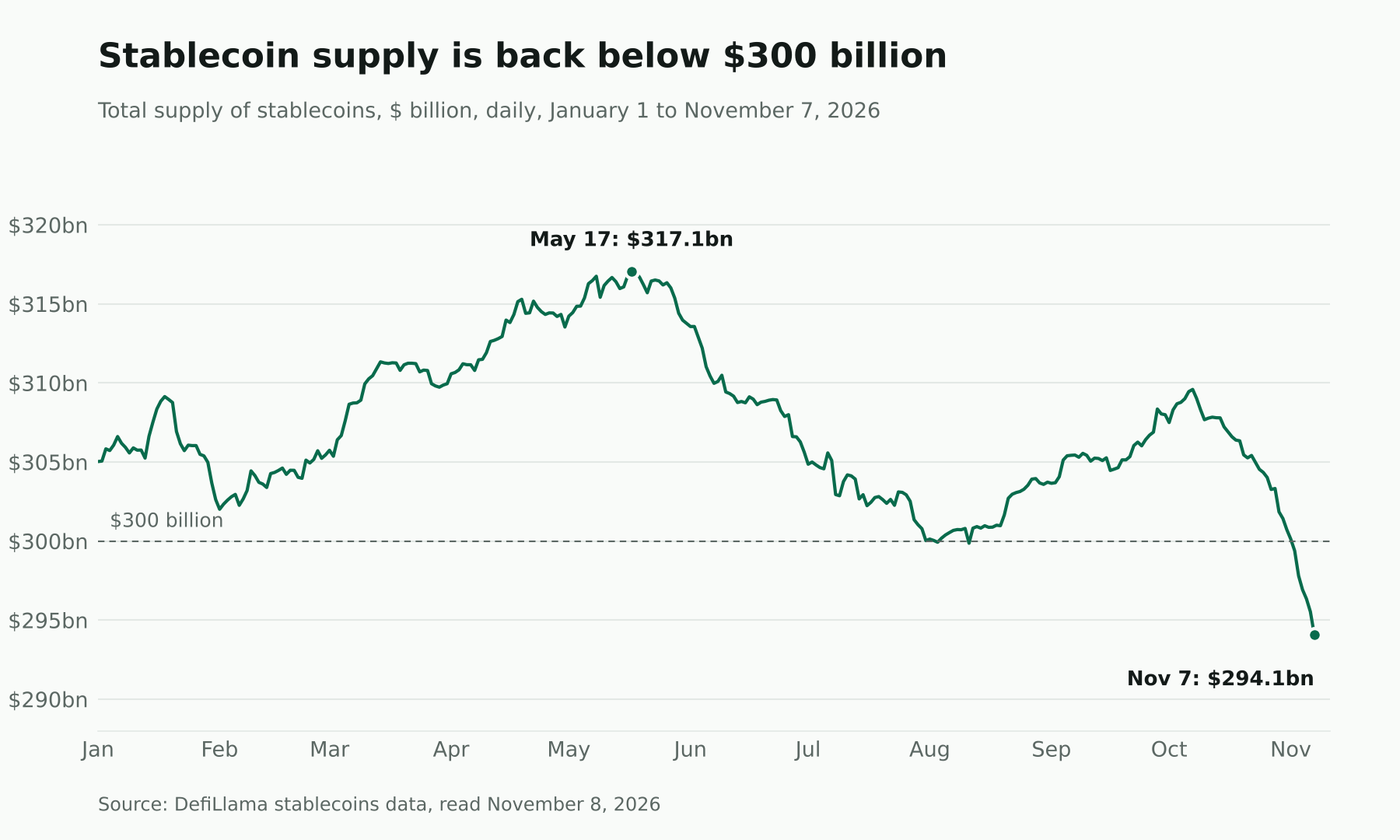
The combined supply of stablecoins fell by $6.6 billion in the seven days to November 7, the biggest weekly decline of 2026, according to figures from data provider DefiLlama as they stood on November 8.
On that reading, supply stood at $294.1 billion on November 7, down from $300.7 billion a week earlier, and the 2026 high was $317.1 billion, on May 17. The chart below shows the series as read that day.
DefiLlama has since revised its past values. Read on November 16, the same series puts supply at $293.2 billion on November 7 and $298.7 billion on October 31, a fall of $5.5 billion, and lowers the 2026 high to $314.4 billion.
In that version the seven days to November 4 fell slightly more, by $5.54 billion against $5.51 billion. Supply has also been under $300 billion since October 29, and it was below that mark on most days from July 14 to August 21.
Which coins shrank
Most of the fall came from the two biggest issuers. DefiLlama’s coin list, read on November 8, measures the seven days to that date, one day later than the headline window. Over those seven days Tether’s USDT shrank by $2.8 billion and Circle’s USDC by $1.2 billion, $4.0 billion between them.
The table shows the largest moves in DefiLlama’s data over the same window, along with the change over the 30 days to November 8, as its list stood that day.
| Coin | Name in DefiLlama | Supply on November 8 | 7-day change | 30-day change |
|---|---|---|---|---|
| USDT | Tether | $176.8 billion | -$2.8 billion | -$7.4 billion |
| USDC | USD Coin | $70.7 billion | -$1.2 billion | -$2.6 billion |
| USDS | Sky Dollar | $5.6 billion | -$763 million | -$1.2 billion |
| USD1 | World Liberty Financial USD | $3.5 billion | -$425 million | -$848 million |
| USDe | Ethena USDe | $4.9 billion | +$422 million | +$102 million |
| RLUSD | Ripple USD | $2.7 billion | +$280 million | +$222 million |
Not every coin lost ground, then. Ethena’s USDe and Ripple’s RLUSD both grew during the week, though their gains together cover only a fraction of what left USDT alone.
The pegs held
None of this broke either peg. A stablecoin’s peg is the $1 value its issuer aims to hold, and DefiLlama’s daily prices kept USDT between $0.9983 and $0.9995 and USDC between $0.9997 and $1.0001 from October 31 to November 8.
Supply usually shrinks when holders hand coins back to the issuer for dollars and the issuer destroys them. DefiLlama values each coin’s supply at its market price, though, so a small part of any change can come from price moves, and the data does not show who redeemed or why.
Tether’s own transparency data, read on November 8, put USDT’s net circulation at about $177.0 billion, close to DefiLlama’s count, against total reported assets of $182.5 billion. Circle’s transparency page says USDC reserves are reported weekly, and on November 8 its latest figures were dated November 5.
What it means for payments
For a business paid in USDC or USDT, a falling supply does not by itself change what a coin is worth. The test is whether the coin can still be redeemed one for one, and the market price is the quickest public sign of that, though it can’t show whether every holder could redeem directly with the issuer. Both coins stayed within a fraction of a cent of $1.
Some merchants never hold the coins at all. Several of the processors that let a shop accept stablecoin payments convert them on arrival and pay out in dollars or euros.
DefiLlama updates its supply series daily, Tether refreshes its circulation figures daily and Circle publishes reserve data weekly. Circle’s weekly figures also split USDC’s change in circulation into coins issued and coins redeemed, which a supply total can’t show.
Update, November 12, 2026: the decline continued. Stablecoin supply fell by $14.8 billion over the 30 days to November 12, the most since June 2022, and most of the USDT that left was on Ethereum. The figures are in our follow-up report.