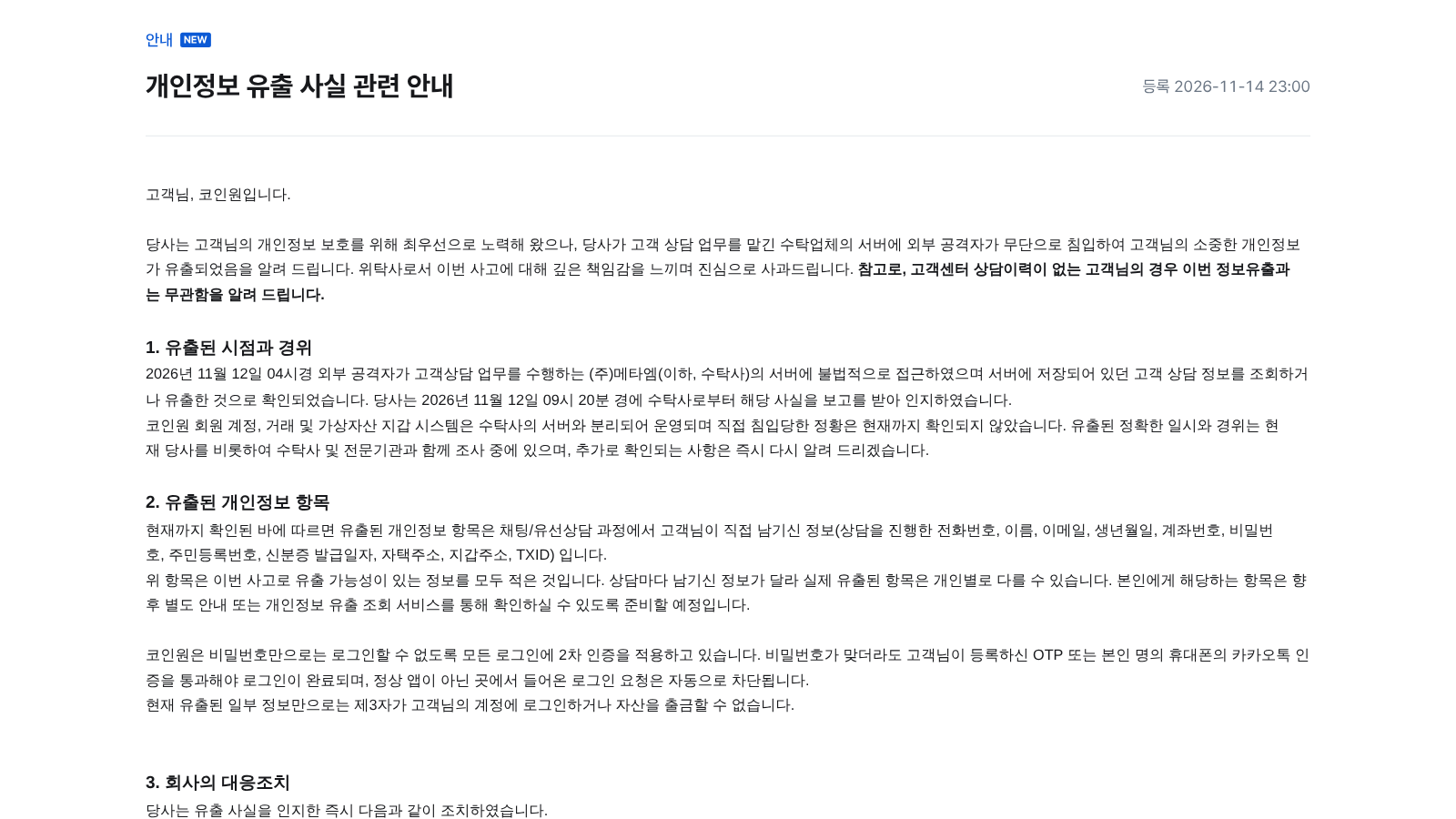
South Korean crypto exchange Coinone said on November 15, 2026, that an attacker broke into the servers of MetaM, the contractor that runs its customer support, and viewed or took records of customer chats and calls. According to Coinone’s notice, the intrusion happened at about 4 a.m. Korea time on November 12, and MetaM reported it to the exchange at about 9:20 a.m. the same day.
Only customers who have contacted support are affected, Coinone says. The exchange has not said how many people that is.
What may have leaked
The exposed data is whatever customers gave support agents in chats and phone calls, and some of it is the kind of identity data exchanges collect for KYC checks. Coinone lists every item that may have leaked and says the set differs from person to person, because each conversation contained different details.
| Kind of data | Items in Coinone’s list |
|---|---|
| Contact | name, phone number used for the call, email address, home address |
| Identity | date of birth, resident registration number, ID card issue date |
| Money | bank account number, password, crypto wallet address, transaction ID (TXID) |
Coinone says it will set up a way for each customer to check which of their own details leaked.
Accounts and wallets, according to Coinone
Coinone says its account, trading and crypto wallet systems run separately from the contractor’s servers, and it has found no sign that they were breached. Every login needs a second factor, either a one-time code or a KakaoTalk confirmation on the customer’s own phone, and the exchange says the leaked details alone can’t be used to log in or withdraw.
The exchange has reported the breach to the Korea Internet & Security Agency (KISA), the Personal Information Protection Commission and the Financial Supervisory Service. It also moved the outsourced support desk to email only.
What Coinone customers should do
The notice asks customers to take three steps.
- Change the Coinone password if you ever told it to a support agent, and change it on every other site where you use the same one.
- Treat any call, text or email that mentions your past support conversation as a possible scam; Coinone says it never asks for passwords, one-time codes, withdrawals or wallet address changes by phone, text or email.
- Check the withdrawal address book for entries you didn’t add, and report any login, order or withdrawal you didn’t make; the app and website also offer an account lock.
Korean law gives customers a claim if they lose money. Under the Personal Information Protection Act, the notice says, the company carries the burden of proof, a court can award up to five times the loss when a leak was intentional or grossly negligent, and customers who can’t prove a loss can seek statutory damages of up to 3 million won.
Part of a wider wave in Korea
Coinone’s breach comes during a run of attacks on Korean finance. The Financial Services Commission counted 40 hacking incidents at 37 financial companies between September 30 and November 3, three of them virtual asset service providers, with about 473,000 cases of personal data exposed. As of November 5 it had seen no reports of customers’ account passwords being stolen.
Until now, Korean crypto exchanges have had to report hacks only to KISA, not to financial regulators, the commission said on November 5. It planned guidelines in November requiring them to report attacks to the financial authorities straight away. Coinone also informed the Financial Supervisory Service.
What it means if you keep money on any exchange
The weak point here was a support contractor, not the exchange’s trading systems. Anything you type into a support chat is stored, at Coinone by another company, so a password or ID number shared there sits outside the exchange’s own defenses.
A real support agent doesn’t need your password, a one-time code or your seed phrase. Exchange balances are custodial, so the exchange’s security, including its contractors’, is part of the risk you take on. In this case, Coinone says, the second login factor is what keeps the leaked details from being enough to log in or withdraw. A withdrawal address list, where an exchange offers one, adds a further check.