ChatGPT Wallet is OpenAI’s way of letting its AI agents pay for things. A user adds a card once. When their agent, called a dot, finds something to buy, the user checks the items and the total and approves the purchase with Face ID or a fingerprint. The card network then gives the shop a token in place of the card number.
OpenAI announced the wallet on November 13, 2026, and built it with American Express, Mastercard and Visa. The wallet is a card-based form of agentic commerce, and its fine print decides what happens when a purchase goes wrong.
What ChatGPT Wallet is
ChatGPT Wallet stores a card, not money. Each purchase is charged to the card the user selects, and the user buys directly from the business, which keeps control of pricing, fulfillment, returns and customer service, according to OpenAI.
The name can mislead crypto users. The wallet holds no coins and no stablecoins such as USDT, only the card the user added.
The wallet lives inside dots, OpenAI’s personal agents. A dot has its own cloud computer and browser, according to OpenAI’s dots documentation, so a purchase usually happens on the shop’s own website, following its existing checkout.
Visa laid the groundwork months earlier. On June 10, 2026, it announced a collaboration with OpenAI at its Payments Forum in San Francisco, offering tokenization and authorization, plus agent identification and fraud monitoring, for agentic payments. American Express calls the wallet its first “American Express Agentic Commerce Experiences integration.”
Who can use it at launch
OpenAI is starting small. The wallet began rolling out on November 13 to a limited group, and the company says it will expand availability as it learns from early use.
| Condition | At launch (November 2026) |
|---|---|
| Plan | ChatGPT Pro |
| Country | United States |
| Age | 18 and older |
| Cards | eligible US-issued cards |
| Built with | American Express, Mastercard and Visa |
| Where it works | inside dots, OpenAI’s personal agents |
| Approval | each purchase, confirmed by Face ID or fingerprint |
Anyone outside that group can’t add a card yet. The announcement gives no date for other countries or other ChatGPT plans.
How a purchase works
Every purchase follows the same path in OpenAI’s description, from the first request to the shop’s own checkout.
- Add a card to ChatGPT Wallet once.
- Ask your dot to find or buy something; it searches the web, product feeds and connected services and brings back options.
- Before paying, review the items, the total and the card that will be charged.
- Approve it, for example with Face ID or a fingerprint scan.
- The card network issues a payment token, and the shop charges it through its normal checkout.
- The shop handles the order, delivery, returns and support, as with any online purchase.
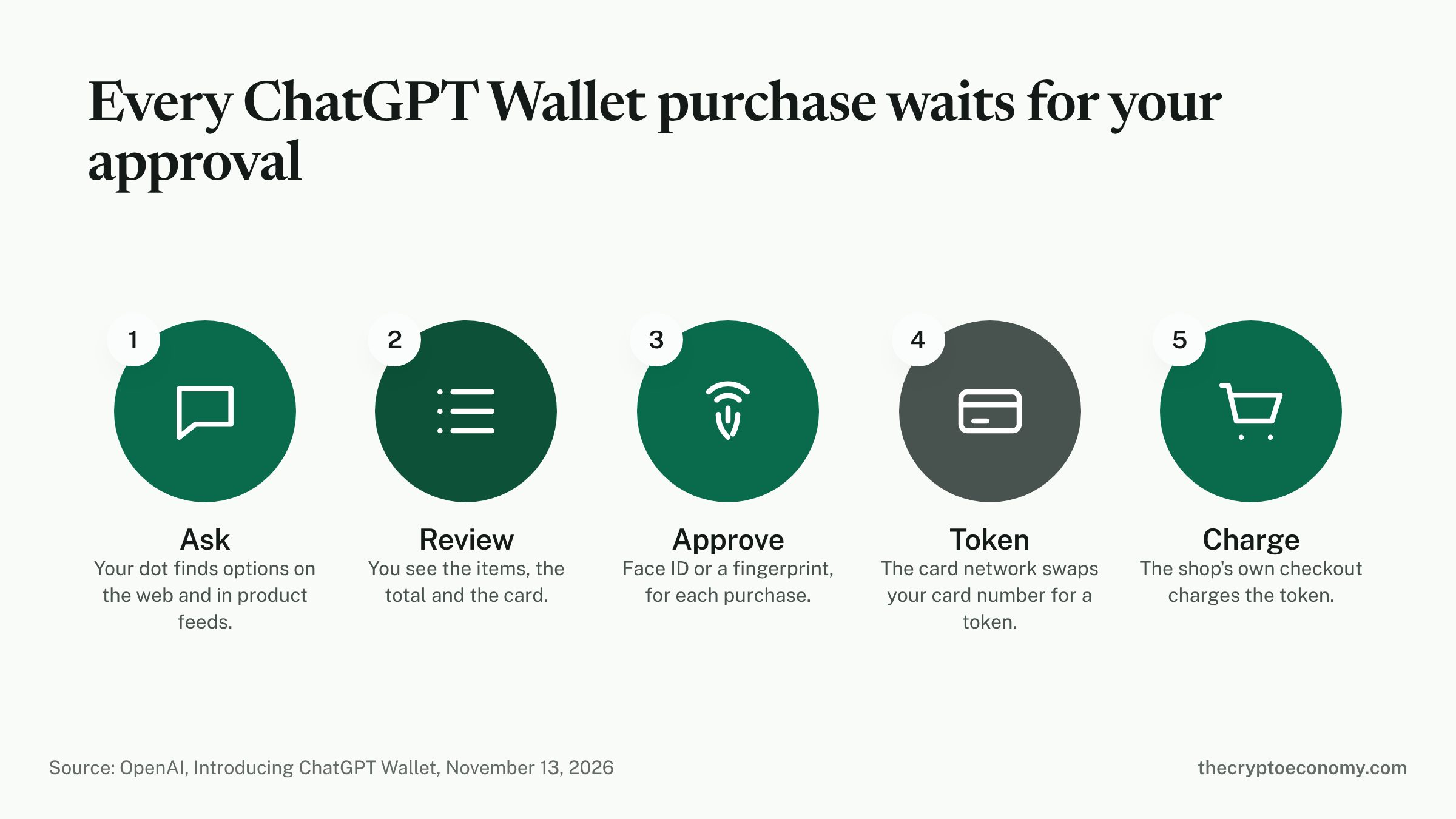
Each approval creates a record of the purchase the user authorized, OpenAI says. The token step is the same method card networks already use for phones and saved cards, known as network tokenization.
Why the agent never sees your card number
Tokens are the security idea behind the wallet. After the user approves, the network provides a substitute card number with its own security code and expiration date, so neither the agent nor the business sees the real card details.
OpenAI’s guide for businesses adds details that the consumer announcement leaves out. A shop receives a network token, never the full card number, and can use the Payment Account Reference (PAR) to link that token to the underlying card account. The consent covers one transaction: the business may not save the credential or reuse it for another purchase.
Visa describes its agent tokens as “bound to specific agents and use cases.” OpenAI says the tokens work with existing checkout flows, so a shop’s payment gateway processes them as card payments without a separate integration.
Your dispute rights depend on the card
Card rewards stay, OpenAI says, and so do the card’s “protections for eligible disputes with businesses, for example when an item is defective.” Which disputes are eligible depends on the card agreement and, in the US, on federal rules that treat credit and debit cards differently.
For credit cards, Regulation Z lists billing errors a cardholder can raise. They include a charge for goods “not accepted” or “not delivered” as agreed, which the official interpretation spells out as the wrong item, the wrong quantity, late delivery or delivery to the wrong place, according to the CFPB’s text of the rule.
That paragraph doesn’t cover the quality of goods the customer accepted. A defective item, OpenAI’s own example, may go through a different dispute process, the CFPB notes. For billing errors, it says to send the card company a written notice within 60 calendar days after the charge appears on the statement.
Debit cards fall under Regulation E. Its list of errors covers unauthorized transfers, incorrect transfers, transfers missing from a statement and bookkeeping mistakes, with notice due within 60 days after the bank sends the statement. Nothing on that list covers goods that weren’t delivered as agreed.
| Federal rule in the US | Credit card (Regulation Z) | Debit card (Regulation E) |
|---|---|---|
| Charge you didn’t authorize | listed as a billing error | listed as an error |
| Goods not delivered as agreed | listed as a billing error | not on the list of errors |
| Quality of goods you accepted | not under the billing-error paragraph | not on the list of errors |
| When to give notice | within 60 days after the charge appears on the statement | within 60 days after the bank sends the statement |
On a debit card, a delivery problem is left to the bank’s and the card network’s own dispute rules, usually through a chargeback. Since each wallet purchase is approved and recorded, the delivery rules are the ones agent shoppers are most likely to need, and a credit card gives them a federal footing.
What businesses need to do
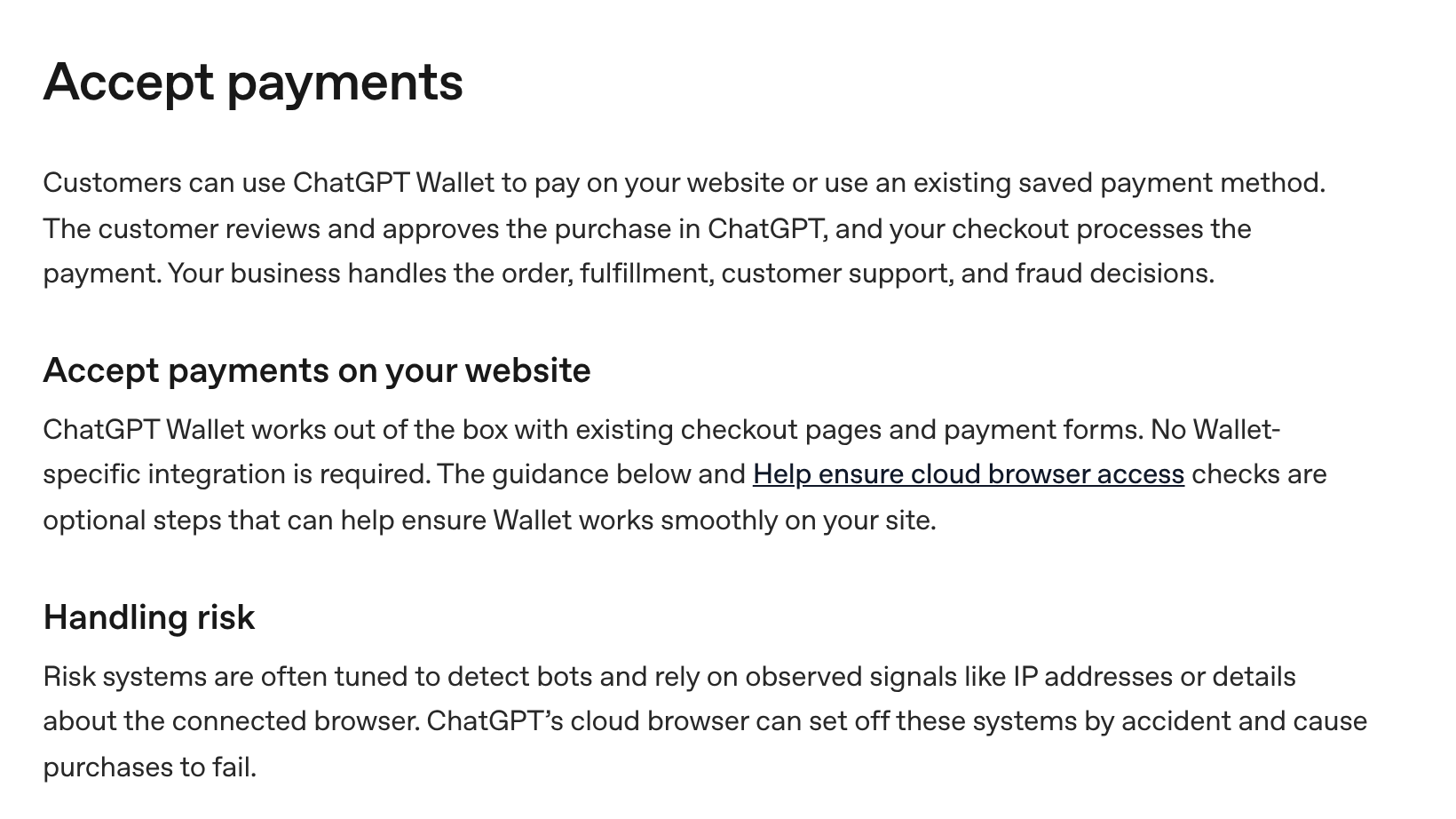
Shops don’t have to build anything to accept the wallet. OpenAI’s Accept payments guide says the wallet “works out of the box with existing checkout pages and payment forms,” and the business keeps handling the order, fulfillment, customer support and fraud decisions. Checkout is the easy part. The trouble usually starts earlier, with security tools built to keep bots out.
Let the agent’s browser in
ChatGPT’s cloud browser signs its requests with Web Bot Auth, which is built on the HTTP Message Signatures standard, RFC 9421. A signed request carries Signature, Signature-Input and Signature-Agent headers, the last one set to “https://chatgpt.com”, according to OpenAI’s access guide.
Akamai, Cloudflare, HUMAN and Vercel verify those signatures automatically. In Cloudflare, the traffic shows up as “dots, OpenAI” under Personal Agents in the AI Crawler and Agent access policies, where a site owner can set it to allow. Sites behind other CDNs or firewalls have to check the signatures themselves.
Tune risk rules for agent traffic
Fraud systems often judge a purchase by the buyer’s IP address and browser, and a cloud browser can set them off by accident, OpenAI warns. It is rolling out a Forwarded HTTP header that relays signals about the real user, among them an IP-based country, a masked network prefix, the network operator’s AS number, locale, time zone and user agent.
Shops with their own risk rules can start reading that header now; shops using a fraud vendor should ask whether it does. OpenAI names Forter, Riskified, Sardine and Signifyd among its fraud prevention partners, and Adyen, Checkout.com and Stripe among payment providers it works with.
Subscriptions and saved cards
A subscription can run through the wallet if the shop’s checkout already supports recurring billing and the customer agrees to the recurring charges. Shops can also keep their existing saved-card flows, because the wallet is a separate payment option.
ChatGPT Wallet vs stablecoin payments for agents
Cards aren’t the only route for agentic payments. x402, an open standard published under the Apache-2.0 license, uses the HTTP 402 “Payment Required” status code, so a website or API can ask for payment before it answers and a client can pay without an account or checkout page, according to the x402 documentation.
Stablecoin payments are its main use, and it supports EVM-compatible chains and Solana, the project says. Coinbase’s developer platform reports more than 100 million x402 payments processed on Base and Solana.
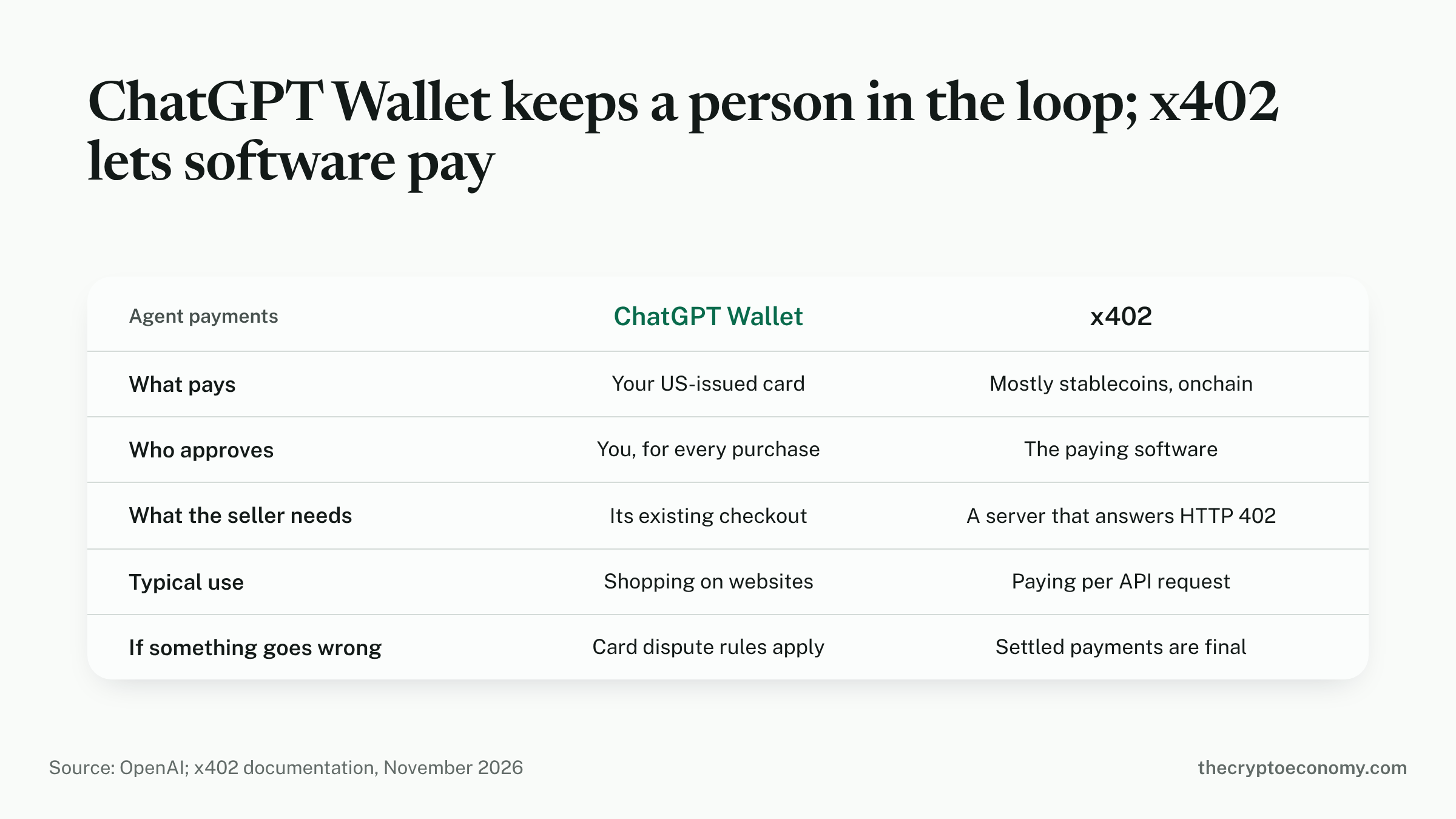
The two answer different needs. ChatGPT Wallet puts a person’s card behind an agent, with a human approval on every purchase and the card’s dispute rules behind it. x402 lets software pay software, often per request, with settlement on a blockchain.
Finality is the practical difference for buyers. A stablecoin payment can’t be charged back, and once it settles only the recipient can send it back, although issuers such as Tether and Circle can freeze tokens at an address, as our freeze tracker records.
What it doesn’t do yet
The launch version is narrow, and OpenAI says as much. These are the limits it describes.
- Purchases need approval one at a time; letting a dot buy within set spending limits, purchase categories or time periods is a plan, not a feature.
- At first it is available only through dots, for ChatGPT Pro subscribers in the US.
- Some sites may block the agent or decline its purchases while their security tools adapt.
- The launch announcement mentions cards only, with no option to pay in crypto.
Businesses that want stablecoin payments today need a separate checkout route, and accepting stablecoin payments starts with choosing the network and the wallet that receives them.
Frequently asked questions
Who can use ChatGPT Wallet?
At launch, ChatGPT Pro subscribers aged 18 or older in the US with eligible US-issued cards, through OpenAI’s dots agents. OpenAI began the rollout on November 13, 2026, and says it will widen availability after early use.
Does the store see my card number?
No. After you approve a purchase, the card network issues a token with its own number, security code and expiration date, and the store charges that. OpenAI’s merchant guide says businesses receive a network token, not the full card number.
Can my dot buy things without asking me?
Not at launch. You confirm each purchase yourself, by Face ID or fingerprint. OpenAI says it expects to let users pre-approve purchases within limits such as spending caps, categories or time periods later, with added safeguards.
Can I dispute a ChatGPT Wallet purchase?
Yes, through your card issuer, as with any card purchase. OpenAI says the card’s protections for eligible disputes still apply. On a US credit card, federal rules treat goods not delivered as agreed as a billing error if you send written notice within 60 days; the debit card rules don’t list that case.
Does ChatGPT Wallet work with crypto?
Not directly. It runs on cards from the networks OpenAI built it with, and the launch announcement mentions no crypto or stablecoin option. Agents that pay in stablecoins use other standards such as x402, where each payment settles on a blockchain and carries a network fee that differs by chain, as our withdrawal fee study shows.