The GENIUS Act is the US law that decides who may issue a dollar stablecoin, what has to back it and how holders get their money back. It became law on July 18, 2025, as Public Law 119-27, and it isn’t in force yet.
Most summaries were written that summer, before any regulator had published a rule. We read the enacted text and the rules issued under it on November 25, 2026, and give the section number for each requirement so you can check it yourself.
When the GENIUS Act applies
Section 20 sets the start date as “the earlier of” 18 months after enactment or 120 days after the federal regulators issue final rules.
The first final rule, from the Office of the Comptroller of the Currency, appeared in the Federal Register on October 23, 2026, too late to beat the 18-month date, so the law takes effect on January 18, 2027. The OCC’s final rule says so directly: “The GENIUS Act will be effective on January 18, 2027.”
Three later dates follow. State regulators must certify their regimes within a year of the effective date, by January 18, 2028, and the waivers regulators may grant pending applicants also run out by then. Section 3(b)(1) then bars crypto platforms from offering unapproved stablecoins in the US from July 18, 2028, three years after enactment.
What counts as a payment stablecoin
Section 2(22) defines a payment stablecoin as a digital asset “used as a means of payment or settlement” whose issuer must “convert, redeem, or repurchase” it “for a fixed amount of monetary value” and says it will keep its value stable. A national currency, a bank deposit “including a deposit recorded using distributed ledger technology” and a security all fall outside the definition.
That last carve-out matters for tokenized deposits. A bank can keep issuing tokens that represent deposits under section 16(a), and those aren’t payment stablecoins under this law.
Section 17 settles the other big question. A payment stablecoin from a permitted issuer is not a “security” under the federal securities laws and not a “commodity” under the Commodity Exchange Act, which takes the coin itself out of both regimes.
Who may issue a stablecoin in the US
Section 3(a) makes it “unlawful for any person other than a permitted payment stablecoin issuer to issue a payment stablecoin in the United States,” with fines up to $1,000,000 per violation and up to five years in prison under section 3(f). Section 2(23) names three kinds of permitted issuer, all formed in the US:
- a subsidiary of an insured bank or credit union, approved by its regulator;
- a federal qualified issuer, such as a nonbank approved by the OCC;
- a state qualified issuer, approved by a state regulator.
The state route has a size limit. Under section 4(c)(1), a state issuer with “not more than $10,000,000,000” of coins outstanding may stay under a state regime that is “substantially similar” to the federal one. Above that, section 4(d) gives it 360 days to move under federal supervision or stop issuing new coins, unless its federal regulator lets it stay.
Regulators must decide on a complete application within 120 days under section 5, and an open public blockchain is not a valid reason to refuse. Section 4(f) bars anyone convicted of felonies such as money laundering or financial fraud from serving as an officer or director, and section 4(a)(12) requires a unanimous vote of a Treasury-led committee before a public company outside finance may issue a stablecoin.
What must back a stablecoin
Section 4(a)(1)(A) requires reserves “on an at least 1 to 1 basis,” and limits them to a short list of assets.
- Coins and currency, or money held at a Federal Reserve Bank
- Demand deposits at insured banks and credit unions
- Treasury bills, notes or bonds “with a remaining maturity of 93 days or less”
- Overnight repurchase and reverse repurchase agreements backed by Treasuries
- Government money market funds holding only these assets, other liquid federal assets a regulator approves, and tokenized forms of these reserves
Reserves can’t be lent out or pledged again, except for margin on those investments, standard custody or raising cash for redemptions, under section 4(a)(2). Each month the issuer must publish how many coins are outstanding and what backs them, have a registered public accounting firm examine that report, and have the CEO and CFO sign off on its accuracy, under sections 4(a)(1)(C) and 4(a)(3).
The OCC’s rule adds numbers for the issuers it supervises. It requires at least 5% of reserves in deposits payable on demand or money at a Federal Reserve Bank, and caps exposure to any one counterparty at 40% of reserves, subject to exceptions.
The largest issuers face one more duty. Under section 4(a)(10), an issuer with more than $50 billion outstanding that doesn’t already file reports with the SEC must publish an audited annual financial statement. By our reading of DefiLlama data on November 25, 2026, only two dollar stablecoins are above either size line.
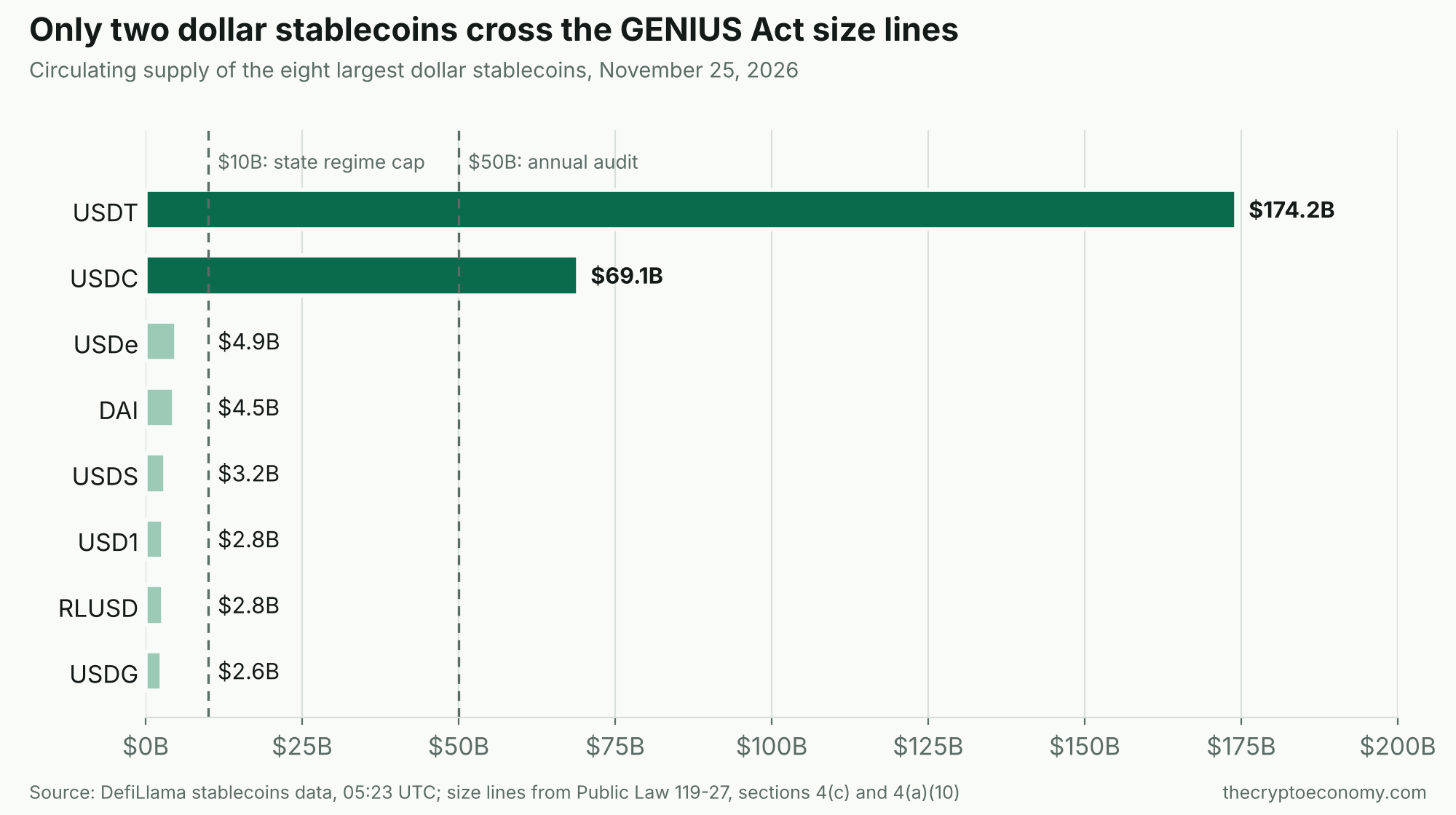
Tether’s USDT stood at $174.19 billion and Circle’s USDC at $69.08 billion, together about 86% of the $283.87 billion in dollar stablecoins DefiLlama tracked. The third largest, Ethena’s USDe, was under $5 billion, so neither threshold touches the rest of the market today.
Redemption, fees and the ban on interest
The redemption rules are the part a holder feels most. The statute sets the standard, and the OCC’s rule turns it into a deadline for the issuers it supervises.
How fast you can redeem
Section 4(a)(1)(B) requires “clear and conspicuous procedures for timely redemption” and says only regulators can impose limits on it. The statute gives no number of days.
The OCC’s rule does. Its section 15.12(c) says a redemption policy must state “that timely redemption may not exceed two business days following the date of the requested redemption.” An issuer that receives redemption requests above 10% of a coin’s outstanding value in 24 hours must notify the OCC within 24 hours and may ask for more time.
Fees
Issuers must disclose “in plain language all fees” for buying or redeeming, and may change them only “upon not less than 7 days’ prior notice to consumers,” under the same section of the statute. Paxos, which issues PayPal’s stablecoin, already says its reserve makes PYUSD funds “available for 1:1 redemption,” and that crypto held in a PayPal balance is “not eligible for FDIC insurance.”
No interest from the issuer
Section 4(a)(11) says no permitted or foreign issuer “shall pay the holder of any payment stablecoin any form of interest or yield (whether in cash, tokens, or other consideration) solely in connection with the holding, use, or retention” of the coin. The sentence names issuers. Section 4(e) adds that stablecoins are not backed by the US government or covered by deposit insurance, and that claiming otherwise is unlawful.
Freezes, sanctions and custody
A permitted issuer is “treated as a financial institution for purposes of the Bank Secrecy Act” under section 4(a)(5). That means anti-money-laundering, customer identification and sanctions programs, including the ability “to block, freeze, and reject” transactions.
Section 4(a)(6)(B) goes further. An issuer may issue coins “only if the issuer has the technological capability to comply, and will comply, with the terms of any lawful order,” and section 2(16) defines a lawful order as one that requires it to “seize, freeze, burn, or prevent the transfer” of coins. Obeying a court-ordered freeze becomes a condition of issuing at all, a power our freeze tracker already sees used on the USDC and USDT contracts.
Section 10 limits who may hold the reserves, the coins used as collateral and the issuing keys to supervised custodians, and says customer property must be kept separate and treated “as belonging to such customer.”
If a stablecoin issuer fails
Under section 11, holders stand first in line for the reserves. In an insolvency, a holder’s claim “shall have priority, on a ratable basis with the claims of other persons holding such payment stablecoins, over the claims of the permitted payment stablecoin issuer and any other holder of claims” against it, with respect to the required reserves.
The same section amends the bankruptcy code so that any shortfall gets first priority among the remaining claims, and asks the court to use “best efforts” to start paying holders within 14 days of the required hearing. Holders still share the reserves pro rata, so a reserve shortfall would be shared too.
Foreign stablecoins and the 2028 platform deadline
Two separate rules govern what US platforms may offer. From July 18, 2028, section 3(b)(1) makes it unlawful for a platform to offer or sell a stablecoin to a person in the US “unless the payment stablecoin is issued by a permitted payment stablecoin issuer.”
Section 18 lets a foreign issuer qualify if its home regime is found “comparable,” it registers with the OCC, it holds reserves in a US institution for US customers, and its country isn’t under sanctions.
The condition on foreign coins starts earlier. Section 3(b)(2) bars platforms from making a foreign issuer’s coin available unless that issuer can comply with US lawful orders, and Treasury’s proposed rule says that provision, “unlike section 3(b)(1) becomes applicable on the effective date of the Act.” The Federal Reserve’s proposal reads it the same way. Both clocks matter for USDT, which Tether issues from El Salvador, as our USDC vs USDT comparison explains.
Individuals are outside the platform rules. Section 3(h)(1) exempts transfers made directly between two individuals for their own purposes, and “any transaction by means of a software or hardware wallet that facilitates an individual’s own custody of digital assets.”
| Section | What it requires | Applies from |
|---|---|---|
| 3(a) | Only permitted issuers may issue a payment stablecoin in the US | January 18, 2027 |
| 3(b)(2) | Platforms may offer a foreign issuer’s coin only if it can obey US lawful orders | January 18, 2027 |
| 4(a)(1) to (3) | 1:1 reserves in listed assets, monthly published reports, examination and certification | January 18, 2027 |
| 4(a)(11) | No interest or yield from issuers | January 18, 2027 |
| 4(c)(4) | State regulators certify their regimes | By January 18, 2028 |
| 5(f) | Waivers for pending applicants end | By January 18, 2028 |
| 3(b)(1) | Platforms may offer only permitted issuers’ coins | July 18, 2028 |
| 11 | Holders’ priority claim on reserves in insolvency | January 18, 2027 |
Most of the law starts on one date, and the two later dates fall on states and on platforms rather than on holders.
Where the rules stand
Section 13 told the regulators to write their rules by July 18, 2026, and none was final by then. By November 25, 2026, the Federal Register showed two final rules and a series of proposals.
| Regulator | Document | Status on November 25, 2026 |
|---|---|---|
| OCC | Rules for the issuers it supervises (2026-21706) | Final, published October 23, 2026, effective January 18, 2027 |
| Treasury | Procedures for certifying state regimes (2026-19966) | Interim final rule, effective September 30, 2026; comments to November 30 |
| Treasury | Issuance, offer and sale under section 3 (2026-16796) | Proposed August 18, 2026; comments closed October 19 |
| FinCEN and OFAC | Anti-money-laundering and sanctions programs (2026-06963) | Proposed April 10, 2026 |
| Federal Reserve | Its responsibilities and application procedures (2026-19860, 2026-19899) | Proposed September 29, 2026; comments to November 30 |
| FDIC | Standards for the issuers it supervises (2026-06974) | Proposed April 10, 2026 |
| NCUA | Rules for credit union issuers (2026-09915) | Proposed May 18, 2026 |
The OCC says it will start taking applications once the Office of Management and Budget approves its forms and will announce that by bulletin. We couldn’t open the OCC’s website from our systems to check whether that has happened, and we found no regulator-published list of approved issuers.
The state side is moving on its own track. Treasury’s interim rule lets a state meet the January 2028 deadline “by submitting any form of certification,” even a conditional one, and six senators have already pressed Treasury on how state issuers will be treated, as we reported in our story on the state safe harbor.
What the GENIUS Act means for people and businesses using stablecoins
For a holder, the law mostly adds protections once it takes effect: published monthly reserve reports, redemption rules and a first claim on reserves if an issuer fails. For a business that pays or gets paid in stablecoins, a few practical steps follow from the text.
- Check whether the coin you hold comes from a permitted issuer once regulators begin approving them, since that decides whether US platforms can keep offering it after July 18, 2028.
- Read the issuer’s redemption policy and fee schedule, which the law requires it to publish, before you rely on redeeming quickly.
- Expect freezes to be part of the product, because issuers must be able to comply with lawful orders to seize or freeze coins.
- If you hold coins in your own wallet, note that section 3(h)(1) leaves self-custody transfers outside the platform rules.
The European Union reached the same point earlier. Its MiCA rules for e-money tokens have applied since June 30, 2024, and the coins that meet them are tracked in our MiCA-compliant stablecoins register check.
Frequently asked questions
When does the GENIUS Act take effect?
On January 18, 2027, 18 months after it was signed. Section 20 allowed an earlier date 120 days after the first final federal rules, but the OCC’s final rule came on October 23, 2026, too late to beat that date. The platform deadline under section 3(b)(1) follows on July 18, 2028.
Can stablecoin issuers pay interest?
No. From January 18, 2027, neither a permitted issuer nor a foreign issuer may pay holders interest or yield of any kind just for holding or using the coin, whether paid in cash or in tokens, under section 4(a)(11).
What happens to my stablecoins if the issuer goes bankrupt?
Under section 11, holders’ claims on the required reserves rank ahead of the issuer’s other creditors, shared pro rata among holders. The law also asks the bankruptcy court to use its best efforts to begin distributions within 14 days of the required hearing.
Are Tether and USDC legal under the GENIUS Act?
The law doesn’t name coins. From January 18, 2027, US platforms may offer a foreign issuer’s coin only if the issuer can comply with US lawful orders, and from July 18, 2028 they may offer only coins from permitted issuers or foreign issuers that meet section 18. Whether a given issuer qualifies depends on approvals regulators had not published when we checked.
Does the GENIUS Act apply to self-custody wallets?
Not to the wallet itself. Section 3 leaves out person-to-person transfers and transactions made through a wallet you control, and the law also excludes “an immutable and self-custodial software interface” from its definition of a digital asset service provider.