Key takeaways:
- From November 1, 2025 to November 10, 2026, Tether and Circle froze 5,282 addresses in 6,557 freeze events on the six contracts we read. Tether’s USDT on TRON accounts for 65% of the events.
- Circle’s freezes mostly track the US sanctions list. 352 of its 550 frozen addresses are on OFAC’s list or are the Ethereum-format twin of a listed TRON address. For Tether it’s 316 of 4,857.
- The biggest day by value was October 29, 2026. Within three hours the two issuers froze about 1.56 billion USDT and 888 million USDC tied to what Tether calls the Binance hack.
Tether and Circle can stop any address from moving their stablecoins. The USDT blacklist and the USDC blacklist live inside the token contracts, and every time an address goes on one the blockchain records an event. We read every such event on six contracts for a year, USDT on Ethereum and TRON and USDC on Ethereum, Polygon, Arbitrum and Base, and put the result in one dataset you can download.
How many addresses Tether and Circle froze
Tether’s USDT blacklist grew far faster than Circle’s, and most of the growth was on TRON. The table counts events, so an address frozen on four chains counts four times.
| Issuer and chain | Freeze events | Unfreezes | Destroy events | Addresses frozen |
|---|---|---|---|---|
| Tether, TRON | 4,233 | 734 | 559 | 4,211 |
| Tether, Ethereum | 648 | 99 | 210 | 646 |
| Circle, Ethereum | 569 | 91 | 0 | 533 |
| Circle, Base | 372 | 0 | 0 | 370 |
| Circle, Polygon | 368 | 5 | 0 | 364 |
| Circle, Arbitrum | 367 | 0 | 0 | 365 |
Across all six contracts that’s 5,282 distinct addresses. Tether froze 4,857 of them and Circle 550, and 125 were frozen by both.
At the block where each freeze landed, the Ethereum addresses Tether froze held 1.46 billion USDT and the addresses Circle froze held 947.5 million USDC. TRON needs a different measure. It can’t be read at a past block without a paid key, so for TRON we report today’s figure. As of November 10, the addresses Tether froze there during the period held 2.64 billion USDT.
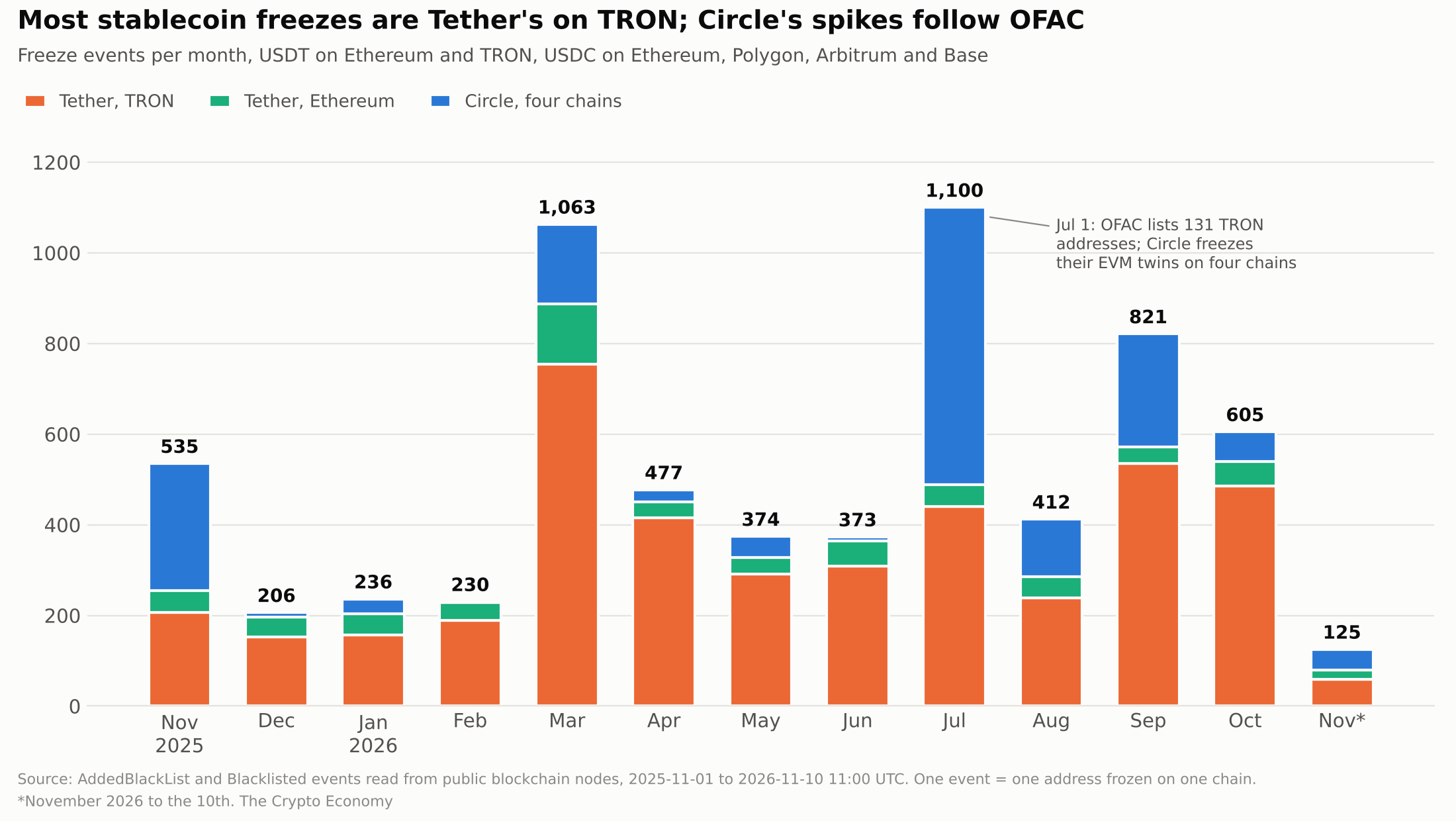
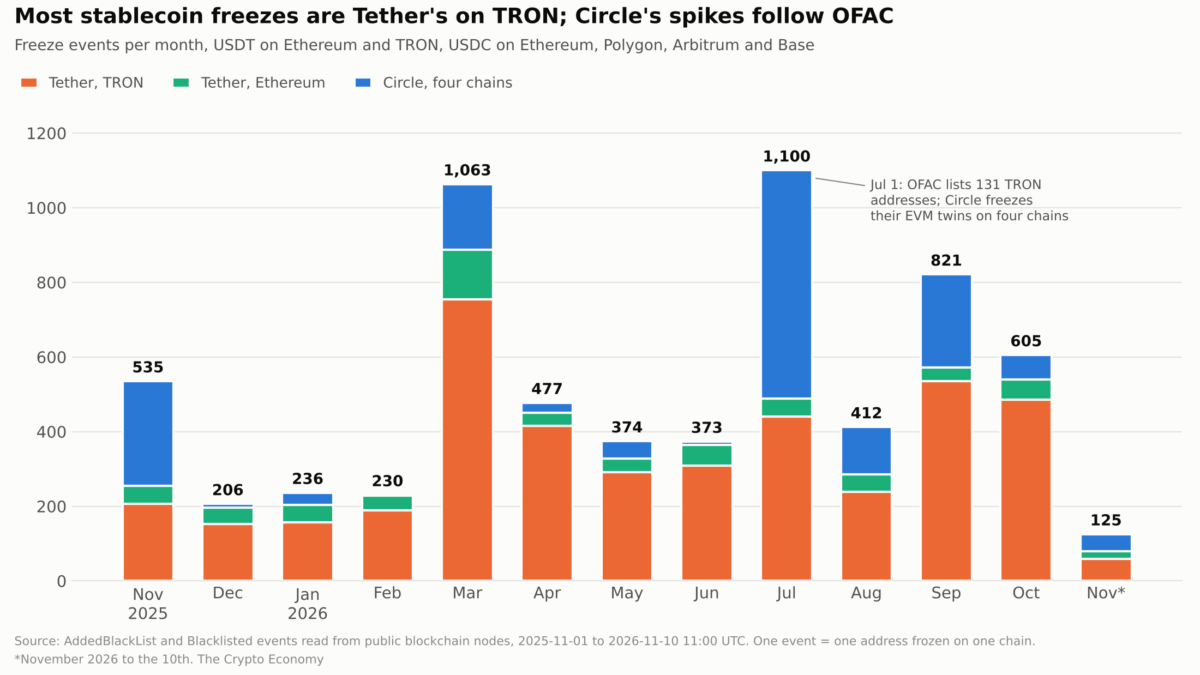
The monthly counts behind the chart are below. March and July stand out for different reasons: March is mostly Tether on TRON, while July belongs to Circle, as the next section shows.
| Month | Tether, TRON | Tether, Ethereum | Circle, four chains | Total |
|---|---|---|---|---|
| November 2025 | 206 | 49 | 280 | 535 |
| December 2025 | 152 | 45 | 9 | 206 |
| January 2026 | 157 | 47 | 32 | 236 |
| February 2026 | 189 | 40 | 1 | 230 |
| March 2026 | 754 | 133 | 176 | 1,063 |
| April 2026 | 416 | 35 | 26 | 477 |
| May 2026 | 291 | 37 | 46 | 374 |
| June 2026 | 309 | 55 | 9 | 373 |
| July 2026 | 441 | 48 | 611 | 1,100 |
| August 2026 | 238 | 47 | 127 | 412 |
| September 2026 | 535 | 37 | 249 | 821 |
| October 2026 | 486 | 54 | 65 | 605 |
| November 2026, to the 10th | 59 | 21 | 45 | 125 |
Tether’s TRON line is the steady base of the chart, a few hundred freezes in an ordinary month. Circle’s line jumps from almost nothing to hundreds, and in November, July, August and September nearly every Circle freeze hit an address tied to an OFAC listing.
Circle’s USDC blacklist follows the sanctions list
We matched every frozen address against our dataset of OFAC crypto addresses, the 1,064 unique addresses on the SDN list of November 9, 2026. Fifty of the addresses Circle froze are on that list directly, and 49 of them were frozen on the day OFAC listed them.
The bigger group took a second step to find. Another 302 addresses Circle froze aren’t on the list, yet each one is the Ethereum-format version of a TRON address that is. TRON’s developer documentation explains why that matters: the 20 bytes after a TRON address’s prefix “are identical to the Ethereum address derived from the same public key.” Whoever holds the key to a sanctioned TRON address also controls that Ethereum-format twin.
Circle froze all 302 twins on all four of its chains, 300 of them on the same day OFAC listed the TRON address. Every one of those 1,208 freezes hit an empty address, so they block future use of the address and seize nothing.
Together that’s 352 of Circle’s 550 frozen addresses, or 64%, tied to the SDN list. Counted by freeze event, 1,442 of 1,676 Circle freezes (86%) hit such an address.
July 1, 2026 shows both issuers reacting to one listing. That day OFAC added 131 TRON addresses to the entry for ISIL Khorasan. Tether froze the same 131 addresses on TRON, and Circle froze their 131 twins on four chains, which made July 1 the busiest day in our data with 699 freezes.
Tether’s list looks very different. Only 316 of the 4,857 addresses it froze, 6.5%, are on the SDN list, and Tether froze none of the twins. Most of the matches came on the day of listing (252), and 59 came earlier. Fifty-two of those belong to Xinbi Guarantee. Tether froze 50 of them on TRON on September 8, a day before OFAC listed them, and the other two in March.
That leaves 93.5% of the addresses Tether froze with no OFAC listing at all. The data can’t say why each one was frozen. Tether says it works “closely with U.S. and international law enforcement”, and those requests aren’t published, so the reason behind most of its freezes stays private.
October 29: the largest freeze in the data
By value, one evening outweighs the rest of the year. Tether says it froze more than $1.5 billion in USDT “within 30 minutes of the 29 October Binance hack.” Here’s how the freezes and the transfers around them appear on-chain.
| Time (UTC) | What the chain shows | Amount |
|---|---|---|
| 20:24:23 | 0x28c6…1d60 sends USDT to 0x5227…2f8c, an address with no earlier transactions |
1,615.4 million USDT |
| 20:30 to 20:33 | 0x5227…2f8c passes USDT on to two other addresses |
700 million USDT |
| 20:41 to 20:59 | 0xee7a…4055 sends USDC to 0x5227…2f8c |
823 million USDC |
| 21:01:35 | Tether freezes 0x5227…2f8c, and the two onward addresses within 12 seconds, both already empty |
971.1 million USDT |
| 21:04:59 | Circle freezes 0x5227…2f8c |
823 million USDC |
| 21:09 to 21:21 | Tether freezes seven more addresses on TRON and Ethereum, four of them holding funds | about 584 million USDT |
| 21:44:11 | 0x28c6…1d60 sends more USDT to the address that’s already frozen |
200.4 million USDT |
| 22:06:23 | Tether freezes 0x28c6…1d60 itself |
1.35 million USDT |
| 23:31 to 23:55 | Circle freezes three more addresses, among them 0x28c6…1d60 and 0xee7a…4055 on all four of its chains |
64.6 million USDC |
Added up, Tether froze about 1.557 billion USDT that evening, with 1.178 billion read on Ethereum at the freeze block and an estimated 379 million on TRON. That fits Tether’s “more than $1.5 billion.” Circle froze about 888 million USDC, 60 million of it on Base.
Two details are easy to miss. The 700 million USDT that left 0x5227 before 21:01 had already moved on by the time the next two addresses were frozen. And the 204.3 million that arrived after the freeze is stuck with the rest, because Tether’s blacklist stops an address from sending, not from receiving.
The sending address 0x28c6…1d60 has sent more than 18.9 million transactions in its lifetime, and Circle froze it on all four of its chains that night.
Unfreezes and destroys on the USDT blacklist
Freezes don’t always last. Tether lifted 833 in the period and Circle 96. Most of Tether’s came in a single day. On May 14, 2026 it took 497 addresses off the USDT blacklist, 447 on TRON and 50 on Ethereum, which made May the only month with more unfreezes (571) than freezes (374). The data doesn’t say why.
Tether can also destroy the USDT on a frozen address, which sets the balance to zero. It did so 769 times in the period, for 538.35 million USDT in all, 196.31 million on Ethereum and 342.05 million on TRON. The largest single destroy was 40.26 million USDT on January 10, 2026.
Not every destroy hits a recent freeze. 435 of the 769, worth 360.4 million USDT, hit addresses frozen before November 2025, and 18.25 million USDT came off the USDT contract’s own address, where tokens sent by mistake can’t be moved by anyone. Destroy events are Tether’s alone in our data.
What this means if you send or accept stablecoins
Checking an address against the sanctions list isn’t the same as checking the freeze lists. A sanctions screening tool that only knows the SDN list would have missed 93.5% of the addresses Tether added to the USDT blacklist in the period.
Sending to a frozen USDT address loses the money for practical purposes. The address can still receive, as the 204.3 million that landed on 0x5227 after its freeze shows, but nothing can leave it unless Tether lifts the freeze. USDC works differently. Circle’s contract refuses a transfer to a blacklisted address, so the payment fails instead.
Before a large payment, check the receiving address itself, because one wrong address can cost the whole amount and only the issuer can decide whether it ever moves again. If you run a stablecoin checkout, the same goes for refunds, since a refund sent to a frozen USDT address can’t be pulled back. On any chain you can read the answer from the token contract, isBlackListed for USDT and isBlacklisted for USDC.
How we built the dataset
We read every AddedBlackList, RemovedBlackList and DestroyedBlackFunds event from the USDT contracts on Ethereum and TRON, and every Blacklisted and UnBlacklisted event from the native USDC contracts on Ethereum, Polygon, Arbitrum and Base. The period runs from November 1, 2025 to 11:00 UTC on November 10, 2026, the same cutoff on every chain.
The logs came from keyless public blockchain nodes and TronGrid. One provider we planned to use answered older queries with “Archive requests require a personal token”, so we used other public gateways for the history and list every endpoint, refused or used, in the method file.
A second read from a different provider returned the same events on every chain, over the full period where the provider allowed it and over the last two million or so blocks on Polygon and Base.
We hand-checked 26 events against the transaction receipt from a second provider, and on Ethereum and TRON against an explorer too. Every field matched. The contracts’ own getters agree with our event history for all 2,307 Ethereum, Polygon, Arbitrum and Base addresses and for a random sample of 300 TRON addresses.
Balances on the EVM chains were read at the freeze block. On TRON they’re current balances read on November 10, with an estimate of the balance at the freeze in a separate column. The OFAC match uses our sanctions dataset of November 9, 2026, so addresses OFAC removed before that date don’t count as matches.
The full dataset, one row per event with the balance and the OFAC match, is available as a CSV file. We’ll add each month’s freezes to this page.
Frequently asked questions
Can Tether freeze USDT in my wallet?
Yes. The USDT contract lets Tether add any address to its blacklist, and a Tether freeze means the address can’t send USDT. Between November 1, 2025 and November 10, 2026, Tether did this 4,881 times on Ethereum and TRON, to 4,857 addresses.
How can I check if an address is on the USDT blacklist?
Read the contract’s getter on a block explorer: isBlackListed on the USDT contract or isBlacklisted on the USDC contract, with the address as input. A result of true means it’s frozen. Our free Address Check runs that lookup for USDT and USDC on Ethereum and USDT on TRON, together with the OFAC check.
What happens to frozen USDT?
It stays on the address and can’t be moved. Tether can later lift the freeze, which it did 833 times in our period, or destroy the balance, which it did 769 times for 538.35 million USDT.
Why does Circle freeze addresses that hold no USDC?
Most of them are Ethereum-format twins of TRON addresses on OFAC’s sanctions list. The same key controls both forms, so Circle froze 302 such twins on Ethereum, Polygon, Arbitrum and Base, usually on the day OFAC listed the TRON address. None of them held any USDC.
How much did Tether and Circle freeze after the Binance hack?
On October 29, 2026 we count about 1.557 billion USDT frozen by Tether across Ethereum and TRON and about 888 million USDC frozen by Circle on Ethereum and Base. The largest single address held 971.1 million USDT and 823 million USDC when it was frozen.