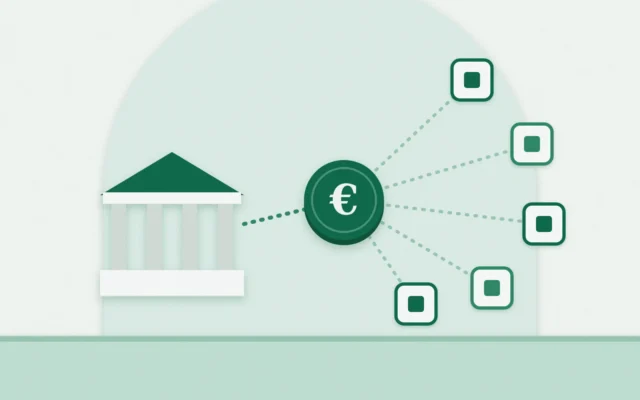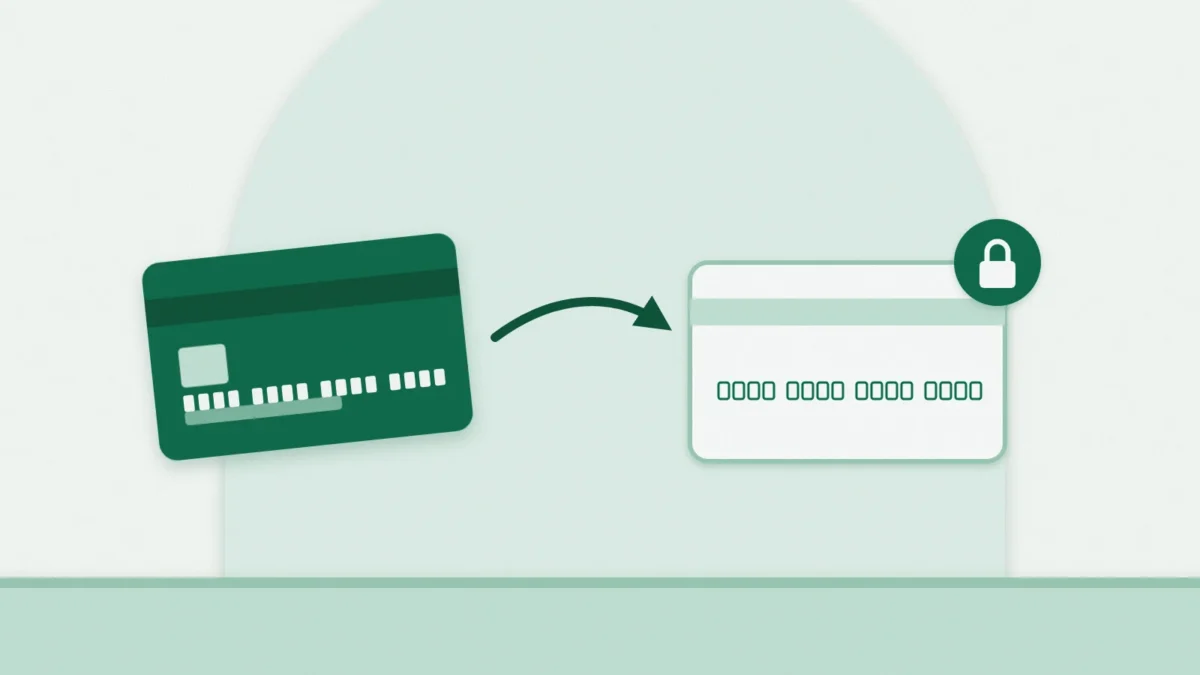
Every time you tap a phone at a checkout or let a shop “remember this card,” there’s a good chance the card number never reaches the merchant. Payment tokenization swaps it for a stand-in. The question is which stand-in, who can turn it back into your number, and what it still leaves exposed.
This guide covers card tokens, the kind that protects card numbers. The word “tokenization” also describes recording bonds or bank deposits on a blockchain, a different idea we come back to near the end.
What a payment token is
A payment token is a substitute for the primary account number, the long number on the front of a card. EMVCo, the standards body behind chip cards and payment tokens, puts it this way on its standards page: the process works by “removing the most valuable data to a fraudster, the primary account number (PAN), and replacing it with a unique alternative value, the EMV Payment Token.”
The second half of that definition matters most. “Importantly, an EMV Payment Token is constrained in how it can be used,” EMVCo adds, “for example, to a specific merchant, device or payment scenario.” A token stolen from one shop’s database shouldn’t work at another shop.
The card industry’s security body, the PCI Security Standards Council, gives the same idea from the merchant’s side in its 2011 tokenization guidelines. It calls the token “a surrogate value” and adds that “the security of an individual token relies predominantly on the infeasibility of determining the original PAN knowing only the surrogate value.” Turning a token back into the card number, which it calls de-tokenization, happens only inside the system that issued it.
How payment tokenization works, step by step
The steps differ by token type, but the pattern holds. The real number is swapped for a token once, the token is used for payments, and only the token’s issuer can map it back. Apple’s security overview for Apple Pay describes the device version in detail.
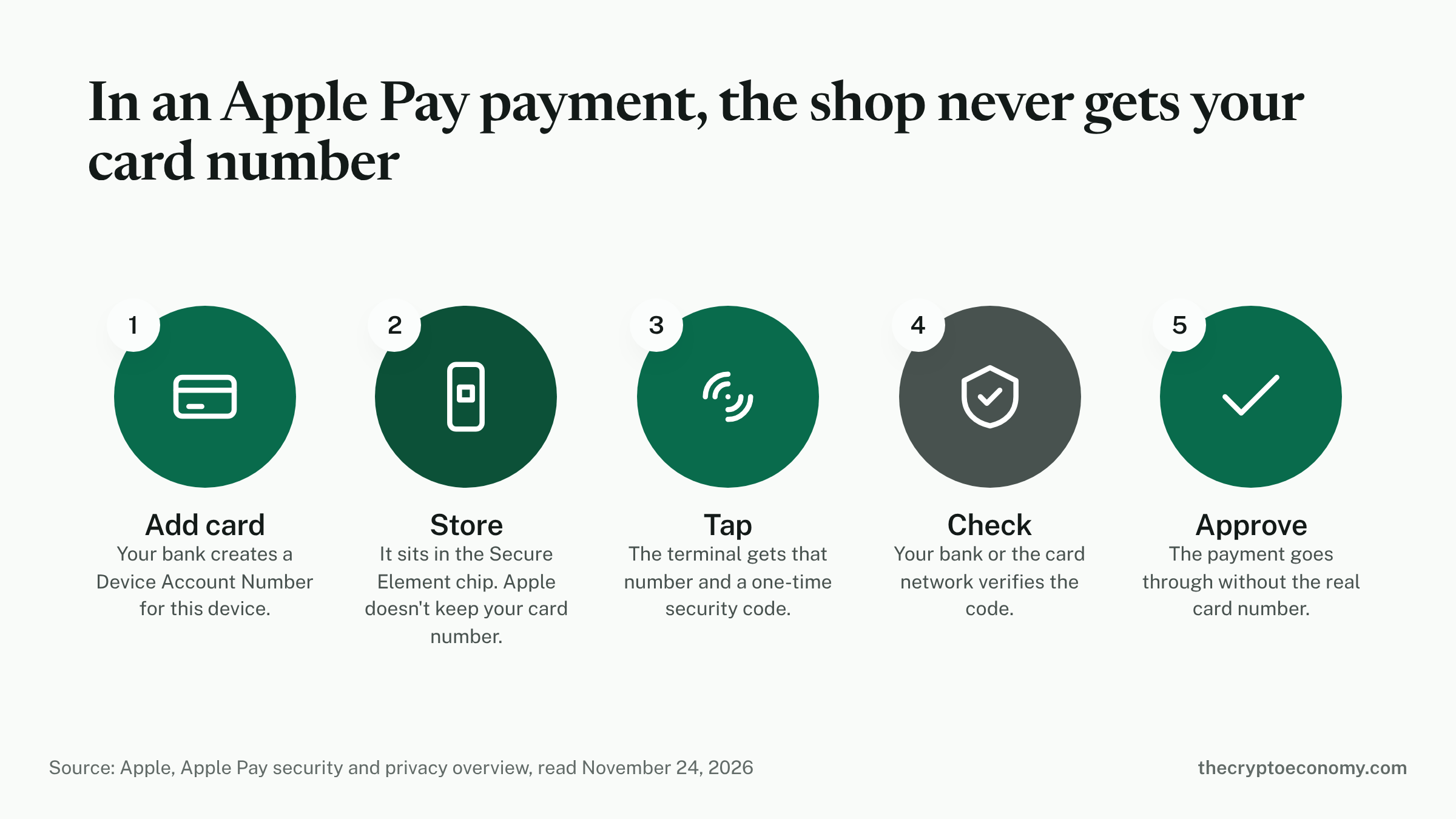
When you add a card, “your bank, your bank’s authorized service provider, or your card issuer creates a device-specific Device Account Number, encrypts it, and sends it” to Apple, which stores it in the phone’s Secure Element chip. Apple says it “doesn’t store the original card numbers” of cards added to Apple Pay.
At the checkout, the phone hands the terminal that Device Account Number plus “a transaction-specific dynamic security code.” Apple is explicit that “neither Apple nor your device sends your actual payment card number.” Before approving, the bank, card issuer or payment network checks the one-time code to confirm the payment came from your device.
The three kinds of payment token
Tokenization in payments comes in three main forms, and they protect different stretches of the payment chain. The PCI Council’s FAQs separate “acquiring tokens,” “issuer tokens” and EMV “Payment Tokens,” and for a shopper or a merchant the practical split looks like this.
| Kind of token | Who issues it | Where it works | What its documentation says |
|---|---|---|---|
| Network token | The card network, such as Visa or Mastercard | One shopper at one merchant | Stays the same when the card is replaced (Adyen) |
| Processor or vault token | The merchant’s payment processor or a token vault | Inside one merchant’s systems | Leaves the merchant in PCI DSS scope if it can retrieve the card number (PCI Council) |
| Device token | The card issuer, through a wallet such as Apple Pay | One phone or watch | Travels with a one-time security code at each payment (Apple) |
Network tokens are the ones card networks promote. Adyen, a payment processor, describes a network token in its documentation as a “16-digit alternative for the Primary Account Number (PAN)” that “is unique per combination of shopper and merchant.” It adds that “if the shopper receives a new card because the old one expired or was lost, the network token remains the same,” and that each payment is protected “with a single-use cryptogram.”
That’s why a saved card on a streaming service or a ride app can keep working after your bank sends a replacement.
Visa describes its own service in its annual report for the year to September 30, 2026. Visa Token Service, it says, “helps protect digital transactions by replacing 16-digit Visa account numbers with tokens that contain surrogate account numbers, cryptographic information and other data designed to protect underlying account information.”
What tokenization protects, and what it doesn’t
Payment tokenization defends against one specific threat, a card number leaking from a merchant’s systems and being reused somewhere else. Against that, it works well, because a token tied to one merchant or one device has little value anywhere else.
Its limits follow from the same design. A token bound to one merchant still works at that merchant, so these risks remain.
- Someone who takes over your account at a shop can spend the card token saved there, since the token is valid for that merchant.
- A phishing page that gets you to approve a payment yourself isn’t stopped, because the payment you approve is genuine.
- Subscriptions keep charging after a card is replaced if the merchant holds a network token, which is convenient until you want to stop paying.
- Your bank and the card network still see the real card and every payment, so a token gives no privacy from them.
- The merchant and its partners still hold your name, address and order history, which a breach can expose even when the card is safe, as Trezor buyers found out this month when the details behind roughly 27,000 orders leaked from a delivery partner.
None of this argues against tokens. It means the security work moves to the accounts and devices that hold them, so a strong password and two-factor sign-in matter at shops that save your card, and so does a locked phone for a wallet.
Card tokenization and PCI DSS for merchants
For a merchant, card tokenization is mostly about the security standard every business that accepts cards must meet, PCI DSS. The 2011 PCI guidelines set the rule of thumb: “If PAN is retrievable by the merchant, the merchant’s environment will be in scope for PCI DSS.”
A shop that only ever holds tokens, and can’t turn them back into card numbers, can shrink the part of its systems that the standard covers. The processor Stripe says in its security guide that a business handling card data directly “might be required to meet more than 300 security controls in PCI DSS,” which is the burden tokens are meant to shrink.
Two caveats from the PCI Council itself apply. Its FAQ 1385, dated April 2016, says the 2011 guidelines “do not define any technical specifications or implementation requirements,” so they’re guidance, not a rule. And the companies that issue EMV payment tokens follow a separate standard for token service providers, whose requirements “apply in addition to PCI DSS.”
Running your own gateway puts card data back in your systems, one of the costs we weigh in our look at payment gateway source code.
Tokens and strong customer authentication in the EU
In the European Union, online card payments often need strong customer authentication under the second Payment Services Directive, which combines independent elements such as a password, a fingerprint and something you hold. The directive defines that last one, possession, as “something only the user possesses.” Can a token count?
The European Banking Authority answered that in its Q&A 2019_4827, finalized on August 7, 2020. Its answer says “tokenised card payment solutions may constitute a possession element” because, depending on how they’re built, they can bind the cardholder and the token to a trusted device and stop the token from being copied.
There are conditions. Strong authentication has to be applied “at the time of the issuance of the token,” and the card issuer has to be involved in issuing it “directly or indirectly,” for example through an agreement with a wallet provider or a merchant that saves cards. A token created without the issuer’s involvement doesn’t meet that test.
The answer ties a token’s value to the moment you add the card. The bank’s check at that step is the authentication the token later stands in for.
How widely payment tokens are used
The networks publish their own figures for payment tokenization in their annual reports to the US Securities and Exchange Commission. They measure different things, so the two can’t be compared directly.
| Network | What it reports | Base | Date | Filing |
|---|---|---|---|---|
| Visa | “over 60% of ecommerce transactions were tokenized” | Ecommerce transactions only | As of September 30, 2026 | Form 10-K for fiscal 2026, filed November 5, 2026 |
| Mastercard | “approximately 40% of all Mastercard transactions are now tokenized” | All transactions, in store and online | 2025 | Form 10-K for 2025, filed February 11, 2026 |
Mastercard’s base includes in-store payments made with a physical card, so the two shares can’t be read as one network being ahead of the other. We found no fraud-reduction figure for tokens in either filing.
Card networks are also using tokens for purchases made by AI agents. Visa says in the same report that through Visa Intelligent Commerce it is “integrating our tokenization technology” with authentication to support “agent-driven commerce experiences,” and OpenAI’s ChatGPT Wallet hands shops a network token rather than the card number.
Payment tokens versus tokenized assets and deposits
Tokenization in payments and tokenization in finance share a word but little else. The Bank for International Settlements, in its Annual Economic Report 2025, describes tokenization as “the process of recording claims on real or financial assets that exist on a traditional ledger onto a programmable platform.”
That kind of token is the asset itself, or a claim on it, moved onto a blockchain or similar system. A card token works the other way round. It holds no value and is only a pointer, which just the token issuer can resolve back to your card. Neither the BIS report nor EMVCo’s page mentions the other sense of the word.
The asset sense shows up in projects such as the European Central Bank’s plan to have banks test tokenized deposits, and in stablecoins, where the token itself is what gets paid.
What to do as a shopper or a small merchant
For shoppers, tokens mostly work in the background, so the useful steps are about the accounts around them. For a small merchant, the choice of processor decides most of it, and stablecoins offer a second route with no card number at all, as our walkthrough of accepting stablecoin payments shows.
- Use a phone or watch wallet at the checkout where you can, since the shop then receives a device token instead of your card number.
- Protect accounts at shops that save your card with a unique password and two-factor sign-in, because the saved token works there.
- After you replace a lost card, check your subscriptions, since some will keep charging through a network token.
- If you run a shop, choose a processor that stores card numbers for you and returns tokens, and ask whether it requests network tokens from Visa and Mastercard.
- Ask your processor which PCI DSS self-assessment questionnaire applies to your setup before you assume tokens put you out of scope.
The common thread is that a token keeps your card number out of the places most likely to leak it. It doesn’t replace care with the accounts and devices that hold it.
Frequently asked questions
Is tokenization the same as encryption?
Not quite. Encrypted card data can be decrypted by anyone holding the key. A token is judged differently. The PCI Council says its security rests on the infeasibility of working out the card number from the token alone, and only the issuing system can map it back. Some token systems use encryption inside, a design called vaultless tokenization.
Can a payment token be reversed into my card number?
Only by the system that issued it. The PCI Council calls this de-tokenization. A token stolen from a merchant can’t be turned back into your card number by the thief, and EMVCo’s tokens are also limited to a specific merchant, device or kind of payment.
Does tokenization make a merchant PCI compliant?
Not on its own. The PCI guidelines say a merchant that can retrieve card numbers stays in scope for PCI DSS, and the 2011 guidance sets no technical requirements. Tokens can shrink the systems a merchant must secure, but the merchant still completes its PCI assessment.
Why did my saved card keep working after my bank replaced it?
The merchant probably holds a network token. Adyen’s documentation says the card networks keep network tokens valid when card details change, so a replacement card doesn’t break a saved payment.
Is a tokenized deposit the same as a payment token?
No. A tokenized deposit is a bank deposit recorded on a programmable ledger, the asset sense of tokenization the Bank for International Settlements describes. A payment token holds no money and only stands in for a card number.