What is USDC? It’s a stablecoin, a crypto token that tracks the US dollar, issued by Circle. The company describes it as “a digital dollar backed 100% by highly liquid cash and cash-equivalent assets” that “is redeemable 1:1 for US dollars.”
The name is short for USD Coin, which is why the token is also called the USDC coin. Circle’s USDC page put $68.0 billion in circulation on November 16, 2026, second only to Tether’s USDT, which our USDC vs USDT comparison sets side by side.
To answer what is USDC beyond a one-line definition, we read Circle’s terms, its third-quarter filing and the latest SEC report of the fund that holds most of the reserve, and took the supply figures from DefiLlama on November 20.
What is USDC and who issues it
USDC launched on September 26, 2018. Circle and the CENTRE consortium “introduced a service to tokenize US dollars,” the company’s launch post says, calling it “USD Coin, also known as USDC.” In an October 23, 2018 post, Circle said it had co-founded the consortium with Coinbase.
That joint structure ended in August 2023. Circle wrote that “Centre will no longer exist as a stand-alone entity and Circle will remain as the issuer of USDC,” and that Coinbase “is taking an equity stake in Circle.”
Today two Circle companies issue the same token. Circle’s MiCA redemption policy says USDC “is co-issued by Circle France in the EEA and by Circle Internet Financial, LLC” outside it. Circle went public in June 2025 at $31 a share, according to its quarterly filing.
How much USDC exists, and where
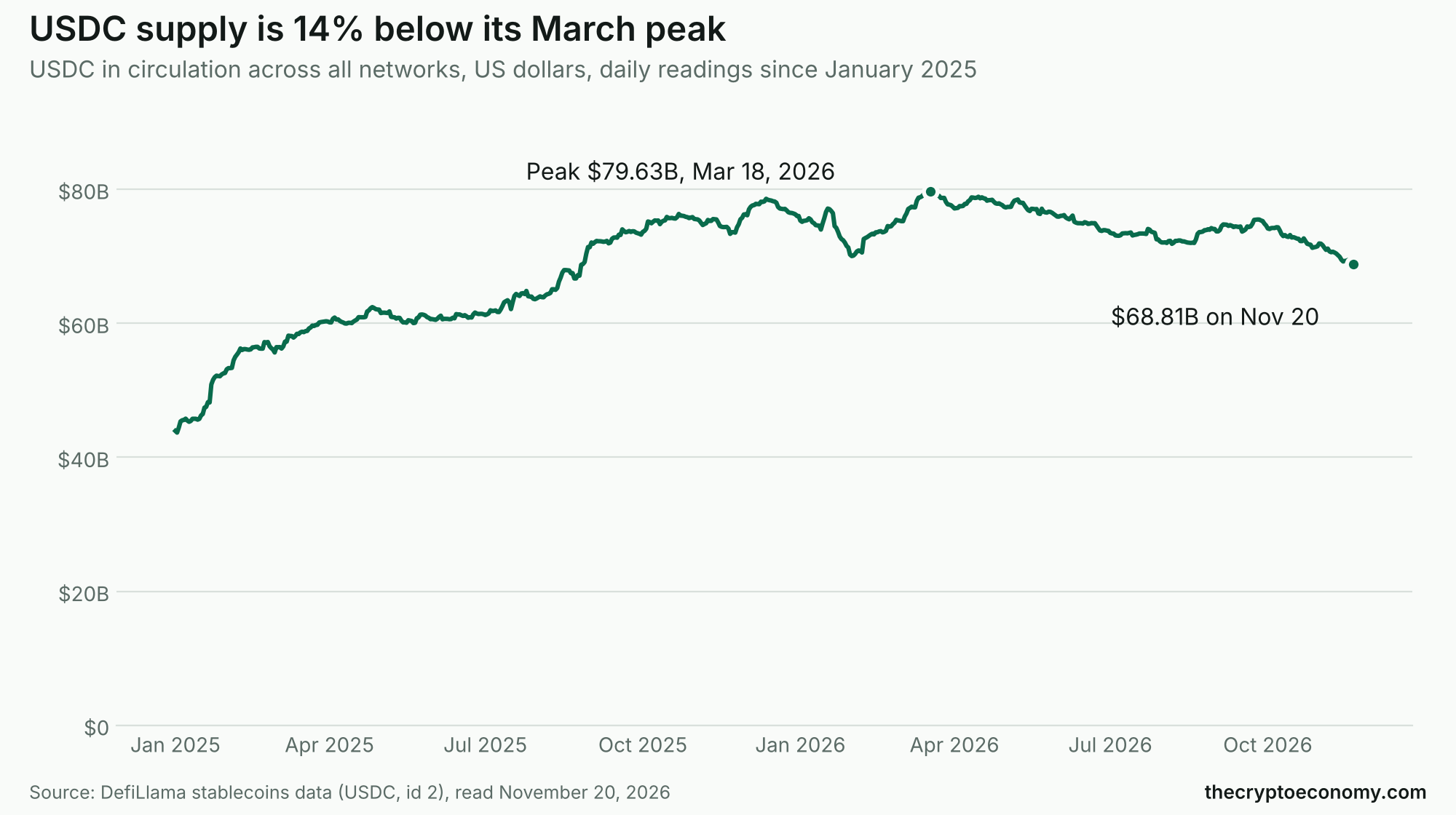
Supply is down from its March high. DefiLlama’s series peaked at $79.63 billion on March 18, 2026, stood at $74.14 billion a year earlier and read $68.81 billion on November 20, 13.6% below the peak. The whole stablecoin market has been shrinking too, by $14.8 billion in a month to November 12.
The coins are spread thinly across many networks but concentrated on a few. DefiLlama lists USDC on 165 of them, and the eight largest held 95.5% of the total on November 20.
| Network | USDC on November 20, 2026 | Share | On Circle’s native list |
|---|---|---|---|
| Ethereum | $41.58 billion | 60.4% | Yes |
| Solana | $6.66 billion | 9.7% | Yes |
| Hyperliquid | $5.86 billion | 8.5% | HyperEVM is listed |
| Base | $4.19 billion | 6.1% | Yes |
| Arbitrum | $2.75 billion | 4.0% | Yes |
| Polygon | $1.61 billion | 2.3% | Yes |
| Arc | $1.60 billion | 2.3% | Yes |
| BNB Chain | $1.49 billion | 2.2% | No |
Circle’s page says USDC is “natively supported on 38 blockchain networks as of September 16, 2026,” and BNB Chain isn’t one of them. The $1.49 billion there isn’t issued by Circle on that chain, which makes it a bridged stablecoin rather than native USDC.
Circle’s own count can differ from DefiLlama’s. Its September 30 reserve report started from 75.87 billion tokens on the chains Circle approves, then subtracted 1.86 billion “Tokens Allowed But Not Issued” and about 131 million “Access Denied Tokens” to reach 73.88 billion in circulation.
What backs USDC
Most of the reserve sits in one money market fund. Circle says the majority is invested in the Circle Reserve Fund, an SEC-registered government fund, “custodied at The Bank of New York Mellon and is managed by BlackRock.”
The fund’s monthly SEC report gives a view our other pages don’t. Its filing for October 31, 2026 shows net assets of $58.97 billion and holdings split between Treasury repurchase agreements, at 56.1%, and Treasury debt, at 43.9%. Its weighted average maturity was 18 days.
That mix has moved. The New York Fed’s 2026 study found the fund held about 86% of USDC’s reserves in March 2026, and that its repo share, which jumped above 90% after the March 2023 bank failures, “still stands at 69 percent.”
Every month an accounting firm examines Circle’s claim that the reserve covers the coins in circulation. The detail of the September report, and why it’s an examination rather than an audit, is in our stablecoin reserves entry.
Who earns the interest on the reserve
Not the holder. Circle’s USDC terms, in the version dated October 15, 2026, say USDC “does not itself generate any interest or return for holders of USDC” and that holders are “not entitled to any interest or other returns earned on such funds.”
Circle keeps that income and shares a large part of it with Coinbase. When the two companies wound up the consortium, Circle said they would “equally share in interest income generated from the broader distribution and usage of USDC,” on top of revenue shared by where the coins are held.
The third-quarter 10-Q shows the scale.
| Quarter to September 30 | 2026 | 2025 |
|---|---|---|
| Reserve income | $657.6 million | $711.2 million |
| Distribution costs under the Coinbase agreements | $331.3 million | $361.3 million |
| Coinbase costs as a share of reserve income | 50.4% | 50.8% |
The share is our division of the two filed figures. Reserve income fell 7.5% even though average circulation rose 8% to $73.3 billion. The filing puts about $106.5 million of the drop down to “a 61 basis point decline in the average yields,” and Circle’s reserve return rate went from 4.2% to 3.5%.
How you get a dollar back
The route depends on where you are. Outside the European Economic Area, Circle’s terms limit direct redemption to customers they call “Users Type A,” and its page says its Circle Mint service “is not available to individuals.”
Inside the EEA, MiCA gives every holder a right to redeem. Circle’s MiCA redemption policy, dated September 15, 2026, says “all Circle Coins Holders have a right of redemption of their Circle Coins at any time and at par value.”
- Register with Circle France through the form the policy describes.
- Pass identity checks.
- Give “an IBAN from an EEA Bank Account.”
- Send the USDC and wait for the dollars, which “should not take more than 5 business days.”
Circle France doesn’t charge for this, but the policy warns that “third party fees may occur when payment in USD is performed” on your bank account. Most people sell USDC on an exchange instead, at fees close to the ones we compared for buying USDC in dollars, pounds and euros.
Has USDC lost its peg?
Once, in March 2023. Circle said on March 12, 2023 that “The $3.3B USDC reserve deposit held at Silicon Valley Bank, about 8% of the USDC total reserve, will be fully available when U.S. banks open tomorrow morning.”
The price fell well below a dollar before that announcement and recovered after it. The Federal Reserve’s note on the episode says Circle couldn’t wire out $3.3 billion of reserves, out of about $40 billion, and that “nearly 2 billion USDC tokens were removed from secondary markets” on March 10.
Hour-by-hour prices from that weekend are in our depeg entry.
USDC rules in the EU and the US
USDC has a regulator on both sides of the Atlantic. Circle announced on July 1, 2024 that it was “the first global stablecoin issuer to achieve compliance” with MiCA, after France’s ACPR licensed Circle France.
On October 14, 2026 the European Banking Authority named USDC the first significant e-money token among the 45 notified in the EU. From November 12, 2026, it said, USDC falls under MiCA’s two-supervisor regime for significant tokens, which our EBA story covers.
In the US, USDC falls under the GENIUS Act’s payment stablecoin rules, which take effect on January 18, 2027. Circle’s page also says “Our view is that USDC is not a security.”
Frequently asked questions
What does USDC stand for?
In short, the USDC meaning is USD Coin. Circle’s 2018 launch post introduced it as “USD Coin, also known as USDC,” a token for using US dollars on public blockchains.
Does USDC pay interest?
No. Circle’s terms say USDC “does not itself generate any interest or return for holders.” Any yield an exchange or app offers on USDC is that firm’s own program, paid on its own terms.
Is USDC the same as a US dollar?
Each USDC coin is a claim on dollars, not a dollar itself. Circle redeems at one dollar per token for eligible customers, and in the EEA any holder can redeem at par through Circle France. Elsewhere most people sell it on an exchange.
Can Circle freeze USDC?
Yes. Circle can block an address in the token’s contract. Our freeze tracker counted the USDC freezes on four networks from November 2025 to November 10, 2026 and matched each one against the US sanctions list.
Is USDC available in the EU?
Yes. Circle France issues USDC under MiCA, and in October 2026 the European Banking Authority classified it as a significant e-money token. EU platforms can list it, and holders in the EEA can redeem it with Circle France.