Key takeaways:
- Across 69 USDT and USDC routes at five exchanges that publish a number, the median withdrawal fee was $1.00. The transfer itself cost the network less than one cent on every network except TRON.
- OKX’s US site came closest to cost, with a median fee of about 7 cents and four routes within 3.3 times the network price. Crypto.com Exchange charged the most on Ethereum, 10 USDT or 10 USDC with a 20-coin minimum.
- TRON is the exception. A sender who burns TRX for energy paid a median $2.16 per USDT transfer, so the $1 to $2 exchange fees there sit below cost for that sender and far above it for the many who use staked energy.
Moving a stablecoin off an exchange has two prices. One is what the blockchain charges to process the transfer. The other is the withdrawal fee the exchange sets, the USDT withdrawal fee or USDC withdrawal fee printed on its fee page. We measured both on the same morning, November 10, 2026, from a US address, and published the data so you can check every number.
What we found
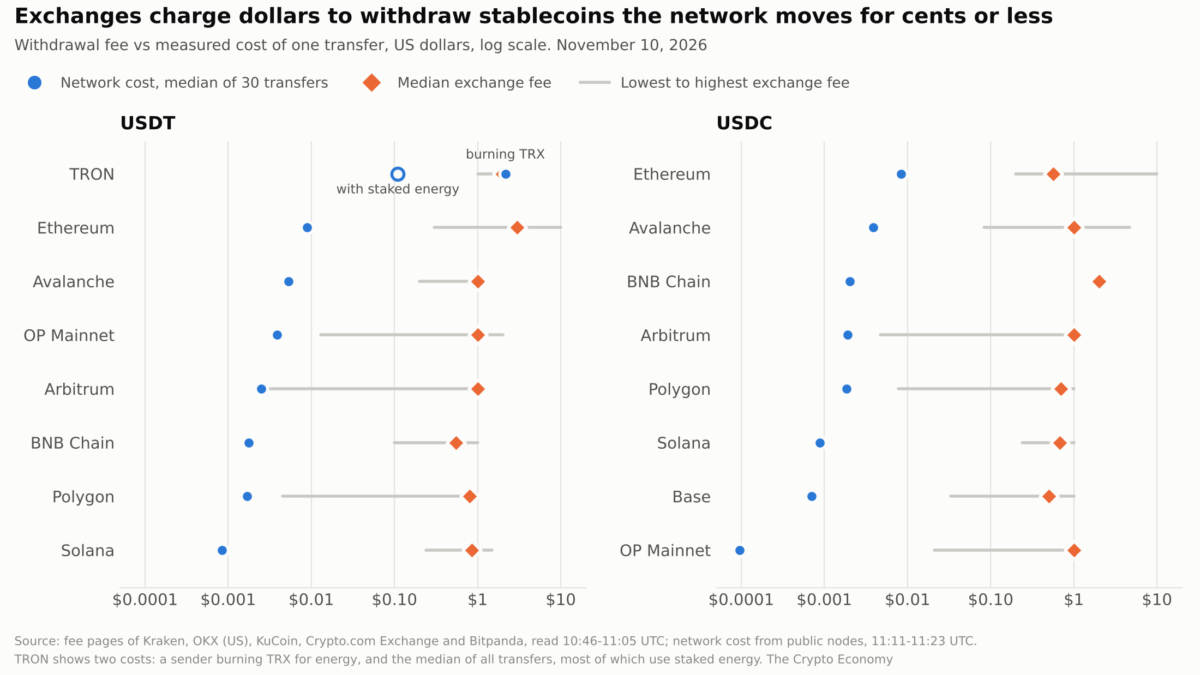
The chart shows each network as a row. The blue dot is what a typical USDT or USDC transfer cost on that network, measured from recent transfers, and the orange diamond is the median fee the exchanges charged to send the same coin there. The gray line runs from the cheapest exchange to the most expensive one.
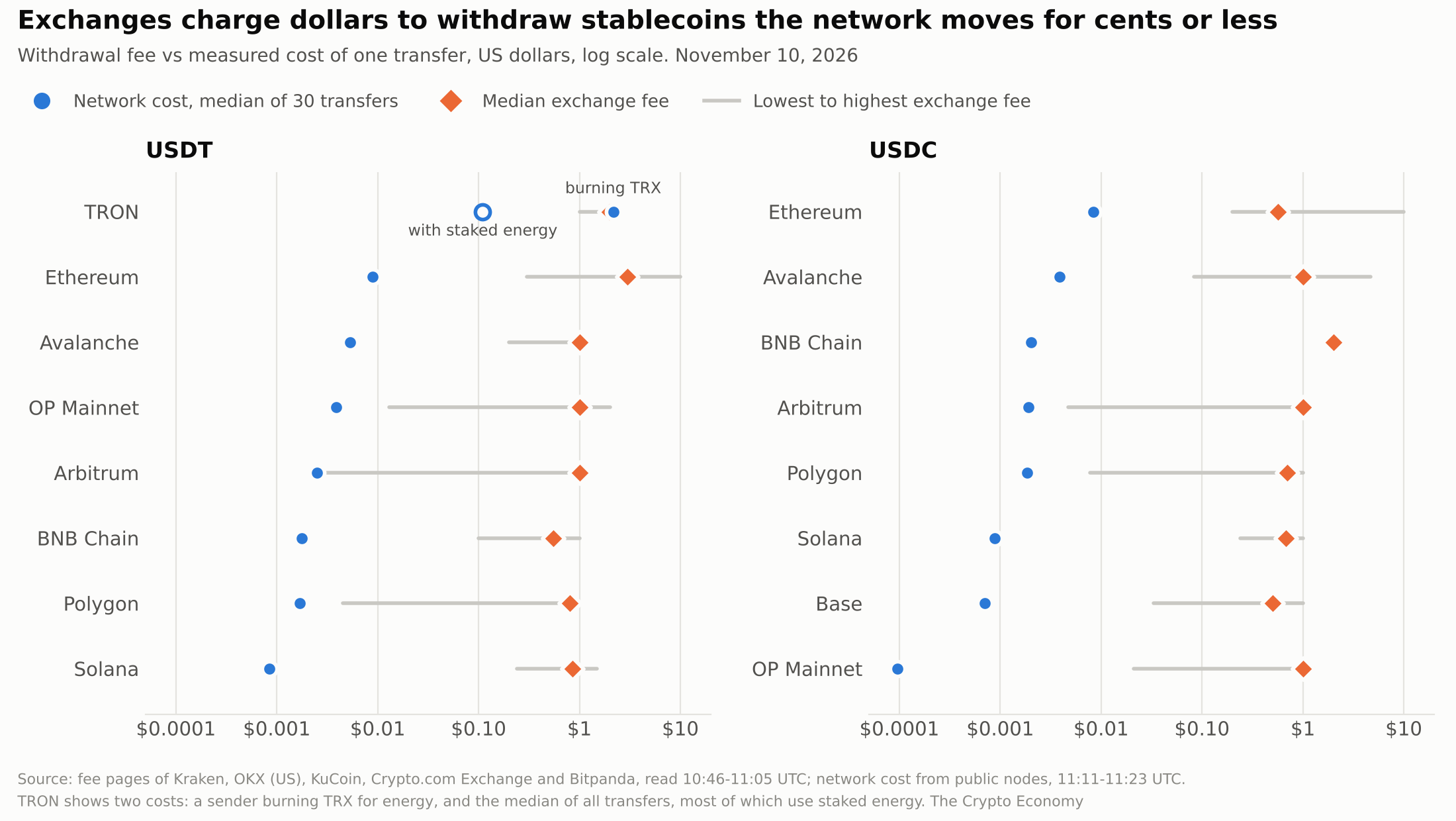
Note the scale: each gridline is ten times the one before. On most networks the gap between the dot and the diamond spans two to four of those steps, which is why ratios in the hundreds turn up so often. In dollars the gap is simpler. At the median, a withdrawal cost you about $1 more than the network charged.
Five of the ten exchanges publish a fee for each network, so they can be compared directly.
| Exchange | Routes compared | Median fee | Median fee ÷ network cost | Cheapest measured route |
|---|---|---|---|---|
| OKX (US site) | 14 | $0.067 | 27x | USDT on Arbitrum, 0.0029 USDT |
| Bitpanda | 14 | $1.00 | 296x | USDT or USDC on Polygon, 0.05 |
| Kraken | 14 | $1.00 | 518x | USDT or USDC on Ethereum, about 0.56 |
| KuCoin | 15 | $1.00 | 522x | USDC on Base, 0.5 USDC |
| Crypto.com Exchange | 12 | $1.09 | 648x | USDC on Base, 0.033 USDC |
Stablecoins are counted at $1 each. Fees were read between 10:46 and 11:05 UTC, and the network costs come from transfers sent between 10:58 and 11:18 UTC. For a business taking stablecoins, that dollar lands on every refund and every cash-out, one of the running costs of a stablecoin checkout.
The cheapest network to withdraw USDT and USDC
The cheapest network to send on isn’t always the cheapest network to withdraw on, because each exchange prices networks its own way. A USDC transfer on Base cost $0.0007, yet Kraken charged 1 USDC there while charging about 0.56 USDC on Ethereum, where the transfer cost twelve times more.
| Network | Network cost, USDT | Network cost, USDC | Lowest exchange fee | Highest exchange fee |
|---|---|---|---|---|
| Ethereum | $0.0089 | $0.0084 | 0.20 USDC, Bitpanda | 10, Crypto.com |
| TRON | $2.16 burning TRX, $0.11 for all transfers | not measured | 1 USDT, Kraken | 2 USDT, OKX US |
| Solana | $0.0008 | $0.0009 | 0.24, OKX US | 1.5 USDT, KuCoin |
| Base | not measured | $0.0007 | 0.033 USDC, Crypto.com | 1 USDC, Kraken and Bitpanda |
| Arbitrum | $0.0025 | $0.0019 | 0.0029 USDT, OKX US | 1.18 USDT, Crypto.com |
| Polygon | $0.0017 | $0.0018 | 0.0045 USDT, OKX US | 1, Kraken |
| OP Mainnet | $0.0039 | $0.0001 | 0.013 USDT, OKX US | 2 USDT, Kraken |
| Avalanche | $0.0053 | $0.0039 | 0.083 USDC, OKX US | 4.7 USDC, Crypto.com |
| BNB Chain | $0.0018 | $0.0020 | 0.10 USDT, Bitpanda | 2 USDC, Bitpanda |
Where a fee shows no token, the exchange charged the same amount for USDT and USDC. KuCoin’s Ethereum fee also has a percentage: its page lists it as 5.5 plus 0.2% of the amount, so a 1,000 USDT withdrawal there costs 7.5 USDT.
The two OP Mainnet costs differ for a reason worth knowing. The USDC transfers in our sample paid far smaller priority tips than the USDT ones, so a fee ratio built on that $0.0001 figure runs past 10,000 and says more about the tips than about the exchange.
Why TRON works differently
TRON doesn’t charge a gas price the way Ethereum does. A USDT transfer uses energy, and a sender can either burn TRX to pay for it or use energy from TRX they have staked or rented. In our 254 sampled TRON transfers, most senders paid nothing or almost nothing in TRX, and the median across all of them was $0.11.
The 30 transfers that burned TRX for energy cost a median 6.77 TRX, or $2.16 at that hour’s TRX price. Against that figure, Kraken’s USDT withdrawal fee of 1 USDT is about half the cost and KuCoin’s 1.99 USDT and OKX’s 2 USDT are just below it. Against the all-transfer median, the same fees are 9 to 18 times the cost.
Sending to an address that has never held USDT costs more on TRON, about 13 TRX instead of about 6.4 to 6.8 in our sample. An exchange that charges a flat fee carries that risk itself, which may explain why TRON is the one network where the fees track the cost.
What the exchanges say their fee covers
Three of the five exchanges that publish a number tie the fee to network costs in their own words. Crypto.com Exchange’s table says “The quoted fee is based on an estimate of the network transaction fees”, and Bitpanda’s limits page says high withdrawal fees on bitcoin and ether come from network traffic and that it adjusts its fees regularly so transactions confirm quickly. OKX’s page says the fee depends on network congestion.
None of the five breaks the fee into parts, so our measurement can’t say what else it pays for. An exchange’s own on-chain costs go beyond your withdrawal, such as moving customer deposits into a hot wallet. Kraken’s page warns that its fees can change and that you see the final amount only at confirmation, and its Ethereum USDC fee moved from 0.558 to 0.5638 between 05:50 and 10:51 UTC that day.
The exchanges that don’t publish a fee
Coinbase, Bitstamp, Gemini, Binance.US and Robinhood all show the fee only when you are about to send. Coinbase and Robinhood describe it as their estimate of the network fee, Bitstamp as a network-fee estimate plus its processing fee, and Gemini as a dynamic fee matching the network fee, adding that “Gemini does not pocket the fee”. Binance.US says its model weighs gas, operating expenses and the amount.
Because there is no number to read in advance, these five can’t sit in the comparison above. The only way to know what you will pay is to start a withdrawal and read the confirmation screen before you approve it.
Five more exchanges stayed out of the study. Binance’s and Bitvavo’s fee pages answered with a bot challenge, Gate returned “Access Denied”, Bybit redirected our US address to its homepage, and Bitget would only show its fees after we declared we were not a US resident, which we did not do.
How to pay less when you withdraw
The data points to a few habits that cut the cost without any special tools.
- Check which networks the receiving wallet or exchange accepts before you choose one, since a cheap network is useless if the other side can’t receive on it.
- Compare the fee and the minimum on your exchange’s fee page for every network it lists, because the same exchange can charge 0.033 USDC on one network and 10 on another.
- Don’t assume Ethereum is the expensive route or the cheap one: Kraken charged less there than on any other network, while Crypto.com and KuCoin charged 10 and 5.5.
- Withdraw in fewer, larger amounts when the fee is flat, so a $1 fee stays a small share of what you move.
- Send a small test amount to a new address first, and use our free Address Check to confirm the address format and network before the full transfer.
Stablecoin withdrawal fees change during the day, so treat the numbers here as a snapshot of one morning, not a price list.
How we measured
Exchange fees came from each exchange’s own fee page, rendered in a browser where the numbers load with JavaScript, or from the exchange’s own public API where it has one. KuCoin’s API matched its page on all 36 chains, and OKX’s table matched three separate reads of the data behind it. Every fee and minimum in our dataset appears word for word in a saved copy of the page or the API answer.
Network costs came from public blockchain nodes. For each network and token we took at least 20 and usually 30 recent successful transfers sent straight to the official token contract, at most two per block and three per sender, and took the median fee in the network’s own coin.
We converted it to dollars at Coinbase’s spot price read the same hour, and for Base and OP Mainnet we included the fee for posting data to Ethereum. Contract addresses came from Tether’s list of supported protocols and Circle’s USDC contract addresses, and from the exchanges themselves for the versions those lists don’t name.
We hand-checked 18 transfers by reading them again through a second endpoint and recomputing the fee. All matched. The readings come from one US address, so OKX served its US site and Crypto.com its US company, and customers elsewhere may see different fees.
You can download the fee comparison and the network cost readings as CSV files. We plan to repeat the study every month.
Frequently asked questions
What is the cheapest way to withdraw USDT?
In our November 10 reading, OKX’s US site charged 0.0029 USDT on Arbitrum and 0.0045 USDT on Polygon, the lowest fees on networks we measured. Kraken listed a fee of zero on Ink, a network we didn’t measure, with a 2.5 USDT minimum. Check that the receiving side supports the network before you pick it.
Why is the USDT withdrawal fee on Ethereum often so high?
It depends on the exchange. A USDT transfer on Ethereum cost the network about $0.009, more than any network we measured except a TRON transfer that burns TRX, yet exchange fees there ran from 0.30 USDT at OKX US to 10 USDT at Crypto.com. Three of the five exchanges with published fees charged their highest USDT fee on Ethereum, while Kraken charged less there than on any other network.
Is TRC-20 always the cheapest network for USDT?
No. A TRON transfer that burns TRX for energy cost a median $2.16 that morning, more than any other network we measured. It gets cheap only for senders with staked or rented energy, and exchange fees on TRON ran from 1 to 2 USDT.
Do exchanges make money on withdrawal fees?
Our data can’t answer that, because no exchange in the study breaks its fee into network cost and other costs. Gemini says it doesn’t pocket the fee, Bitpanda ties its fees to network traffic, and Crypto.com calls its fee an estimate of network costs. What we can show is the gap: at the median, the fee was about $1 above the cost of the transfer itself.
How often do withdrawal fees change?
Some change within hours. Kraken’s Ethereum USDC fee moved between two readings on the same morning, OKX says its fee depends on network congestion, and Crypto.com’s table carries a “Last Updated” date. We repeat this study monthly and keep each edition’s data for comparison.