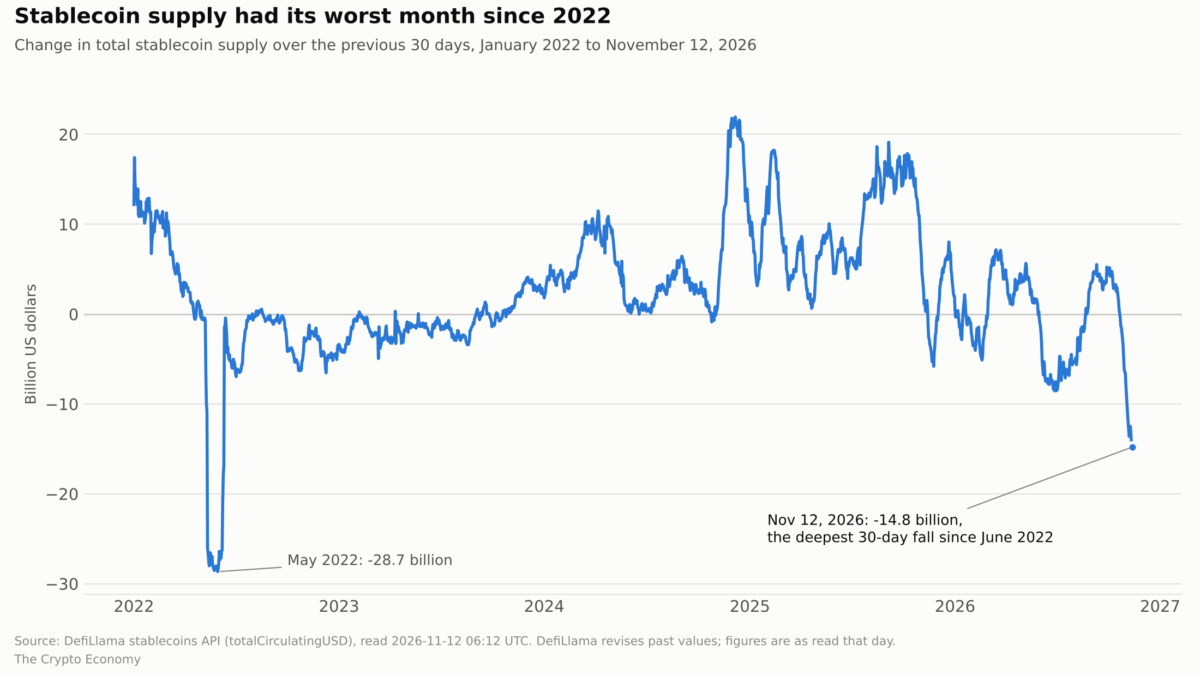
Stablecoins lost $14.8 billion of supply in the 30 days to November 12, 2026, the largest 30-day fall in DefiLlama’s data since June 2022. Total stablecoin supply stood at $290.8 billion on November 12, down from $305.6 billion on October 13, and 7.5% below this year’s high of $314.4 billion on May 17.
The fall is getting faster. Supply dropped $8.9 billion over the last 14 days and $4.3 billion over the last seven. When we reported the weekly drop on November 8, total supply had only just slipped under $300 billion.
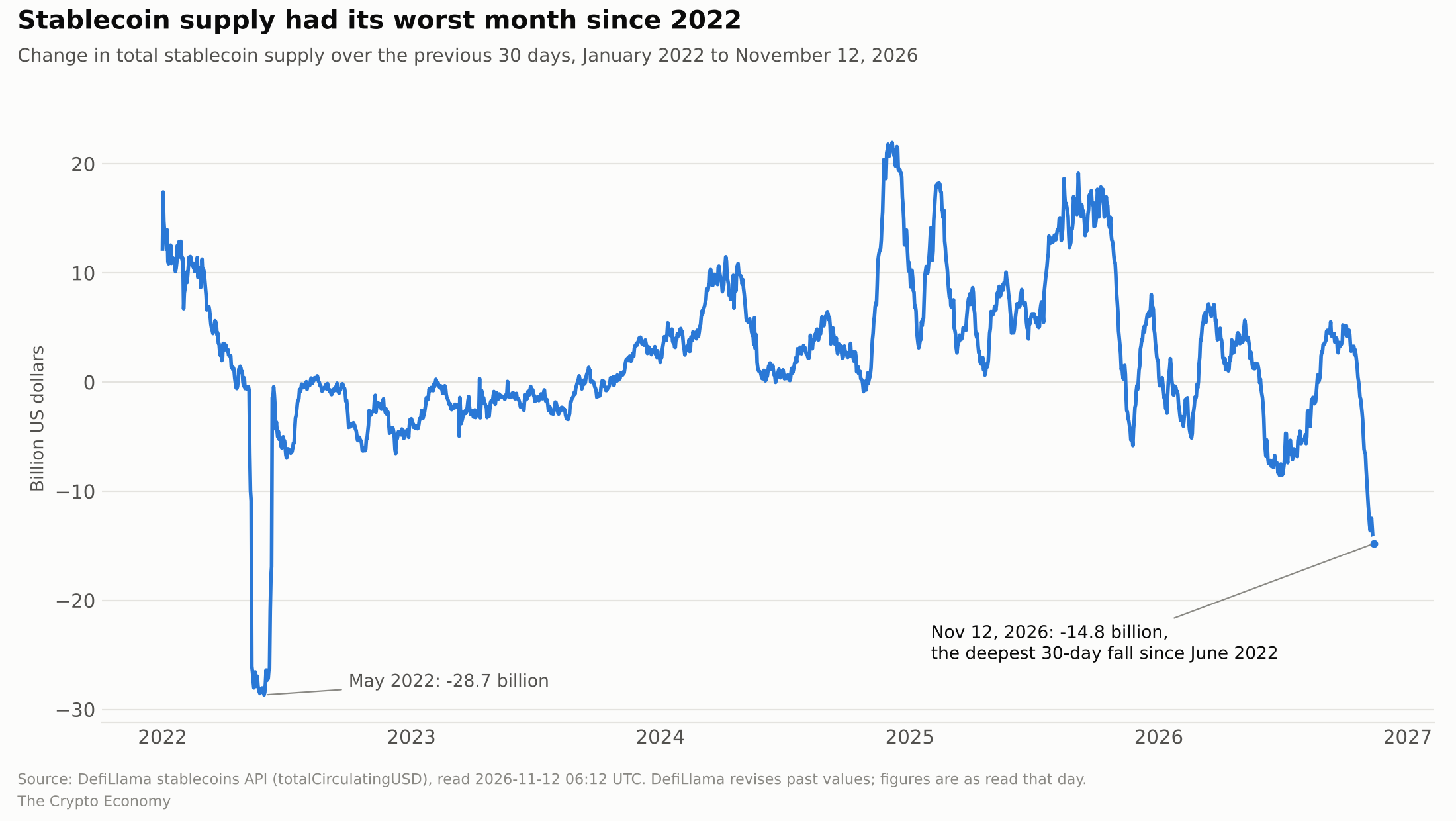
The chart puts the month in context. The only deeper 30-day falls in the series, which starts in November 2017, came between May 12 and June 10, 2022. The worst reading was minus $28.7 billion on May 30, 2022.
Which coins shrank
Two coins carry most of it. Over the 30 days, Tether’s USDT shrank by $8.3 billion and Circle’s USDC by $3.0 billion, which together come to $11.3 billion, or about three-quarters of the $14.8 billion fall.
| Coin | Supply on November 12 | 7-day change | 30-day change |
|---|---|---|---|
| USDT (Tether) | $175.4 billion | -$2.06 billion | -$8.30 billion |
| USDC (Circle) | $69.8 billion | -$1.30 billion | -$3.03 billion |
| USDS (Sky) | $5.4 billion | -$1.14 billion | -$1.60 billion |
| USD1 (World Liberty Financial) | $3.2 billion | -$0.47 billion | -$1.02 billion |
| RLUSD (Ripple) | $2.7 billion | +$0.10 billion | +$0.27 billion |
| USDe (Ethena) | $4.9 billion | +$0.34 billion | +$0.14 billion |
Few coins grew. Ripple’s RLUSD and Ethena’s USDe added a few hundred million dollars between them, a small offset to what left USDT alone. The coin-level figures in DefiLlama’s list add up to a $14.0 billion fall, a little less than the drop in its total series.
Where the USDT left from
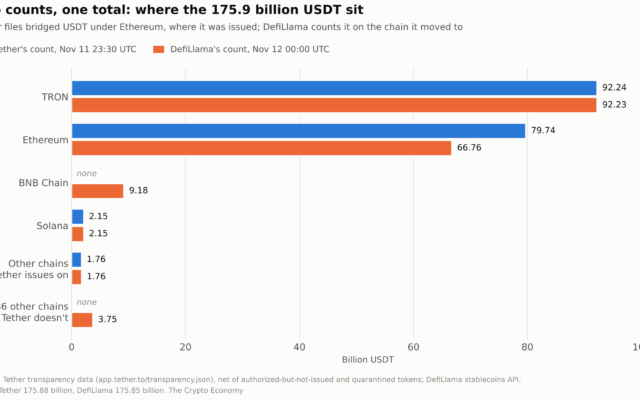
Most of the USDT that disappeared was on Ethereum. DefiLlama’s count of USDT supply on Ethereum fell from $73.2 billion to $66.8 billion over the 30 days, a drop of $6.4 billion that accounts for 77% of USDT’s fall. TRON, which holds more USDT than any other network, lost $1.0 billion, about 1% of its balance.
| Network | USDT 30 days earlier | USDT on November 12 | Change |
|---|---|---|---|
| Ethereum | $73.20 billion | $66.76 billion | -$6.44 billion |
| TRON | $93.24 billion | $92.23 billion | -$1.01 billion |
| Solana | $2.82 billion | $2.15 billion | -$0.67 billion |
| Plasma | $0.79 billion | $1.03 billion | +$0.24 billion |
DefiLlama counts USDT that was bridged from Ethereum on the network it moved to, so a shift between networks could look like a fall on Ethereum. That isn’t what happened here. The networks that gained USDT, led by Plasma and Avalanche, added $0.33 billion together, far less than the $6.4 billion Ethereum lost.
USDC followed the same pattern. USDC supply on Ethereum fell by $2.9 billion and on Hyperliquid by $0.8 billion, while Arc gained $0.8 billion and Solana $0.3 billion. Tether’s own count puts 52.4% of all USDT on TRON, as our USDT explainer sets out, so the network that holds most of the coin is also the one that barely moved.
The pegs held
None of this has moved prices. DefiLlama priced USDT at $0.99873 and USDC at $0.99972 at 06:12 UTC on November 12.
A note on the numbers
DefiLlama revises its past values, and it did so between our two reports.
On November 8 its series put total supply at $294.1 billion on November 7 and this year’s high at $317.1 billion. Read on November 12, the same series puts those two days at $293.2 billion and $314.4 billion. That matters for comparisons. Every figure in this article comes from the series as read at 06:12 UTC on November 12, so the comparisons inside it are like for like.
Trackers that count differently give different totals for the same fall. The Block reported a $14.2 billion contraction on November 11, while our $14.8 billion covers the 30 days to November 12.