What is PYUSD? It’s PayPal’s stablecoin, a crypto token built to stay worth one US dollar, and the ticker stands for PayPal USD. When PayPal launched it on August 7, 2023, its announcement said the token “is redeemable 1:1 for U.S. dollars and is issued by Paxos Trust Company.”
That second clause is the part most explainers skip. Paxos, not PayPal, creates every token and holds the money behind it, and PayPal acts as the brand and the main shop window. Answering what is PYUSD properly means reading the issuer’s own papers.
We read Paxos’s reserve report for September 2026, signed by KPMG on October 23, the PYUSD page and freeze terms on Paxos’s site, four PayPal announcements, the US stablecoin law and ESMA’s register on November 21, 2026, and took supply figures from DefiLlama the same day.
What is PYUSD and who issues it
Paxos is blunt about it. Its PYUSD page says the token “is issued by Paxos, not PayPal or Venmo.” Holders are bound by Paxos’s stablecoin terms, not PayPal’s. The first tokens were ERC-20 tokens on Ethereum, the launch release says, and PayPal called the PYUSD stablecoin “the only stablecoin supported within the PayPal network.”
The issuer changed its regulator after launch. Paxos’s September report says the company was a New York limited purpose trust company chartered by the state’s financial regulator in 2015, and that on December 12, 2025 it converted “to a national bank that is limited to the operations of a trust company.”
Since then it has operated as Paxos Trust Company, National Association, under the Office of the Comptroller of the Currency, the federal regulator of national banks. The report adds that Paxos “will be subject to the framework imposed by” the GENIUS Act, the 2025 US stablecoin law, and keeps following New York’s 2022 stablecoin guidance where that law is silent.
Old names linger. The footer on the same Paxos page still calls “Paxos Trust Company, LLC” PayPal’s licensed crypto service provider, while Paxos’s transparency page says PYUSD is “Issued by Paxos Trust Company N.A.” Both describe the same company before and after the charter change.
How much PYUSD exists, and where
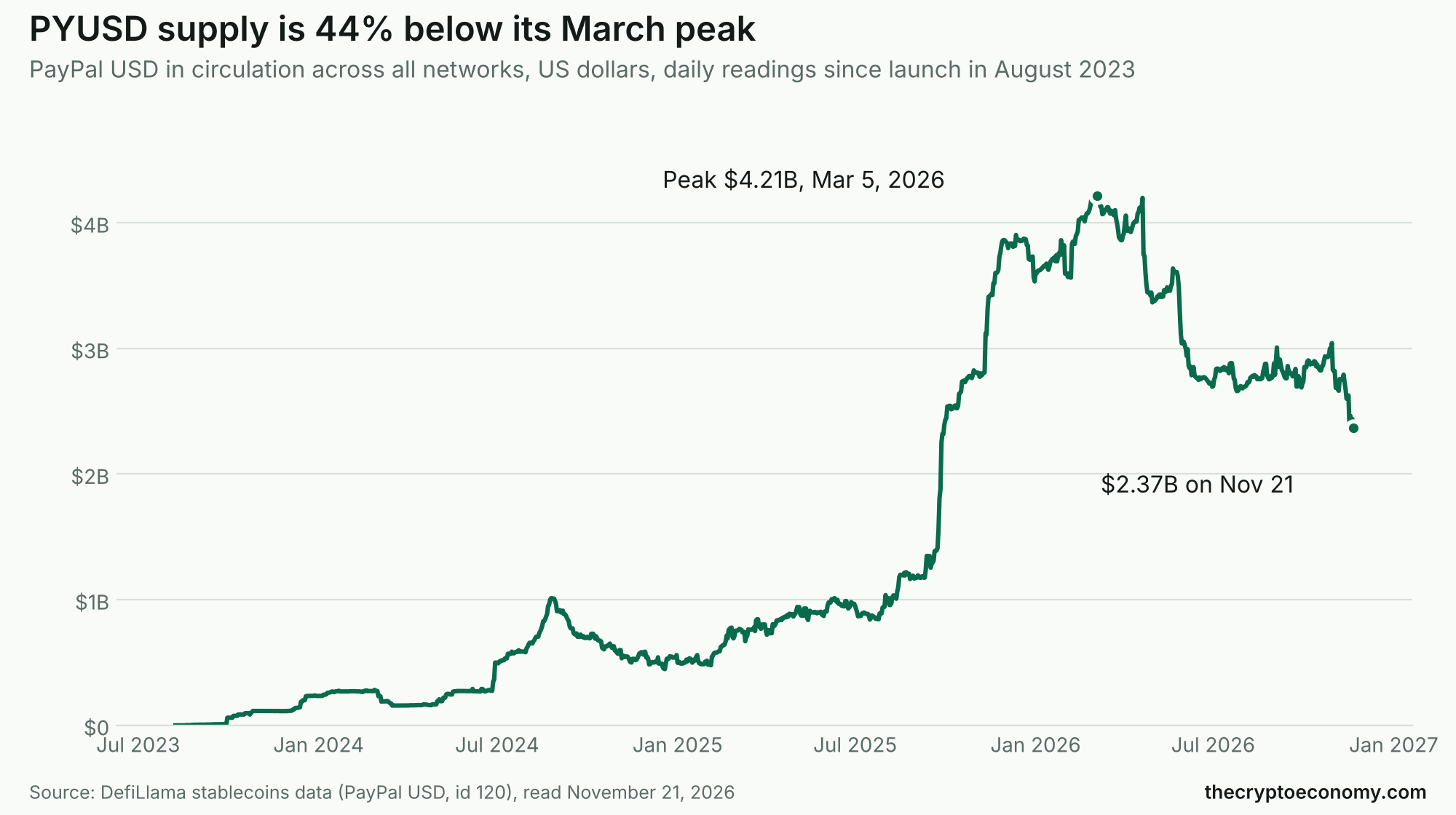
The PYUSD stablecoin grew late and then shrank.
DefiLlama’s series shows about $0.50 billion on January 1, 2025 and $1.18 billion on September 1, 2025, then a jump to $3.86 billion by December 1. Supply peaked at $4.21 billion on March 5, 2026.
By November 21, 2026 it was down to $2.37 billion, 34% below the $3.60 billion of a year earlier and 17% below October 21. The fall runs against a wider pullback, as total stablecoin supply shed $14.8 billion in the 30 days up to November 12.
Paxos’s page says PYUSD “is available on seven blockchain networks.” Its September report counts tokens minted on eight, because it also lists Ink, a network that held 111 PYUSD on September 30.
| Network | DefiLlama, November 21, 2026 | Share | Minted there by Paxos, September 30 |
|---|---|---|---|
| Ethereum | $1,367 million | 58.0% | 1,682 million tokens |
| Solana | $723 million | 30.7% | 748 million tokens |
| Arbitrum | $164 million | 6.9% | 293 million tokens |
| Flow | $35 million | 1.5% | None, not on Paxos’s list |
| Stable | $28 million | 1.2% | 0.25 million tokens |
| Stellar | $26 million | 1.1% | 12 million tokens |
| Polygon | $10 million | 0.4% | 10 million tokens |
| X Layer | $2 million | 0.1% | 2 million tokens |
The two columns don’t match row by row. They’re seven weeks apart, and DefiLlama also counts tokens moved between networks through LayerZero, a cross-chain bridge. All $35 million on Flow got there that way, about $33.7 million of it from Arbitrum, so those tokens are a bridged version whose value depends on the bridge as well as on Paxos.
Either way, two networks hold almost nine tenths of the supply. Solana joined in May 2024, when PayPal said the move made “PayPal’s stablecoin faster and cheaper to use.”
What backs PYUSD
Paxos publishes a reserve report every month, examined by KPMG under AICPA attestation standards. The latest one covers two dates in September 2026 and shows what sat behind the tokens at 5 p.m. Eastern time on each.
| Reserve asset | September 17, 2026 | September 30, 2026 | Share on September 30 |
|---|---|---|---|
| Overnight repurchase agreements | $2,466.0 million | $2,155.3 million | 78.2% |
| US Treasury bills | $249.6 million | $499.0 million | 18.1% |
| Cash at banks | $72.1 million | $100.4 million | 3.6% |
| Government money market funds | None | None | 0% |
| Total reserve | $2,787.7 million | $2,754.7 million | 100% |
| PYUSD tokens outstanding | 2,784.3 million | 2,747.6 million |
The reserve exceeded the tokens by $7.1 million on September 30. Most of the reserve was lent for one night. Paxos placed $2.16 billion with two unnamed US banks in three repurchase agreements at 3.73% to 3.88%, all secured by US Treasury debt and due back on October 1, and the report says the collateral was worth more than the loans.
The Treasury bills were two lots of $250 million at face value, one due October 1 and the other November 5. That mix fits the GENIUS Act, which lets an issuer hold Treasury bills “with a remaining maturity of 93 days or less” and overnight reverse repurchase agreements, in which the issuer buys Treasury securities and sells them back the next day, as long as the collateral exceeds the loan.
The law says reverse repurchase agreements because it names the trade from the issuer’s side, while Paxos’s tables label the same deals repurchase agreements. The report says Paxos applies the reserve rules of the law’s Section 4(a)(1)(A).
The cash comes with its own caveat. About $100.2 million sat in bank deposits above the FDIC’s $250,000 limit on September 30, and Paxos’s extra deposit insurance of $50 million comes from Paxos Insurance Company Ltd, which the report calls “a captive insurance company for the Company and its affiliates.” USDC, by contrast, keeps most of its reserve in one SEC-registered government fund managed by BlackRock.
How you get PYUSD, and a dollar back
The usual way in is through PayPal or Venmo. The launch release said eligible US customers could move PYUSD between PayPal and external wallets, send it to other people, pay for purchases with it and convert PayPal’s other cryptocurrencies to and from it.
The UK came next. PayPal’s UK announcement of November 17, 2025 listed PYUSD among seven tokens British customers could buy, hold and sell, and said “UK users are the first outside the US to have the ability to purchase PayPal USD directly from PayPal.”
Getting dollars back runs through the same apps. Paxos’s page says its reserve means “customer funds are available for 1:1 redemption with Paxos,” and adds that crypto held in a PayPal balance or Venmo account is “not eligible for FDIC insurance.”
Merchants that accept stablecoin payments through PayPal’s Pay with Crypto service meet PYUSD from the other side, since PayPal sends refunds in it when the buyer’s wallet can take it.
The rewards PayPal pays
The token pays nothing by itself. Under the GENIUS Act no issuer may pay holders “any form of interest or yield” just for holding a payment stablecoin, so any return comes from PayPal, a distributor, rather than from Paxos.
PayPal announced rewards for PYUSD held in PayPal or Venmo on April 23, 2025, at an “anticipated rate upon program launch” of 3.7% a year. The same release says the rate is set “at all times in PayPal’s sole discretion and is not guaranteed,” and that rewards may not reach New York users at launch.
PayPal’s current rewards page refused our reader, so we can’t confirm today’s rate. Check it in the app before you count on it.
Can Paxos freeze PYUSD?
Yes. Paxos’s illegal activity terms say it may freeze PYUSD, “temporarily or permanently,” and the dollars behind it, “with or without advance notice, if we are required to do so by law, including by court order or other legal process.”
The terms go further than a pause. Frozen tokens and their dollars “may be forfeited” and may become “wholly and permanently unrecoverable and unusable, and in appropriate circumstances, may be destroyed.” The rule “applies to all holders,” whether or not they ever opened an account with Paxos.
US law now expects that power. The GENIUS Act lets an issuer create payment stablecoins “only if the issuer has the technological capability to comply, and will comply, with the terms of any lawful order.” We found no dated, primary record of a PYUSD freeze. Our stablecoin freeze tracker reads USDT and USDC contracts only, so it doesn’t count PYUSD.
PYUSD in the EU, the UK and the US
The EU is where PYUSD has the least room.
ESMA’s file of e-money token white papers, last changed on November 18, 2026, has no entry for PayPal or PYUSD. Paxos does appear, through Paxos Issuance Europe Oy, a Finnish company supervised by FIN-FSA, for its other dollar token, USDG.
A missing entry means no EU white paper under that name, not a ruling on the token. Exchanges act on it anyway. On Kraken, PYUSD is one of the stablecoins clients in the EEA can no longer trade, and its support page of October 29, 2026 says they “can only be deposited or withdrawn.” Our list of MiCA compliant stablecoins shows which dollar tokens EU platforms can still offer.
So what is PYUSD in practice? A dollar token for PayPal and Venmo users in the US, and for PayPal users in the UK since the November 2025 relaunch, with little room in the EU. In the US it sits under the OCC and the GENIUS Act.
The Bank for International Settlements, which central banks own, is skeptical of the whole category, and its 2025 annual report argued that stablecoins “fall short” of what a monetary system needs, judged on singleness, elasticity and integrity.
Frequently asked questions
What does PYUSD stand for and who issues it?
PYUSD stands for PayPal USD. Paxos issues it, not PayPal or Venmo. Since December 12, 2025 the issuer has been Paxos Trust Company, National Association, which the OCC oversees as a national bank limited to trust work.
Is PYUSD the same as a US dollar?
No. It’s a token designed to trade at one dollar and backed by dollar assets held by Paxos, mostly overnight repurchase agreements and Treasury bills on September 30, 2026. Crypto in a PayPal or Venmo account isn’t covered by FDIC insurance, Paxos’s page says.
Does PYUSD pay interest or rewards?
The token itself pays nothing, because the GENIUS Act bars issuers from paying interest. PayPal announced rewards in April 2025 at an anticipated 3.7% a year, at its sole discretion, so check the current rate in the app.
Can PYUSD be frozen?
Yes. Paxos’s terms let it freeze PYUSD with or without notice when the law requires it, including under a court order, and frozen tokens may be destroyed. US law also requires issuers to be able to obey lawful orders.
Is PYUSD available in the EU?
ESMA’s register of e-money token white papers had no PYUSD entry in its November 18, 2026 version, and Kraken lists it as delisted for clients in the EEA. Paxos’s EU company appears in that register for USDG, a different token.