There’s no single USDC transfer fee. When you send USDC from your own wallet, you pay the network that carries the transaction, in that network’s own coin. That means ETH on Ethereum and on Base, Arbitrum and Optimism, POL on Polygon, AVAX on Avalanche and SOL on Solana. The amount depends on the network, on how busy it is and on whether the person you’re paying has held USDC before.
To put numbers on it, we sampled 210 recent USDC transfers on seven networks on November 25, 2026, from public nodes, and compared them with the same reading taken on November 10. We also read Circle’s live fee data for moving USDC between networks and the withdrawal fees Kraken and OKX showed that afternoon. Treat every figure as a dated reading, since network fees change from one block to the next.
Where a USDC transfer fee goes
On Ethereum and the networks built like it, each transaction pays for the computation it uses, counted in units of gas. The gas fee is the gas used times the price per unit, and that price has two parts. The EIP-1559 specification says that “the base fee is always burned,” so the block producer keeps only the priority fee, the tip on top.
Base, Arbitrum and Optimism are layer 2 networks, so each transaction there also pays a share of the cost of posting data to Ethereum. The EIP-4844 proposal introduced “blobs” for that data, expecting them to be “much cheaper,” and noted that even before them Optimism and Arbitrum “frequently provide fees that are ~3-8x lower than the Ethereum base layer itself.”
Solana prices transactions another way. Its documentation sets a base fee of 5,000 lamports per signature, “split 50% burned / 50% to the validator,” plus an optional priority fee that makes a validator more likely to schedule the transaction. A lamport is one billionth of a SOL, so a plain transfer with one signature starts at 0.000005 SOL.
What sending USDC cost on seven networks on November 25
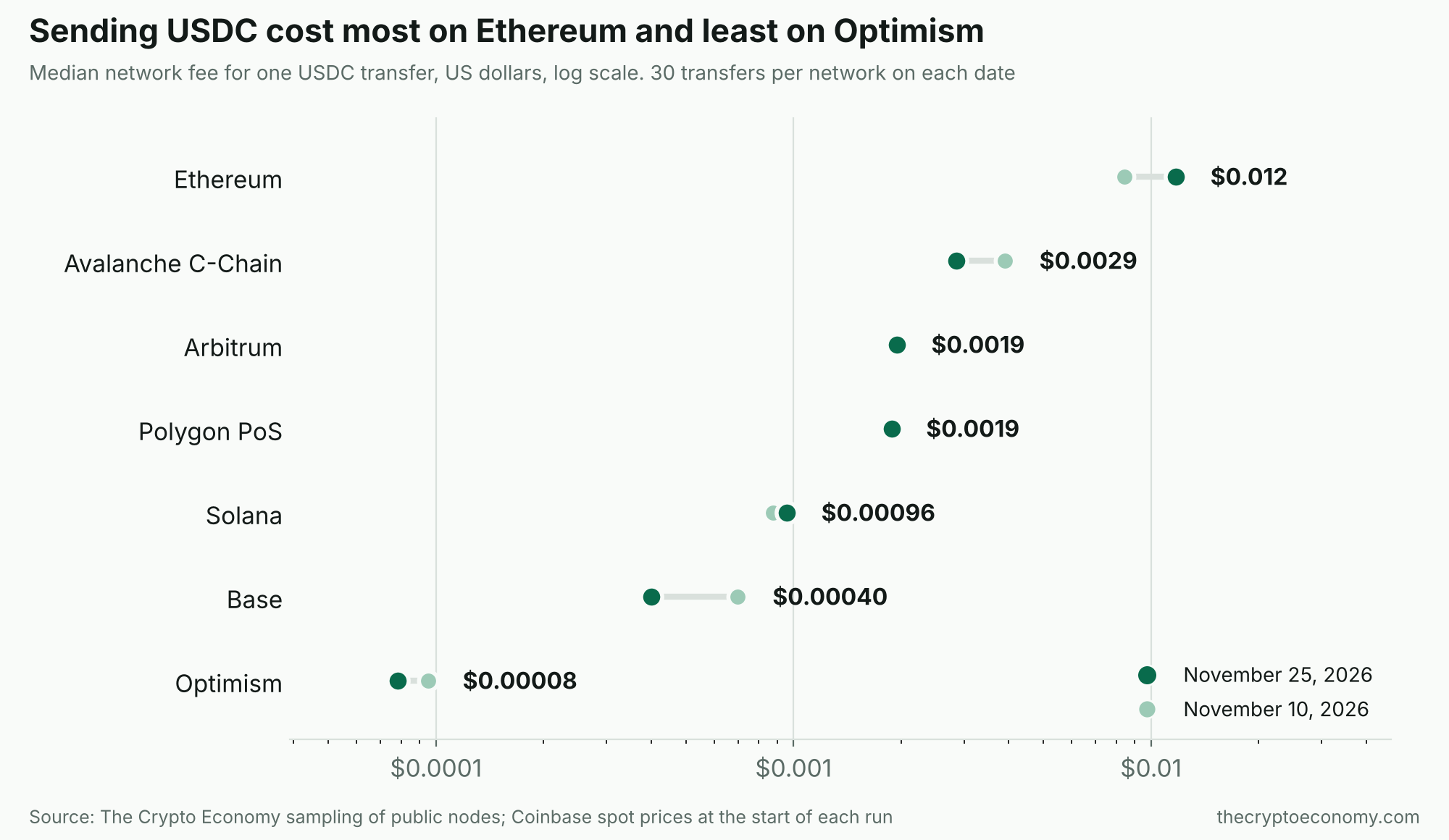
Between 13:19 and 13:57 UTC on November 25, 2026, the median fee for a direct USDC transfer looked like this. The November 10 column comes from our earlier withdrawal fee study, sampled the same way.
| Network | Median fee, November 25 | In the network’s coin | Median fee, November 10 |
|---|---|---|---|
| Ethereum | $0.0117 | 0.00000713 ETH | $0.0084 |
| Avalanche C-Chain | $0.0029 | 0.000449 AVAX | $0.0039 |
| Arbitrum | $0.0019 | 0.00000119 ETH | $0.0019 |
| Polygon PoS | $0.0019 | 0.0256 POL | $0.0018 |
| Solana | $0.00096 | 0.0000142 SOL | $0.00088 |
| Base | $0.00040 | 0.000000245 ETH | $0.00070 |
| Optimism | $0.000078 | 0.0000000475 ETH | $0.000095 |
Ethereum stood apart. It was the only network where the median transfer cost more than a cent. Its dollar cost rose about 39% from November 10 even though ETH fell from $2,095.08 to $1,645.86 in the Coinbase prices we used, because the ETH paid per transfer rose about 77%. Base, Avalanche and Optimism got cheaper, while the other three moved by less than 10%.
Sending USDT cost more in the same runs, $0.0175 on Ethereum and $0.0046 on Solana, against $0.0117 and $0.00096 for USDC.
How we measured
For each network, a script read the most recent blocks from a public node and kept direct USDC transfers of at least 1 USDC, meaning one successful call to the token’s transfer function, sent straight to the USDC contract Circle lists for that network. It took 30 such transfers per network and recorded what each one paid, the gas used times the effective gas price plus any layer 1 data fee, or the transaction fee on Solana.
Medians are in each network’s coin and were converted to dollars at Coinbase spot prices read when the run started. On Polygon, Arbitrum and Optimism we sampled native USDC, not the older bridged USDC that exchanges still list as USDC.e. Every transaction and price we used is saved with the run.
Why your transfer can cost more than the median
A median hides the spread, and two things push a transfer above it. The first is sending to someone who has never held USDC on that network, which raised the cost on each network where we checked it.
Sending to a wallet that has never held USDC
On Ethereum, 12 of our 30 sampled transfers went to an address whose USDC balance was zero one block earlier. Those used a median of 62,254 gas, against 45,148 for transfers to addresses that already held USDC, 38% more. Polygon showed the same pattern, with 8 of 30 recipients new to USDC and 78,119 gas against 56,231, or 39% more. On Arbitrum, where half of the 30 recipients were new, their median fee was 40% higher.
Ethereum’s gas schedule charges far more to fill an empty storage slot than to change one already in use, 20,000 gas against 5,000 in EIP-2200 before later adjustments, and a first USDC balance is exactly that kind of new entry.
On Solana the extra cost is a deposit rather than gas. A wallet holds USDC in a separate token account, and Solana’s documentation says that whoever sends someone their first USDC “usually creates it and pays about 0.0015 SOL at the current rate.”
We asked a Solana node at 13:24 UTC on November 25 for the deposit a standard token account needs. It answered 1,488,440 lamports, or 0.00148844 SOL, which is $0.1009 at that minute’s SOL price of $67.795.
In our Solana sample, 11 of the 30 USDC transfers included the instruction that creates the recipient’s token account if it doesn’t exist yet. The deposit is about 105 times the median Solana transfer fee we measured. That money isn’t lost. Closing an empty token account returns it, but Solana’s docs note that it goes to whatever address the close instruction names, and “the original creation payer is not automatically the refund destination.”
Busy blocks
The second cause is congestion. Under EIP-1559 the base fee rises after a block fills past its target and falls after a quiet one, so a transfer sent during a busy minute pays more for the same gas. Within the 15 Ethereum blocks we sampled, single USDC transfers cost between $0.0080 and $0.0443, a spread that mixes base fee moves, different tips and the extra gas of first-time recipients.
Paying the network fee without holding ETH
The usual stumbling block for a new user is having USDC but none of the coin needed to move it. Circle offers a way to pay the USDC gas fee in USDC itself, for some wallets. Its Paymaster documentation says users can pay network fees in USDC “instead of chain native tokens,” through wallets built on the ERC-4337 smart account standard.
The convenience has a price. “There is a 10% surcharge on gas fees to account for operational costs,” Circle says, and the current version covers Arbitrum, Avalanche, Base, Ethereum, Optimism, Polygon and Unichain. Solana isn’t on the list. At our Ethereum median, the surcharge would add about $0.0012 to a transfer, which matters less than the fact that you don’t need to buy ETH first.
Moving USDC to another network with CCTP
Sending USDC from one network to another is a different transaction from a plain transfer. Circle’s Cross-Chain Transfer Protocol, CCTP, burns the USDC on the source network and mints new USDC on the destination, so no wrapped token is involved. Circle’s fee page says it charges “on Fast Transfers only. Standard Transfers are free.”
We read the fee for each route from Circle’s public fee API at 13:23 UTC on November 25, 2026. The CCTP fee depends on the network you send from, and Circle warns that fees “are subject to change at any time.”
| Sending from | Fast Transfer fee | Fee on $1,000 | Standard Transfer |
|---|---|---|---|
| Ethereum | 1 basis point | $0.10 | free |
| Solana | 1 basis point | $0.10 | free |
| Base | 1.3 basis points | $0.13 | free |
| Optimism | 1.3 basis points | $0.13 | free |
| Arbitrum | 1.4 basis points | $0.14 | free |
| Avalanche | no Fast Transfer | none | free |
| Polygon PoS | no Fast Transfer | none | free |
Avalanche and Polygon PoS have no Fast Transfer because, in Circle’s words, their standard attestation times are “already fast enough.” The Fast Transfer fee comes out of the amount when USDC is minted on the destination, unless the sender pays it upfront. On top of either kind of transfer you still pay network fees, for the burn on the first network and the mint on the second.
What exchanges charge to withdraw USDC
An exchange withdrawal often carries the largest USDC transfer fee you’ll see, because the exchange sets its own price per network. We read Kraken’s withdrawal fee page at 13:26 UTC and OKX’s US fee page at 13:27 UTC on November 25, 2026, and set both beside the network medians from the same afternoon.
| Network | Kraken fee | OKX fee | Network median |
|---|---|---|---|
| Ethereum | 0.5259 USDC | 0.26 USDC | $0.0117 |
| Solana | 0.6939 USDC | 0.19 USDC | $0.00096 |
| Avalanche C-Chain | 1 USDC | 0.013 USDC | $0.0029 |
| Arbitrum | 1 USDC | 0.0039 USDC | $0.0019 |
| Polygon PoS | 1 USDC | 0.0077 USDC | $0.0019 |
| Base | 1 USDC | 0.012 USDC | $0.00040 |
| Optimism | 1 USDC | 0.016 USDC | $0.000078 |
On Base, Kraken’s 1 USDC was about 2,500 times the network median and OKX’s 0.012 USDC about 30 times. OKX came closest to the network’s cost on Arbitrum, at about twice the median. The medians leave out costs an exchange can carry, such as the Solana deposit of about $0.10 for a recipient with no USDC account, which is still well under Kraken’s Solana fee.
Minimums matter for small amounts. Kraken’s ranged from 0.63108 USDC on Ethereum to 5 USDC on Avalanche, while OKX asked for at least 2 USDC on each of these networks.
The gap isn’t new. Our withdrawal fee study of November 10 compared 69 stablecoin routes at the five exchanges that publish a number and found a median fee of $1.00, while the transfer cost the network less than one cent everywhere except TRON.
How to send USDC for less
Most of the savings come from choices made before you press send. These steps work for a wallet payment and for a withdrawal.
- Ask which network the recipient can receive on, and send only on that network, because an address on one network can’t receive USDC sent on another.
- Among the networks you both support, pick the one with the lowest fee; in our sample every network except Ethereum cost less than a third of a cent.
- Keep a small balance of the network’s own coin in your wallet, or use a wallet that pays the fee in USDC through a paymaster.
- Before a first payment to a new Solana address, expect the token account deposit of about 0.0015 SOL on top of the fee.
- Send a small test amount to any address you haven’t used before, then the rest once it arrives.
- To move USDC between networks, use a Standard CCTP transfer when you can wait, since the Fast Transfer fee buys only speed.
- Before withdrawing from an exchange, compare its fee on each network, since a 1 USDC flat fee on a cheap network can cost more than a dynamic fee on Ethereum.
If you are still choosing where to buy USDC, check which networks the platform withdraws to and at what price, because that fee recurs every time you move your money out.
Frequently asked questions
How much does it cost to send USDC?
A wallet you control pays only the network fee. Our sample of November 25, 2026 put the median at $0.0117 on Ethereum and $0.000078 to $0.0029 on the other six networks we measured, paid in each network’s coin. An exchange withdrawal adds the exchange’s own fee.
Which network has the lowest USDC transfer fee?
In our sample of November 25, 2026, the lowest median was on Optimism, at $0.000078, followed by Base, at $0.00040. The ranking changes with congestion and coin prices, so check the fee your wallet shows before you send.
Do I need ETH to send USDC?
On Ethereum, Base, Arbitrum and Optimism you need a little ETH for the network fee, on Polygon you need POL, on Avalanche AVAX and on Solana SOL. Wallets that use Circle’s Paymaster can take the USDC gas fee in USDC instead, with a 10% surcharge on the gas cost.
How much does it cost to move USDC from Ethereum to Base?
A Standard Transfer through Circle’s CCTP has no Circle fee. For a Fast Transfer from Ethereum, the CCTP fee was 1 basis point, $0.10 per $1,000, on November 25, 2026. You also pay the network fees for burning USDC on Ethereum and minting it on Base.
Why is my exchange’s USDC withdrawal fee higher than the network fee?
Exchanges set their own withdrawal fees, and many charge a flat amount per network. Kraken charged 1 USDC on Base on November 25, 2026, against a network median of $0.00040, while its Ethereum withdrawal fee changed between our readings, from 0.5638 USDC on November 10 to 0.5259 on November 25.