The Monetary Authority of Singapore (MAS) and Germany’s Bundesbank said on November 16, 2026 that they had settled euro-Singapore dollar foreign exchange trades between their two test systems, in a project called Project Simbolon. The trades settled in wholesale central bank digital currency, and each side checked the other’s leg without the two central bank ledgers being wired together.
Simbolon was a test, not a launch. The joint release says the central banks connected their settlement solutions’ “test environments,” and no live service or start date was announced.
How the trades settled
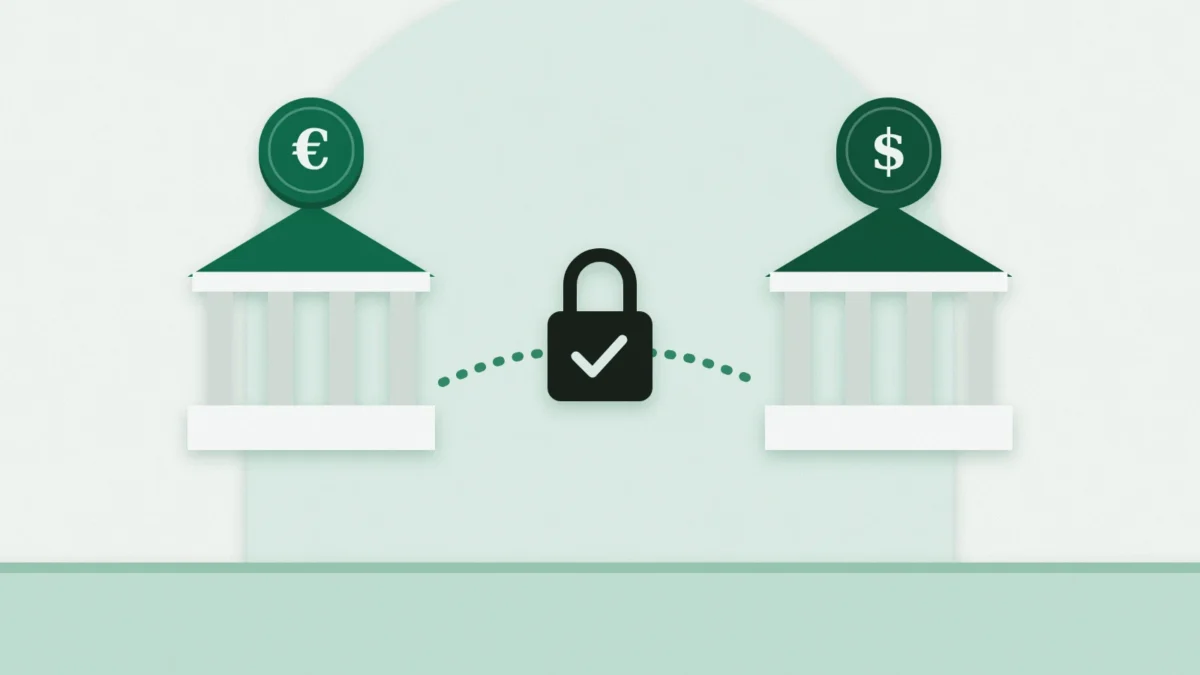
Two commercial banks took part, Singapore’s DBS and Deutsche Bank, with Partior as their technology provider. They used payment-versus-payment, which the release defines as a mechanism in which the transfer in one currency happens “if and only if” the transfer in the other currency takes place.
The new piece is how the two ledgers trusted each other. A zero-knowledge proof, a cryptographic method that proves a statement is true without revealing the private data behind it, let each environment confirm that the settlement conditions had been met. The release says this worked “without requiring direct technical integrations between the two central bank ledgers.”
The name comes from the ancient Greek “symbolon,” a token made of two matching pieces, which MAS uses as an analogy for coordinating the two legs of a trade.
Why central banks care
The target is settlement risk, the chance that one side of a currency trade pays and the other doesn’t. Sabine Mauderer, the Bundesbank’s first deputy governor, said in the Bundesbank’s copy of the release that the project “paves the way for eliminating settlement risk in global foreign exchange transactions.”
Time zones are the second problem. Singapore and Germany are six or seven hours apart, and the project also looked at how banks could raise and commit liquidity closer to when they need it, for securities trades and intraday funding.
MAS is running more than one test of this kind. It also took part in the trial of linked FX settlement with the Bank of England and the Bank of Thailand that we covered as Project Meridian FX. That trial joined three different kinds of systems through a separate coordinating operator, also built by Partior, while Simbolon’s two ledgers checked each other’s proofs directly.
What comes next
Nothing changes yet for businesses or people sending money abroad. The project works with central bank money between banks, not with payments that customers make.
The two central banks published a short insights note on November 16 and say a detailed report, “Project Simbolon: Cross-Border FX Settlement Connectivity Across Independent Digital Infrastructures,” will follow “in due course.” They list settlement performance and the legal, regulatory, operational and governance questions of wider use as areas to explore next.
The project is the first major result of a memorandum of understanding the two signed in November 2025. It sits alongside Project Guardian, the tokenization program MAS started in May 2022, whose policymaker group the Bundesbank joined in November 2024.