An exchange asks who you are sending crypto to because the Travel Rule makes it pass the sender’s and the recipient’s details to the firm on the other end. Without those details, it may refuse to move the coins.
The rule binds the companies that move crypto for customers, such as exchanges and custodial wallet apps, and it reaches you as a form on the withdrawal or deposit screen. This guide covers what those Travel Rule crypto checks ask, the legal text behind them, the lines in seven rulebooks and the fixes for a transfer that gets stuck.
What the exchange asks for when you send crypto
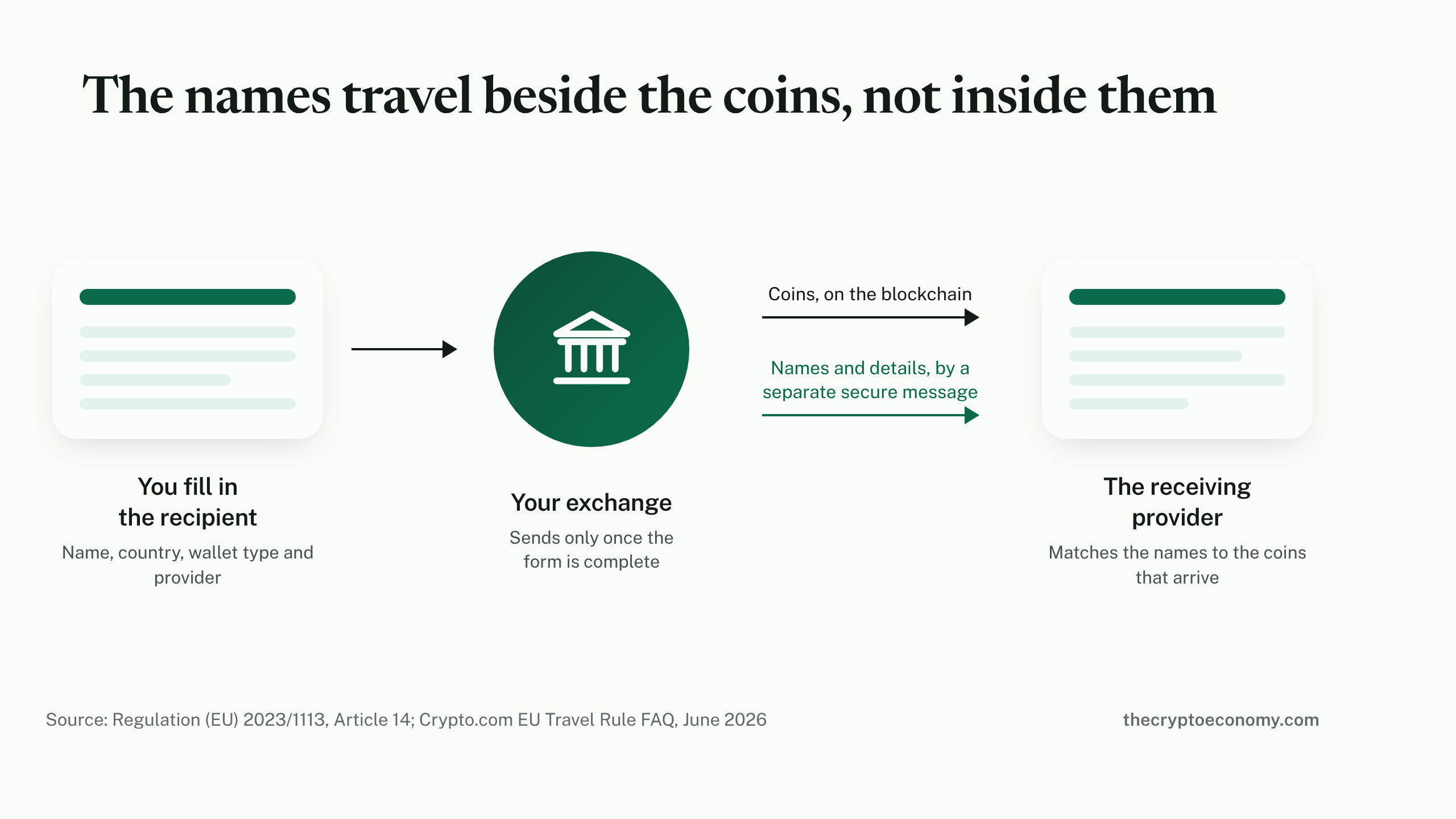
Crypto.com sets out the fields in its EU Travel Rule FAQ, last updated on June 18, 2026. When you send to an external wallet or another exchange, it wants the recipient’s name and country, whether the wallet is custodial or non-custodial, and the name of the recipient’s crypto-asset service provider where there is one. After the withdrawal, it passes your name and the recipient’s name to that provider.
Kraken’s page for EU and UK clients, updated November 3, 2026, says it may ask which provider holds the receiving wallet, and it swaps the data with partners such as Travel Rule Universal Solution Technology (TRUST).
Coinbase’s developer documentation shows the same idea as code. A transfer through its business API to the EU or EEA needs the beneficiary’s name, wallet type and country, plus a flag for whether the recipient is the sender. These are API rules. The retail app may look different.
A few details are worth collecting before you press send:
- The recipient’s full legal name, as it appears on their exchange account.
- The country where the recipient lives, or where a business is registered.
- Whether the address belongs to an exchange account or to a wallet the recipient runs with their own keys.
- The name of the receiving exchange, which for an EU firm you can look up among MiCA-licensed firms in ESMA’s register.
- The network the receiving exchange accepts for that coin.
Having them ready matters most on the first transfer to a new address, since Crypto.com says it may not ask again while the information it holds is still current and valid.
Why the law makes them ask
In the European Union the duty sits in Regulation (EU) 2023/1113, which has applied since December 30, 2024. Article 14 lists what each transfer must carry. For the sender, that is a name, the wallet address and any account number, and either an address with an official document number and customer number or a date and place of birth; the recipient’s side repeats the name, address and account fields.
The text is strict about timing. Article 14(8) says the sender’s provider “shall not allow for the initiation, or execute any transfer” before it complies, which is why a missing field stops a withdrawal outright.
The details do not have to ride on the blockchain, though. Article 14(4) lets them go ahead of the transfer or with it, by a secure channel, and says they need not be attached to the transfer itself. Coins and names reach the receiving firm by two separate routes.
Who the rule leaves out matters as much. Article 2(4) excludes transfers between two providers acting on their own account, and any “person-to-person transfer of crypto-assets carried out without the involvement of a crypto-asset service provider.”
The United States applies an older rule written for funds transfers. Under 31 CFR 1010.410(f), a sending institution must include the sender’s name, address and account number, the amount, the date and the recipient’s institution in any transmittal of $3,000 or more. FinCEN’s 2019 guidance on convertible virtual currency says a transfer of that size, or its equivalent in crypto, may trigger those duties for a money transmitter.
Travel Rule crypto thresholds, country by country
A single “threshold” column would mislead. Most rulebooks draw two lines, one where details must start to travel and one where extra data or an extra check begins. The texts were read on November 17, 2026; the FATF row uses a 2020 notice by FinCEN and the Federal Reserve that summarizes FATF Recommendation 16.
| Rulebook | Legal source | Where the rule starts | Where extra data or checks start |
|---|---|---|---|
| FATF (standard setter) | Recommendation 16, as summarized in a 2020 Federal Register notice | Cross-border wire transfers; names and account numbers go with the transfer even below any minimum | Checking those details for accuracy, above a minimum each country may set at no more than USD/EUR 1,000 |
| United States | 31 CFR 1010.410(f) and FinCEN guidance FIN-2019-G001 | Transmittals of $3,000 or more, including crypto worth that much | One line only, with the full list applying from $3,000 |
| European Union | Regulation (EU) 2023/1113, Articles 14 and 16 | Every crypto transfer a provider carries out, with no minimum | Above EUR 1,000 to or from a self-hosted address, the provider also checks that its customer owns or controls the address |
| United Kingdom | Money Laundering Regulations 2017, regulation 64C | Every transfer between cryptoasset businesses, with names and account numbers or a transaction identifier | £800 or more, counting linked transfers, when a business in the chain is outside the UK, plus a customer number, address, ID document number or date and place of birth |
| Canada | Proceeds of Crime (Money Laundering) and Terrorist Financing Regulations, section 124.1 | Virtual currency transfers of CAD 1,000 or more, the size at which a record must be kept, with names, addresses and account or reference numbers of both sides | No second line in section 124.1; providers need written policies on whether to suspend or reject a transfer that lacks the details |
| Singapore | MAS Notice PSN02, paragraph 13, as revised on June 30, 2025 | Every value transfer, with names and account or reference numbers, which is all that is needed at S$1,500 or below | Above S$1,500 the sender is identified and verified, and an address, ID number or date and place of birth is added |
| Australia | AML/CTF Transitional Rules 2026, section 12, and their explanatory statement; AML/CTF Rules 2025, section 5-18 | Virtual asset transfers by exchanges and other providers, from July 1, 2026 | For a self-hosted wallet, the provider’s policies must say how it identifies the payee and any steps to verify who controls the wallet |
Australia’s row is a start date rather than an amount. The Department of Home Affairs gives March 31, 2026 for the new value transfer obligations as a whole, while the explanatory statement to the transitional rules says virtual asset providers “must implement the ‘travel rule’ for virtual asset transfers from 1 July 2026.”
The US kept its $3,000 line when FinCEN and the Federal Reserve withdrew a $250 plan on November 9, 2026. An exchange’s help page can still name a different number.
Crypto.com’s UK FAQ, last updated on June 18, 2026, says it passes extra information on withdrawals over 1,000 EUR, though the UK line became £800 on June 30, 2026. Coinbase’s API asks for a Canadian recipient’s name and address from 999 CAD on transfers to an exchange wallet, just under the regulation’s CAD 1,000. Nothing stops a firm from running Travel Rule crypto checks earlier than the law requires, so the trigger you meet is your exchange’s.
Sending to your own wallet: proving it is yours
In the EU, a self-hosted wallet brings an extra step once a transfer to it passes EUR 1,000. Article 14(5) tells the sending provider to take “adequate measures” to confirm that the customer owns or controls the address, and Article 16(2) sets the same duty for the receiving provider on deposits from such a wallet.
Exchanges apply it their own way. Kraken prompts EU and UK clients to verify a private wallet on deposits and withdrawals above 1,000 EUR, and Crypto.com’s EU FAQ asks for a Satoshi test once cumulative transfers to a non-custodial wallet pass €1,000.
Crypto platform SpectroCoin prefers a signed message. Its help page also carries a notice that its operator, Spectro Finance OÜ, can no longer provide crypto-asset services in the EU and EEA, and asks those clients to withdraw their assets.
| Method | What you do | Where it is offered | What trips it up |
|---|---|---|---|
| Self-attestation | Confirm with one click that the wallet is yours; Kraken pairs it with a 2FA check | Kraken (EU and UK clients) | Not every exchange offers it, and Crypto.com’s EU FAQ asks for a test transfer instead |
| Satoshi test | Send a small amount from the wallet to show you control it | Kraken; Crypto.com (EU); Coinbase API rules for the EU and EEA above 1,000 euros | It needs a confirmed on-chain transfer, so you pay a network fee and wait for it |
| Message signature | Sign a message from the exact address you plan to withdraw to | SpectroCoin, “where supported” | It fails when the signing address differs from the withdrawal address, the signature format is wrong or the address is a smart contract |
At Kraken and Crypto.com the check is a one-off per address. Kraken says verified wallets “won’t need to be re-verified for future transactions,” and Crypto.com accepts later transfers to an address once its details have been verified.
The catch is timing. On Reddit, a Kraken user wrote in September 2026 that support told them wallet ownership verification can start only after a qualifying transfer, and that signatures from smart-contract wallets such as Safe (the ERC-1271 standard) were not supported at the time.
That is one user’s account, but it matches Kraken’s page, which describes the check as part of a flagged deposit or a withdrawal. Expect your first large transfer to a new wallet to pause.
Paying someone else from an exchange account
Some platforms will not send to a wallet that isn’t yours at all. Kraken says it “only allows first-party transactions” when crypto goes to or from a self-hosted wallet. Crypto.com’s help page for its Exchange, dated August 18, 2025, bans third-party deposits and withdrawals and tells customers who want to pay someone to withdraw to their own non-custodial wallet first.
The EU FAQ for Crypto.com’s app takes another line. It collects the recipient’s name and country and passes them on, so on the app a direct payment to another person goes through that form.
Its UK FAQ adds a limit on networks. When the recipient is in a country where the Travel Rule is in force and the address is a custodial wallet, such as an account at another exchange, Crypto.com sends only on the Bitcoin and Ethereum networks. For a USDT payment that rules out TRON and every other chain outside those two, so settle the network with the recipient before you work out which network to pick on cost.
Receiving crypto: why a deposit is put on hold
Deposits get the same questions in reverse. Crypto.com’s EU and UK FAQs ask you to declare the sender’s name and country, the wallet type and the sending provider through a “Submit Now” prompt in the app’s Accounts tab. On the Crypto.com Exchange, a deposit from an address you have not declared as yours “will be put on hold” until you declare it.
SpectroCoin compares the sender’s name in the incoming Travel Rule message with the name on your account. When the two look inconsistent, it may hold the deposit and ask you or the sender to correct the details or provide supporting evidence. If the information never arrives, the deposit may stay on hold, and “in rare cases” SpectroCoin may return the funds to the sending institution.
The law gives the receiving firm that choice. Article 17(1) requires procedures for deciding whether to execute, reject, return or suspend a transfer that lacks the required information, and lets the firm reject or return the coins, or ask for the missing details before crediting them. Moving coins from your own wallet to an exchange to cash out crypto is a deposit of exactly this kind, so expect the declaration before the sale.
What to do when a transfer is held or rejected
The exchanges’ pages describe two outcomes, a withdrawal that is refused and a deposit that is held, and the fix differs for each. Start with the notice. SpectroCoin, for one, sends a notification that the withdrawal was unsuccessful and asks you to review the requested fields.
If a withdrawal is rejected
According to SpectroCoin, a withdrawal that fails its Travel Rule checks is simply not sent, so the coins remain in your account. Work through it in this order:
- Note the field the notice names, such as the recipient’s name, the wallet type or the provider.
- Confirm the recipient’s legal name and receiving exchange with the recipient before you try again.
- Complete the wallet ownership verification when the address is your own wallet and the amount is above your exchange’s trigger.
- Submit a new withdrawal to the same address, because Kraken and SpectroCoin both ask for a fresh request rather than reviving the old one.
- Contact support when the same field fails twice, quoting the transfer ID and never a seed phrase.
A wallet app that cannot sign messages is a dead end for the signature method. SpectroCoin suggests switching to a wallet that can, or asking its support for alternatives.
If a deposit is on hold
Answer the declaration in the app first. On the Crypto.com Exchange, a held deposit is credited once you declare that you own the sending address. When the name in the incoming message does not match the name on your account, the fix may have to come from the sending exchange, so check which name it passes on.
What the firm does next is largely its own call. Canada’s regulation, in section 124.1(2), requires written risk-based policies on whether to suspend or reject a transfer missing the details, and FINTRAC’s guidance adds “allow” to the options. Singapore is stricter on the sending side, where a provider that cannot meet paragraph 13 of PSN02 “shall not execute or arrange for the value transfer.”
Not every hold is a Travel Rule crypto problem. Exchanges also screen addresses for sanctions, and a match with one of the crypto addresses OFAC lists stops a transfer for a reason no form can fix.
Before your next transfer
The rules keep moving. The UK’s line for cross-border data has been £800 since June 30, 2026, when it replaced a 1,000-euro figure, and Australia’s crypto Travel Rule for virtual asset providers started on July 1, 2026, so the page that counts is your exchange’s own, and the date on it. A short check before a large transfer:
- Find your exchange’s Travel Rule page and note the amount at which it asks for more.
- Collect the recipient’s legal name, country and provider before you start.
- Leave time for the first transfer above that amount to a new wallet of your own, since the check starts only then.
- Keep a little of the network’s coin in the wallet in case the exchange asks for a small test transfer from it.
After that first check, Kraken and Crypto.com both remember the address, so later transfers to it should not stop for the same question.
Frequently asked questions
What is the Travel Rule in crypto?
The Travel Rule is an anti-money-laundering rule under which a provider that sends crypto for a customer passes the sender’s and recipient’s details to the provider that receives it. It grew out of FATF Recommendation 16 on wire transfers, which FATF extended to virtual asset providers in June 2019, according to recital 2 of the EU regulation. Each country then writes its own crypto Travel Rule into law.
Does the Travel Rule apply between two self-custody wallets?
No provider, no Travel Rule. The EU regulation excludes person-to-person transfers made without a crypto-asset service provider, and the US and UK texts place their duties on financial institutions and cryptoasset businesses. It returns as soon as an exchange sits at either end, which is when the EU’s check above EUR 1,000 for a self-hosted address can apply.
What is a Satoshi test?
Sending a small amount of crypto from a wallet proves you control it. Kraken and Crypto.com use it for self-hosted wallets above 1,000 euros, and Coinbase’s API rules require one in the EU and EEA above that amount. It never needs your seed phrase, so a request for one during a Travel Rule check is a warning sign.
Why does a Travel Rule crypto check start below the legal threshold?
The law sets the point where a provider must act, and nothing stops it acting sooner. Crypto.com counts cumulative transfers to a non-custodial wallet toward its €1,000 line in the EU, and Kraken uses one 1,000 EUR trigger for EU and UK clients although the two rulebooks differ. Between providers in the EU there is no minimum at all.
What happens to my crypto if a Travel Rule check fails?
On a withdrawal, the coins are not sent. EU Article 14(8) bars the sending provider from starting an incomplete transfer, and SpectroCoin says rejected crypto stays unsent. On a deposit, the receiving provider may hold the coins while it asks for the details, reject them or return them to the sender, as the EU regulation’s Article 17(1) allows.