To cash out crypto to a bank account, almost every exchange works the same way. You sell the coins for your own currency, then withdraw that balance to a bank account in your name. What differs is the price of each step, how long the payout takes, and the checks that can hold it up.
We read the fee and help pages of four providers on November 16, 2026, and priced one named amount at each: $1,000 for US users and £1,000 in the UK. Coinbase, Bitstamp and Uphold blocked our requests that day, so their figures aren’t in the tables.
According to the Financial Conduct Authority’s consumer research, 8% of people in the UK are cryptoasset users, so cashing out is an everyday question, not an edge case.
How to cash out crypto in four steps
Every route below follows the same order, whether you start with bitcoin, ether or a stablecoin. The details sit with your exchange, but the steps don’t change.
- Move the coins to an exchange account that supports withdrawals to your country’s banks, on a network the exchange accepts for that coin, if they sit in a wallet you control.
- Sell them for dollars or pounds, ideally on a trading screen with a published fee rather than an instant-buy button.
- Link a bank account in your own name and withdraw the cash balance by the rail you need, such as ACH, a wire or Faster Payments.
- Save the trade confirmation, because the sale is the taxable event and you’ll need the date, amount and price later.
Sending a small amount first is worth the extra fee when the exchange or the bank account is new to you. It shows the account names match and that the payout arrives before you move the rest.
What it costs to cash out $1,000
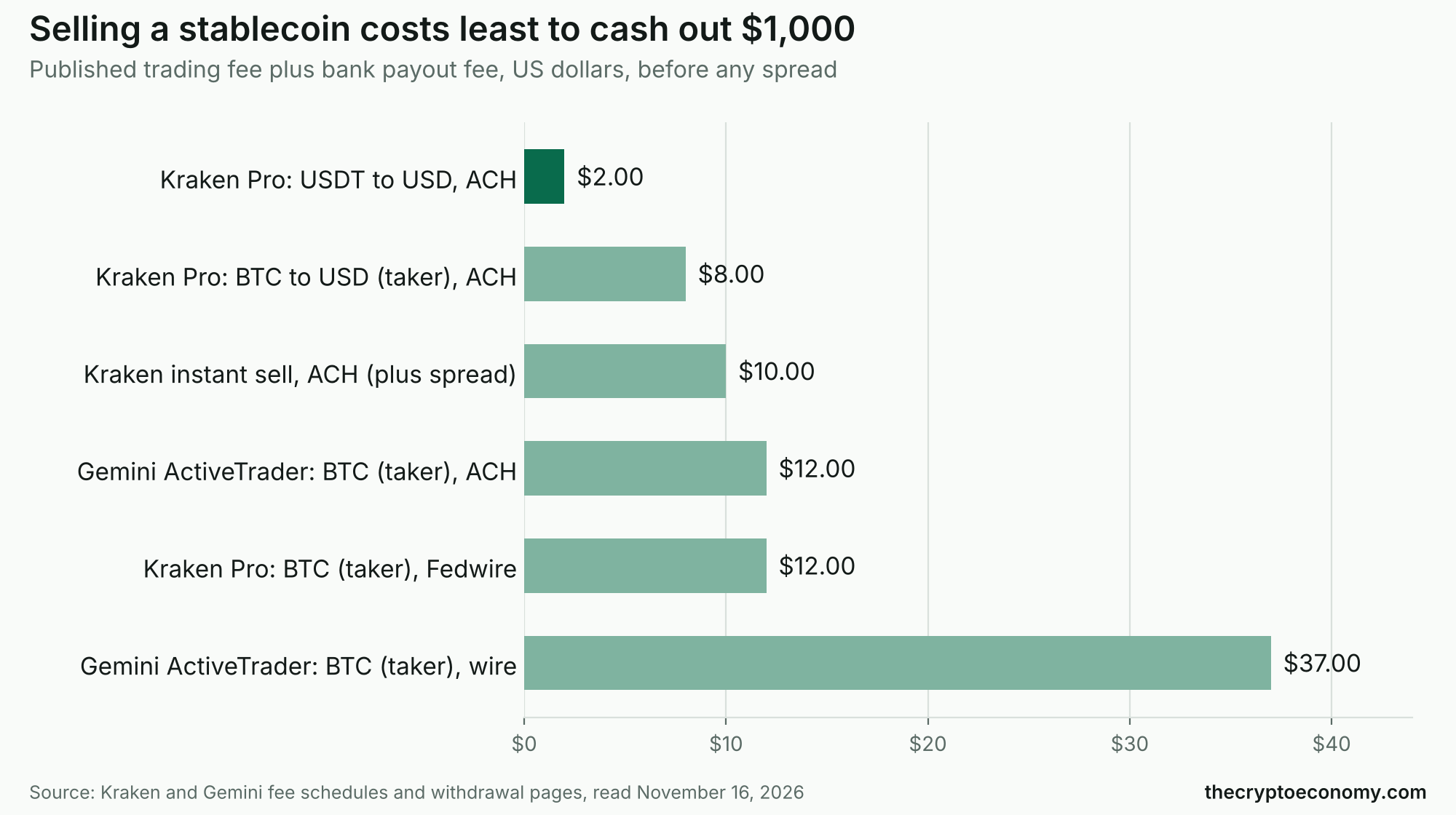
The trading fee and the spread dominate the cost, and the bank transfer is a small fixed charge or free. Selling a stablecoin for dollars is usually the cheapest way to cash out crypto, because exchanges price stablecoin pairs far below other crypto pairs.
Here is $1,000 priced from each provider’s published schedule. The spread, the gap between buying and selling prices, comes on top where the schedule says so.
| Route | Trading fee on $1,000 | Payout | Total published cost |
|---|---|---|---|
| Kraken Pro, USDT to USD, then ACH | 0.20%, $2.00 | ACH free | $2.00 |
| Kraken Pro, BTC to USD as a taker, then ACH | 0.80%, $8.00 | ACH free | $8.00 |
| Kraken instant sell, then ACH | 1%, $10.00, plus a spread | ACH free | $10.00 plus spread |
| Gemini ActiveTrader, BTC to USD as a taker, then ACH | 1.20%, $12.00 | ACH free | $12.00 |
| Kraken Pro, BTC to USD as a taker, then Fedwire | 0.80%, $8.00 | $4 | $12.00 |
| Gemini ActiveTrader, BTC to USD as a taker, then wire | 1.20%, $12.00 | $25 | $37.00 |
The figures come from Kraken’s Pro fee schedule, which lists 0.20% for USDT/USD in its stablecoin and FX table and 0.80% for a tier-one taker, and from Kraken’s instant buy and sell rate of 1%, where “the price you see includes a spread.” Gemini’s ActiveTrader schedule, dated September 1, 2026, starts at 1.20% for takers and 0.60% for makers. Placing a limit order that waits on the book makes you a maker and halves the fee at both.
Gemini’s simple buy and sell screen publishes no percentage at all, only a fee shown at order review, so it can’t be priced in advance. The same goes for Crypto.com’s in-app conversion, which we couldn’t find on a fee page.
In the UK
Revolut prices crypto by a percentage with a minimum. Its retail crypto fees document, version 1.1.5 from January 2026, charges 1.49% on the Standard and Plus plans for exchanges under £10,000, so selling £1,000 of bitcoin costs £14.90.
Stablecoins are cheaper there too. Revolut says “we do not apply a percentage based fee or minimum fee to exchanges between fiat currency and stablecoins”, though a 1% fair usage fee applies to Standard plan exchanges over £1,000 a month, and 0.5% over £3,000 on Plus. Kraken charges £1.95 to send pounds by Faster Payments and Crypto.com’s app £1.90, on top of the trading fee.
Which stablecoin you hold matters
Not every stablecoin pair is cheap everywhere. One Reddit user described on r/CoinBase being quoted $906, about 1.9%, to cash out 48,707 USDT, and the top reply said converting to USDC first would have cost nothing on that exchange. That’s one person’s account, and we couldn’t check Coinbase’s fee page, but it shows why you should look up the exact pair before you sell.
How long the payout takes
The transfer time has two layers: how long the exchange takes to send the money, and how long the payment rail takes to deliver it. Exchanges quote their own windows, and those are the numbers to plan around.
| Provider and rail | Fee | Minimum | Stated time |
|---|---|---|---|
| Kraken, ACH (US) | Free | $1 | 0-2 business days, 2pm ET cutoff |
| Kraken, Fedwire (US) | $4 | $20 | 0-1 business days |
| Kraken, RTP (US) | 1.50%, $50 maximum | $20 | Near-instant |
| Kraken, Faster Payments (UK) | £1.95 | £5 | Near-instant |
| Kraken, SEPA Instant (EU) | €1 | €2 | Near-instant |
| Gemini, ACH (US) | Free | Not stated | Not stated |
| Gemini, USD wire (US) | $25 | Not stated | Same-day option |
| Crypto.com Exchange, ACH (US) | Free up to $1 million net over 30 days | $100 | 1 to 3 business days |
| Crypto.com app, Faster Payments (UK) | £1.90 | £70 | Not stated on that page |
Kraken’s figures come from its withdrawal options page, last updated November 4, 2026, and Gemini’s from its transfer fee schedule. Crypto.com’s Exchange page says “ACH withdrawals typically take 1 to 3 business days,” and its UK Exchange page puts Faster Payments at about one business day. The app’s £1.90 fee and £70 minimum come from a help page dated April 2025.
The rails themselves can be quick. Nacha, which runs the US ACH network, says payments “can be processed in a matter of hours on the same business day,” though they aren’t settled on weekends or federal holidays, and Same Day ACH covers payments of up to $1 million.
In the UK, Faster Payments runs 24 hours a day, and banks can allow single payments of up to £1 million, according to Pay.UK. Your own bank sets your limit.
What holds up a cash-out
The longest waits in the providers’ own pages come from holds and checks, not from the rails. Kraken says “Cash deposits via ACH Plaid are held from withdrawal for 7 days. This applies to all crypto and fiat withdrawals,” and card or PayPal purchases carry a 72-hour hold. If you bought the coins recently with a bank deposit, the clock started then.
Names have to match. Crypto.com sends dollars only to a bank account in the same name as the app account, and in the UK it pays out only to the bank account you deposited from by Faster Payments. Kraken adds that banks’ own “regulatory checks and compliance procedures” can stretch a near-instant transfer.
An exchange can also pause every withdrawal at once. Binance stopped them for three days after the October hack and was still reopening networks two weeks later, so cash you need soon is safer in your bank than on an exchange.
UK bank limits apply to buying, not selling
UK banks publish limits on payments to crypto exchanges, which is the buying direction. NatWest caps Faster Payments and debit card transactions to exchanges at £1,000 a day and £5,000 over 30 days, and says on its cryptocurrency payments page that “there’s no block or limits on payments being made to you.” Nationwide limits current account payments to buy crypto to £1,000 a day.
So a cash-out landing in a NatWest account isn’t capped by that policy. We found no UK bank page describing checks on incoming payments from exchanges, so we can’t say how often they happen.
Taxes: the sale is the taxable step
The tax question sits with the sale, not the bank transfer. The IRS treats digital assets as property, and stablecoins are included in its examples. Its digital assets page says you report sales “whether or not they result in a taxable gain or loss,” and lists the records to keep: the asset, the date and time, the units, the fair market value and your basis.
Your exchange may report the sale too. From 2025, US brokers file Form 1099-DA for sales they handle, and the dollars you withdraw afterwards are ordinary cash, not another crypto transaction.
In the UK, HMRC says you may owe Capital Gains Tax when you dispose of tokens by “selling them; exchanging them for a different type of cryptoasset; using them to pay for goods or services; giving them to another person.” Your gain is “normally the difference between what you paid for an asset and what you sold it for,” and the pooling rules in our UK crypto tax guide decide what you paid.
A checklist before you sell
A few minutes of checking before you cash out crypto avoids most of the problems above. Run through these before you move a large amount.
- Look up the trading fee for your exact pair on the exchange’s fee schedule, not just the headline rate.
- Check whether a deposit hold still applies to your account.
- Make sure the bank account is in the same name as the exchange account.
- Send a small test withdrawal to a new bank account first.
- Save the trade confirmation and the cost basis of the coins you sold.
If the coins sit in your own wallet, moving them to the exchange costs a network fee, and our withdrawal fee study measured what one transfer cost on each major network in November.
Frequently asked questions
How long does it take to cash out crypto to a bank account?
It depends on the provider and the rail. Kraken lists ACH at 0 to 2 business days and Faster Payments and SEPA Instant as near-instant, while Crypto.com’s Exchange says ACH typically takes 1 to 3 business days. A hold on a recent deposit can add days, such as Kraken’s 7 days after an ACH Plaid deposit.
What is the cheapest way to cash out crypto?
On the schedules we read, selling a stablecoin for dollars costs least. Kraken Pro charges 0.20% on USDT/USD against 0.80% for a taker on bitcoin, and ACH withdrawals there are free. Check that your exchange lists the stablecoin pair you hold, since rates differ by pair.
Do I pay tax when I move crypto to my bank?
The tax point is the sale, when you swap crypto for dollars or pounds. The IRS asks you to report digital asset sales whether or not they made a gain, and HMRC counts selling as a disposal for Capital Gains Tax. Withdrawing the cash afterwards is a normal bank transfer, and a US broker that handled the sale reports it on Form 1099-DA.
Can I send crypto directly to a bank account?
No. Banks hold dollars and pounds, not tokens, so the coins have to be sold first, usually on an exchange or a broker such as Revolut. The exchange then pays the cash to your bank by ACH, wire, Faster Payments or SEPA.
Will my bank block money from a crypto exchange?
The UK limits we found apply to payments to exchanges. NatWest says “there’s no block or limits on payments being made to you,” while it caps payments to exchanges at £1,000 a day. Your exchange will usually send money only to an account in your own name.