Key takeaways:
- USDT is a token that Tether International, licensed in El Salvador, redeems at one dollar less fees, but only for verified customers. Tether counted 175.9 billion in circulation on November 11, 2026, 97.8% of them on TRON and Ethereum.
- On September 30, 2026 the reserves came to $191.45 billion against $183.50 billion of liabilities, with 64.2% in US Treasury bills, according to an assurance report by BDO.
- Tether can freeze any USDT address. Our tracker counted 4,881 Tether freezes on Ethereum and TRON in a year, and 93.5% of the frozen addresses weren’t on the US sanctions list.
USDT is the biggest stablecoin, about 60% of all of them by DefiLlama’s count on November 12, 2026. It’s a token that tracks the US dollar and moves on public blockchains. If you’ve been paid in it, seen it on an exchange or been told to “send USDT on TRC-20”, this guide covers the USDT meaning that matters in practice: who stands behind the token and which rules apply to the tokens in your wallet.
Every figure here carries a date, because USDT changes by the hour. Most come from Tether’s own reports and terms, from regulators’ records and from our own reading of the blockchain.
What is USDT and who issues it
What does USDT stand for? US dollar tether, the name the CFTC’s 2021 release uses for “the U.S. dollar tether token (USDT)”. The tether meaning is literal. Tether’s FAQ says its tokens are “anchored or ‘tethered’ to real-world currencies on a 1-to-1 basis and backed by our Reserves.” On its own pages the company writes the ticker as USD₮ or USDt.
The issuer is Tether International, S.A. de C.V., formerly Tether International Limited. Tether’s terms of service, last updated February 26, 2026, say it moved its seat from the British Virgin Islands to El Salvador. The notes to its latest reserve report describe it as a licensed stablecoin issuer there and as a money services business registered with FinCEN in the US.
Tether dates USDT to October 2014, when the first tokens ran on the Omni Layer on top of bitcoin. Its FAQ puts the USDT meaning plainly, saying “Tether currencies are not money, but are digital tokens formatted to work on blockchains.”
Tether issues new tokens only when customers who passed its identity checks buy them. Tokens it has created but not sold sit in its treasury and aren’t counted as circulating. Everyone else gets USDT second-hand, on an exchange or from another person.
Where USDT runs
Tether issues USDT on 13 blockchains, from Ethereum and TRON to Solana and TON. On September 1, 2025 it stopped being obliged to redeem tokens on five older ones, the Omni Layer included.
In practice two chains carry almost everything.
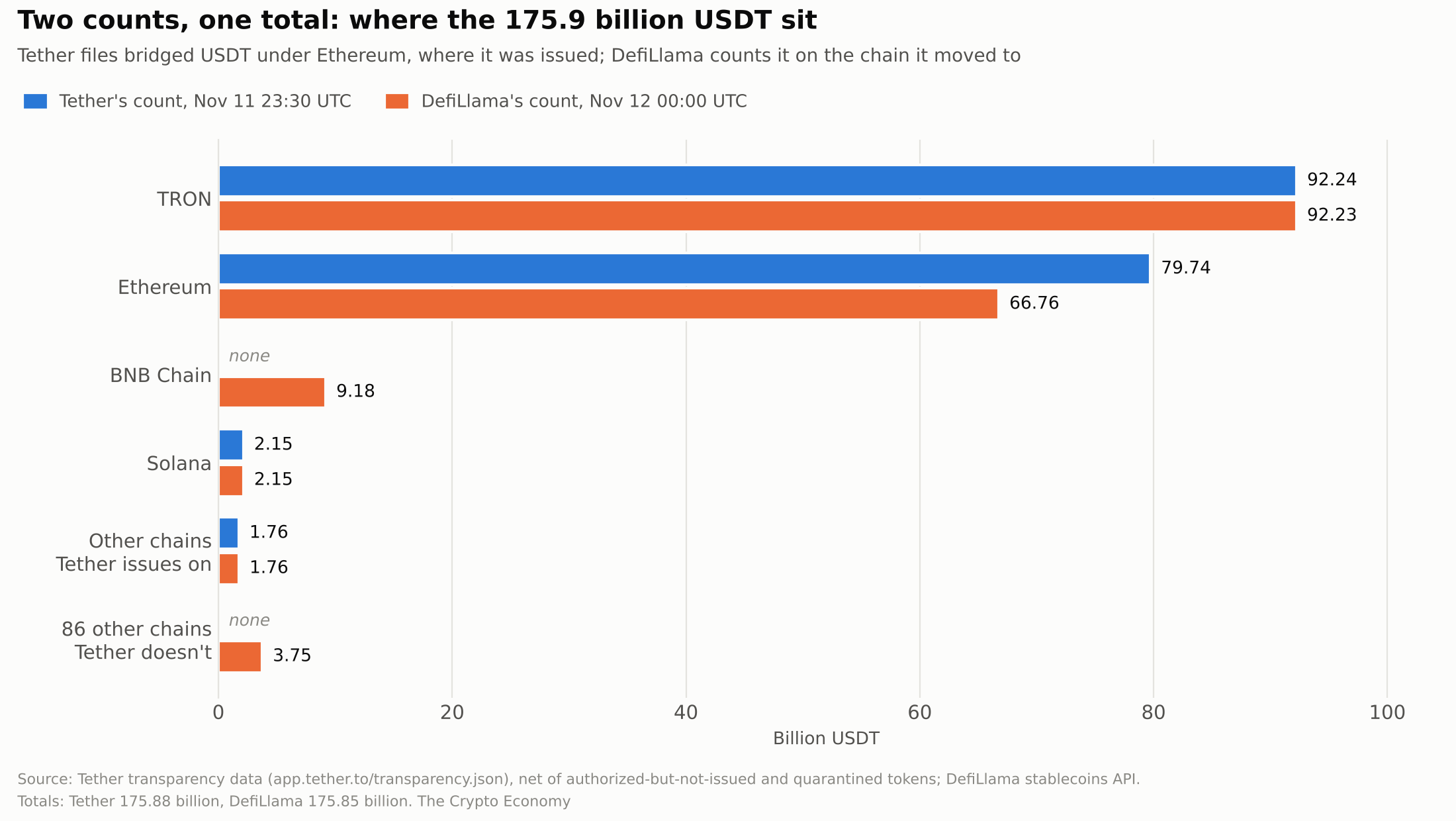
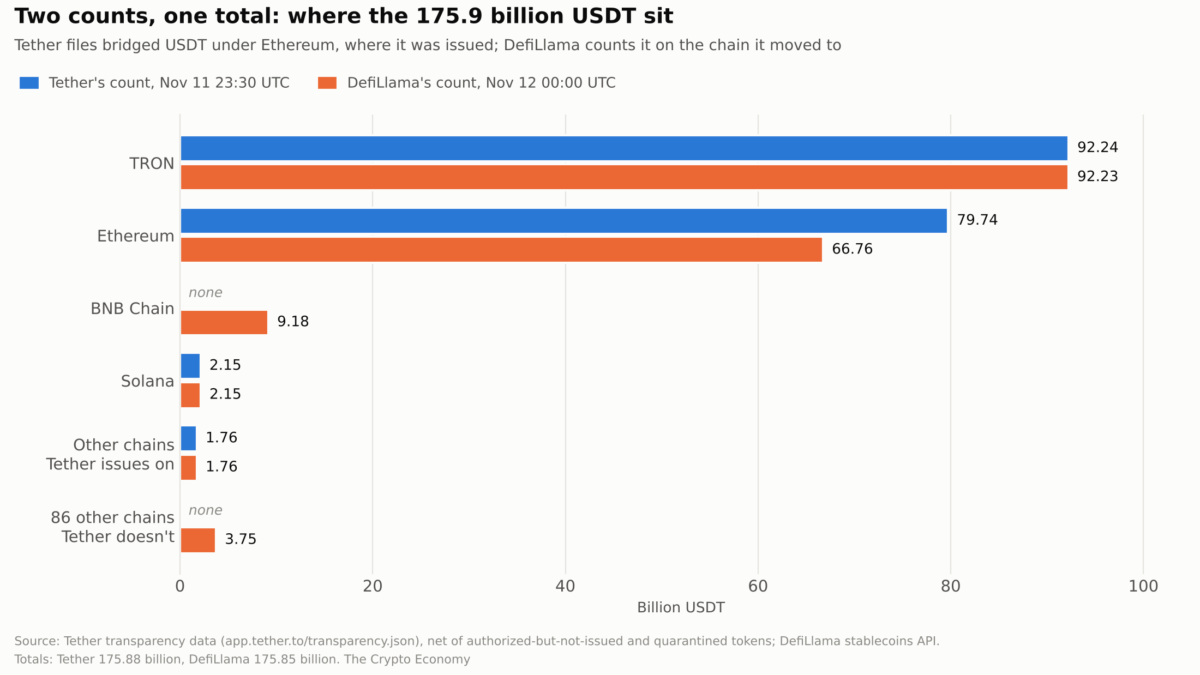
We read two counts half an hour apart, Tether’s own data at 23:30 UTC on November 11 and DefiLlama’s at midnight. The totals differ by 0.02%. The split by chain differs far more.
| Chain | Tether’s count (billion USDT) | DefiLlama’s count (billion USDT) |
|---|---|---|
| TRON | 92.24 | 92.23 |
| Ethereum | 79.74 | 66.76 |
| BNB Chain | none issued | 9.18 |
| Solana | 2.15 | 2.15 |
| Other chains Tether issues on | 1.76 | 1.76 |
| 86 other chains Tether doesn’t issue on | none issued | 3.75 |
| All chains | 175.88 | 175.85 |
The gap is bridged USDT. DefiLlama finds 12.94 billion USDT, 7.4% of the total, on 87 chains where Tether issues nothing, BNB Chain alone holding 9.18 billion, while Tether counts the tokens behind them on Ethereum, where they were issued.
That difference reaches your wallet. Under the terms, wrapped or bridged versions “are not Tether Tokens” and “cannot be redeemed with Tether”. The token on BNB Chain calls itself “Tether USD” in its contract, yet Tether’s list of supported chains has no USD₮ contract there.
Tether has also invested in LayerZero Labs, whose infrastructure Everdawn Labs used to build USDT0, the bridged version KuCoin lists on Arbitrum and Polygon. Its terms still class bridged tokens as something other than Tether Tokens.
What backs USDT
What is USDT backed by? Mostly short-term US government debt. Tether publishes its reserves every quarter, with an assurance report from BDO in Milan. The latest covers September 30, 2026 and was signed on October 30. BDO checked a single date and says it “did not perform procedures or provide any assurance at any other date or time”.
| Reserve asset, September 30, 2026 | Billion US dollars | Share |
|---|---|---|
| US Treasury bills | 122.84 | 64.2% |
| Reverse repos, cash, deposits and non-US bills | 16.74 | 8.7% |
| Gold | 19.08 | 10.0% |
| Secured loans | 14.18 | 7.4% |
| Bitcoin | 8.37 | 4.4% |
| Other investments, shares and bonds | 10.25 | 5.4% |
| Total | 191.45 | 100% |
Shares add to 100.1% because of rounding. Liabilities came to $183.50 billion, $183.47 billion of it tokens issued. That leaves a cushion of $7.95 billion, or 4.3%. That cushion has swung by billions between reports: $6.34 billion at the end of 2025, $8.23 billion in March 2026, $4.11 billion in June and $7.95 billion in September, each as first reported.
Cash and near-cash made up 72.9% of the reserves. The other 27.1%, about $51.9 billion, sat in gold, bitcoin, secured loans, shares and other investments, whose prices move. Our reserve attestation entry explains what a report like BDO’s can and can’t prove.
How you get a dollar back
Tether redeems USDT only for its own verified customers, and the minimum is large. Its fee page sets a minimum of $100,000, a redemption fee of the greater of $1,000 or 0.1%, and a verification fee of 150 USD paid in Tether tokens. At the minimum the fee is 1%, and the 0.1% rate only takes over from $1 million.
Most holders can’t meet that minimum, so they exit through an exchange instead, by selling USDT for dollars or withdrawing it to another wallet. When we read the fee pages of five exchanges on November 10, 2026, the median fee across 33 USDT withdrawal routes was 1 USDT. The transfer itself cost the network under a cent on every chain we measured except TRON, as our withdrawal fee study shows route by route.
The network you pick changes the bill. Crypto.com Exchange charged 0.84 USDT to withdraw on Solana and 10 USDT on Ethereum. Check that the wallet or exchange receiving the tokens supports the network before you send.
Can Tether freeze your USDT?
Yes. The terms of service let Tether “freeze any Tether Tokens held by you” when the law requires it or when Tether decides “it is prudent to do so”. Its FAQ adds that Tether “may also seize and destroy Tether Tokens remotely, in response to demands from government, law enforcement or other authorities.”
Each freeze leaves a record on the blockchain, so it can be counted.
Our freeze tracker read every one between November 1, 2025 and November 10, 2026, and found that Tether froze 4,857 addresses in 4,881 events on Ethereum and TRON. It also destroyed 538.35 million USDT in 769 events and lifted 833 freezes. Only 6.5% of the addresses it froze were on OFAC’s sanctions list. For the other 93.5%, the chain shows the freeze and not the reason.
Two cases show the scale. On April 23, 2026 Tether froze two TRON addresses holding about 344 million USDT, a day before OFAC listed them under Iran’s central bank. On October 29 it froze about 1.56 billion USDT within three hours, after what Tether’s release describes as a Binance hack.
Frozen tokens still count in Tether’s supply figure, by our reading of its data. Its transparency file lists zero quarantined USDT on Ethereum and TRON, against 3.7 million on Solana.
How to check an address before you pay
A frozen USDT address can still receive tokens, but it can’t send them. At one address frozen on October 29, another 204.3 million USDT arrived after the freeze and stayed stuck. Before a large payment, paste the address into our free Address Check, which reads the USDT freeze list on Ethereum and TRON.
Is USDT allowed where you live?
The rules depend on where you are and on who’s selling it to you. Tether’s own terms add another layer. In places they’re stricter than the law.
| Where | What applies | Source |
|---|---|---|
| European Union | No Tether token is in ESMA’s MiCA register (checked November 12, 2026). ESMA’s 2025 statement had platforms stop trading such coins by the end of March 2025 while custody and transfers continued. Its opinion of October 8, 2026 asks licensed providers to drop every service for them, custody and transfers included, and to clear remaining client holdings within three months, keeping only sell-only, conversion, transfer or withdrawal functions | ESMA register; ESMA statement of January 17, 2025; ESMA opinion of October 8, 2026 |
| United States | From July 18, 2028, US platforms may offer only stablecoins from permitted issuers, with a route for foreign issuers whose home rules Treasury finds comparable. Tether’s separate US token, USA₮, is issued by Anchorage Digital Bank, N.A. and launched on January 27, 2026 | GENIUS Act, Public Law 119-27; Tether |
| New York | Tether agreed in 2021 to stop trading with New Yorkers and paid $18.5 million in penalties | New York Attorney General, February 23, 2021 |
| Tether’s own terms | US persons may not hold USDT “in any way” unless Tether approves them as eligible contract participants. Canadian and Singaporean persons are excluded too | Tether terms, February 26, 2026 |
Tether’s contract binds its customers and isn’t a law, and US exchanges still list USDT: on November 10 we read USDT withdrawal fees at Kraken and at OKX’s US site from a US address. In the EU, the 15 MiCA-compliant stablecoins we track came to $74.07 billion on November 10, against $176.21 billion of USDT that day.
The US rule sits in section 3 of the GENIUS Act. USA₮ is small next to USDT, with 179 million tokens on DefiLlama on November 12.
Regulators have fined Tether before over what backed the coin. The CFTC’s 2021 order found Tether held enough fiat reserves “for only 27.6% of the days” in a 26-month sample from 2016 through 2018, and set a $41 million penalty.
Has USDT ever lost its peg?
What is USDT worth on a normal day? Since January 2023, DefiLlama’s daily price hasn’t fallen below $0.9959, though it traded lower a few times before that, and each dip was short. The prices below are DefiLlama’s aggregated market-wide figures, so a single exchange may have printed lower.
| Date | USDT price | What Tether said at the time |
|---|---|---|
| April 25, 2017 | $0.9138 (daily), the lowest in DefiLlama’s series since March 2015 | Its Taiwanese banks had blocked and refused incoming international wires since April 18 |
| October 16 to 19, 2018 | $0.9839 to $0.9894 (daily) | It had redeemed “a significant amount of USDT” and would destroy 500 million USDT |
| May 12, 2022 | $0.9926 (hourly low) | It had honored over 300 million USDT of redemptions in 24 hours during market volatility |
| November 12, 2026 | $0.99874 at 04:04 UTC | No statement |
That 2023 low came on November 22. Some guides say USDT fell to about $0.95 in May 2022. The market-wide price we read didn’t go below $0.9926.
Supply moved far more than the price. It fell from 83.42 billion on May 1, 2022 to 66.54 billion on June 30, down 20% in two months. It still moves week to week: USDT supply fell $2.8 billion in the week to November 8, 2026, and on November 12 it stood 7.8% below its peak of 190.43 billion on May 20.
Frequently asked questions
What does USDT stand for?
USDT stands for US dollar tether, the full name the CFTC used for the token in 2021. The tether meaning is the peg, the token’s value tied to the dollar one to one. On its own site Tether spells it USD₮ or USDt.
Is USDT the same as a US dollar?
No. A dollar in a US bank account is a deposit with a bank, while USDT is a token that Tether redeems for its verified customers. Its terms say the tokens “are not legal tender” and aren’t covered by FDIC or SIPC protection.
Who issues USDT?
Tether International, S.A. de C.V., a company licensed as a stablecoin issuer in El Salvador and registered with FinCEN as a money services business. Tether’s US token, USA₮, is a different coin issued by Anchorage Digital Bank, N.A.
Can Tether freeze my USDT?
Yes. Tether can blacklist any address, after which that address can’t send USDT. From November 2025 to November 10, 2026 it froze 4,857 addresses on Ethereum and TRON, and 93.5% of them weren’t among the addresses OFAC has sanctioned.
Is USDT legal in the US?
No US law we found bans holding USDT, and US exchanges list it. Tether’s own terms exclude most US persons, though, and from July 18, 2028 the GENIUS Act bars US platforms from offering stablecoins whose issuers it doesn’t permit, though a foreign issuer can qualify under its section 18.