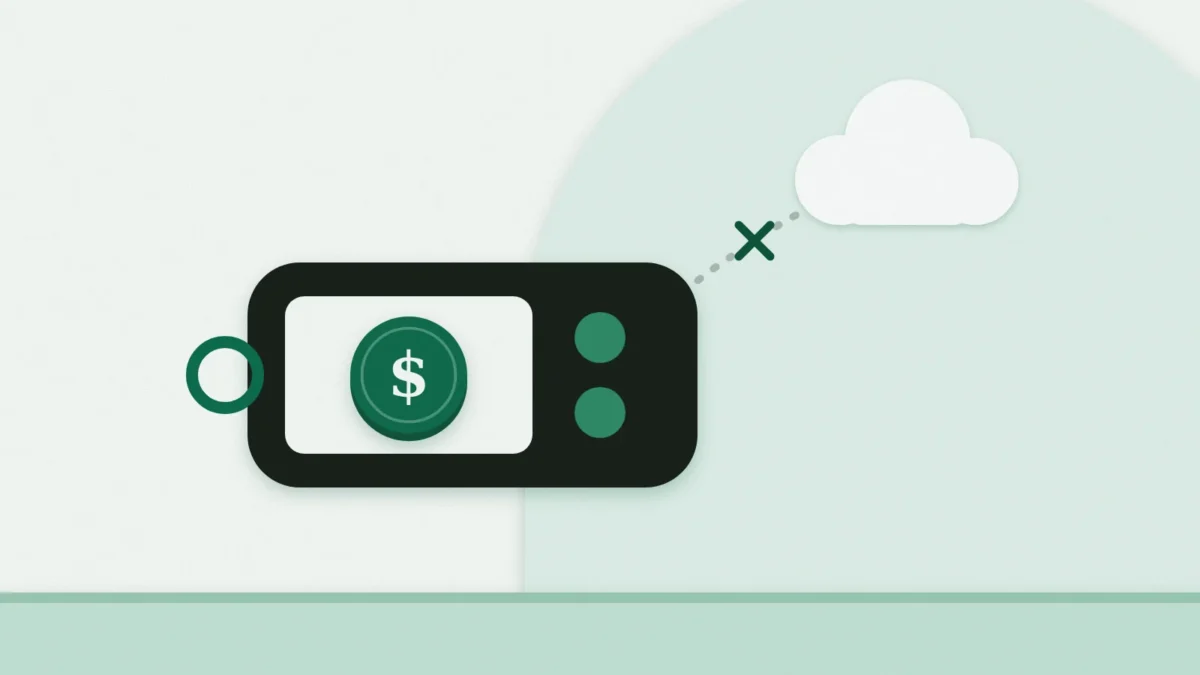
What is a cold wallet? It’s a crypto wallet whose private keys stay off the internet, on a hardware device, a computer that is never connected, or paper. Because nothing online holds the keys, someone who breaks into your phone or laptop can’t copy them from there.
Most people who own crypto don’t use one. In the FCA’s 2025 consumer survey, 74% of UK crypto owners said they keep their coins on the exchange they bought them from, up from 59% in 2021, and 13% said they chose cold storage.
We read how regulators define the term, priced the main devices on their makers’ stores on November 19, 2026, collected the rules on how much exchanges must keep offline, and went through this year’s cases where coins were lost anyway.
What is a cold wallet, by the official definitions
The fullest definition comes from NIST, the US federal standards agency, in its 2021 report on token design and management. A cold wallet, it says, is “not connected to the internet” and is meant to be “highly secure (containing high-value/at-rest tokens).” A hot wallet is the connected kind, “intended to be highly accessible.”
NIST adds a second test. “Physical human intervention or authentication is required to sign transactions, such as pushing a button, entering a local pin, or scanning a quick response (QR) code.” So a key that sits offline but signs whatever it’s sent wouldn’t meet the definition.
The SEC’s December 2025 bulletin for retail investors is looser. It says a cold wallet “is typically a physical device that is not connected to the internet, such as a USB drive, external hard drive, or even a piece of paper.”
Ask a maker “what is a cold wallet?” and you may get a different answer. Ledger’s academy says a cold wallet “does not connect to the internet or interact with any smart contract” and that “not all hardware wallets are cold wallets.” That’s Ledger’s view, not a regulator’s. NIST and the SEC go by the connection alone.
How a cold wallet signs a transaction
The key never leaves the cold wallet. Your phone or computer runs the wallet app, which knows your addresses and balances but holds no key.
When you send coins, the app builds an unsigned transaction and passes it to the device. The device shows the amount and the receiving address on its own screen, you approve with a button or a PIN, and it hands back a signed transaction for the app to broadcast.
That handoff travels by USB cable or Bluetooth on most Ledger and Trezor models. An air-gapped wallet passes it by QR code or microSD card instead, so no data cable touches the device. An offline computer does the same job with a USB stick.
The screen matters most. NIST names “secure display” among a hardware wallet’s integrity features, the idea of “what you see is what you sign.” If the address on the device differs from the one you meant to pay, something on the computer has changed it, and the device is the one to believe.
Cold wallet devices and what they cost
Hardware is the most common form. Paper and an offline computer cost nothing extra, but they put the whole job of signing on you, and for most people paper’s real use is as the backup of a device’s recovery phrase. The SEC’s bulletin notes that “Physical devices for cold wallets typically cost money to purchase, while hot wallets may initially be free.”
| Device | Price on the maker’s US store | How it talks to your phone or computer | Note |
|---|---|---|---|
| Trezor Safe 3 | $59 | USB-C | |
| Ledger Nano S Plus | $69 | USB-C | Ledger says it doesn’t work with iOS devices |
| Ledger Nano X | $99 | Bluetooth or USB-C | |
| Trezor Safe 5 | $129 | USB-C | |
| Coldcard Mk5 | $219 | microSD, NFC or USB-C | Bitcoin only |
| Trezor Safe 7 | $249 | USB-C or Bluetooth | |
| Ledger Stax | $399 | Bluetooth, NFC or USB-C |
We read the Ledger, Trezor and Coldcard prices on the makers’ own pages on November 19, 2026, before shipping and tax. Ledger counts “15,000+ coins and tokens” on its Nano pages, Trezor speaks of thousands, and the Coldcard holds only bitcoin.
Every device on the list has at least one secure element, the kind of tamper-resistant chip used in bank cards, though each maker gives it a different job.
The makers also differ on how much of their code you can read. Trezor advertises “Open-source security,” while Ledger says its agreement with chipmaker STMicroelectronics “legally prevents us from exposing the low-level code that talks to the hardware blocks of the Secure Element.”
How much crypto exchanges keep in cold wallets
Coins you leave on an exchange mostly sit in the exchange’s own offline wallets. Three Asian regulators put a number on it.
| Where | Rule on customer crypto | Source |
|---|---|---|
| Japan | The online share may not exceed 5% of its yen value; the rest goes on a device “always disconnected from the internet” or a paper record | Cabinet Office Order, Article 27 |
| Hong Kong | Licensed platforms “should store 98% of client virtual assets in cold storage” | SFC guidelines, June 2023, paragraph 10.6 |
| South Korea | “more than 80 percent” in cold wallets, and the FSC can set a higher ratio for a given exchange | FSC press release, June 25, 2024 |
| EU | No ratio. MiCA Article 75 asks for a custody policy that keeps the risk of loss to clients low | MiCA Article 75 |
| US | No federal ratio found |
Hong Kong also makes platforms arrange compensation covering 50% of client assets held cold and 100% of those in hot and other storage, a sign that the SFC sees the online share as the riskier one. Japan’s figure comes from the government’s English translation of the 2021 version of the order.
The exchanges’ own figures come from different kinds of documents. Coinbase’s annual report for 2025 puts its own ceiling for hot wallets at “no more than 2%” of the assets it holds for customers. OKX says on a marketing page that it stores “over 95%” of client crypto offline. Kraken speaks of “the vast majority” and Gemini of “the majority,” without a number.
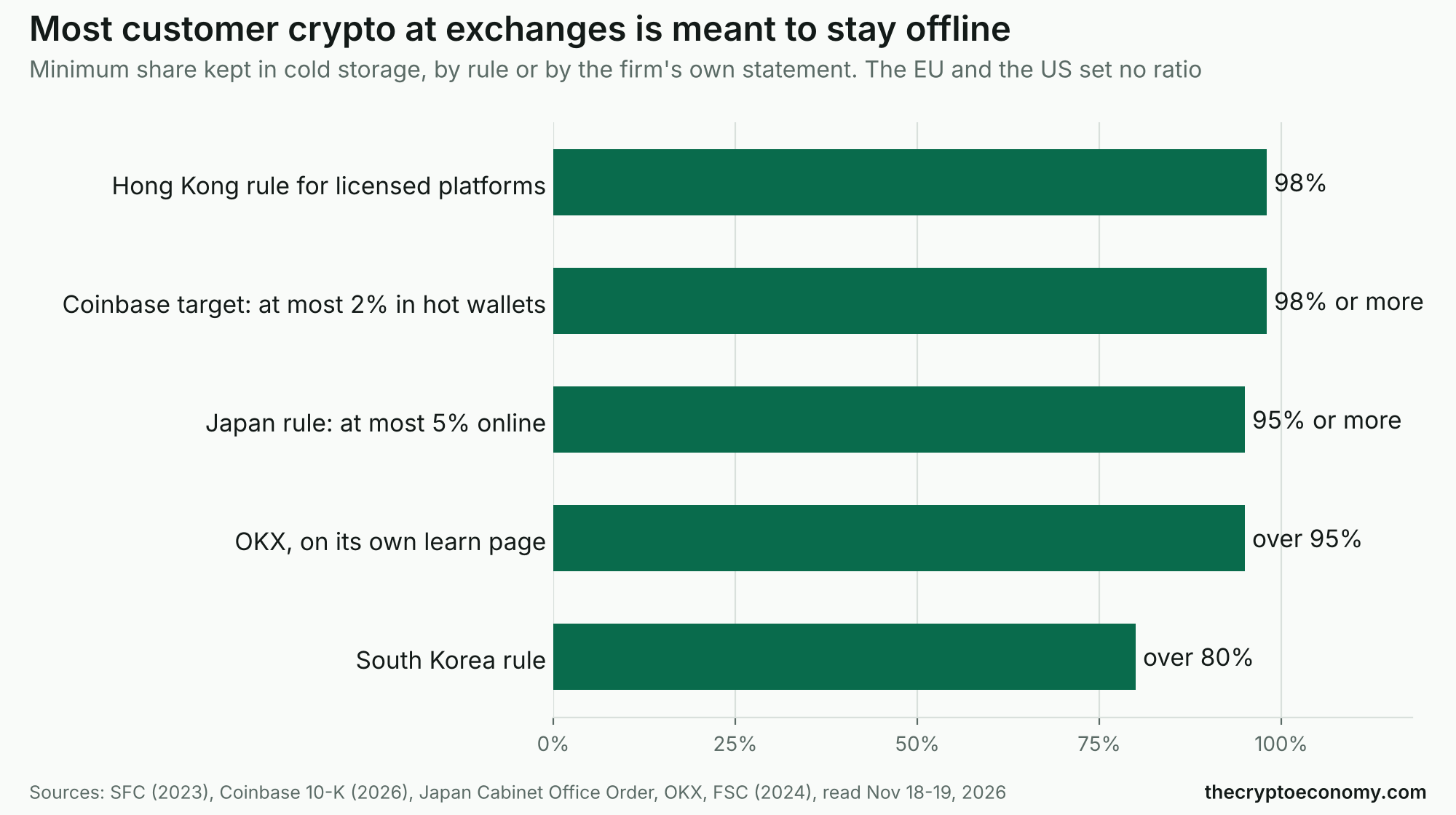
In the EU and the US, then, “cold storage” means whatever the firm’s custody policy says. Before you leave coins with a European exchange, check that it holds a MiCA license in our list of licensed crypto firms and read the custody section of its terms.
How coins were lost around cold wallets in 2026
Keeping keys offline stops them from being copied over a network. This year’s losses show what it doesn’t cover.
Exchange hot wallets: Bitget and Binance
At 19:05 UTC on September 24, Bitget detected unauthorized transfers from some of its hot wallets. Its first notice said “Cold wallets remain fully secure” and that the breach reached only part of its hot and warm wallet layers. A day later it raised the loss to about $387.5 million.
Binance lost about $6.3 billion in tokens from its hot wallets on October 29, starting at around 20:05 UTC, by its own account. It found “no evidence of any wallet private key leak.” The attacker had used a compromised engineer’s laptop to submit withdrawals, as our Binance hack report describes, and neither exchange reported a loss from cold storage.
Devices fitted with implants by a reseller
On October 15, Ledger said attackers had bought genuine Ledger devices, “opened them, fitted custom-built hidden components designed to capture the recovery phrase during setup,” and sold them through resellers in Southeast Asia. “There was no flaw in Ledger’s chip, operating system or servers,” it wrote. Ledger gave no loss figure.
The reseller was CryptoBilis, which also sold Trezor devices. Trezor’s November 12 update found the implant in three Trezor Safe 5s bought from CryptoBilis between August 20 and September 23, 2026, and said none of their owners had lost funds.
The implant copies what appears on the screen, recovery words included, and sends it over the mobile network to the attackers. Trezor’s firmware 2.13.1 of November 11 stops the implants it found from capturing anything, and the company has cut its reseller network by about 80%.
A weak key from the device itself
Coinkite’s Coldcard had a different problem. Its July 30 advisory says a firmware bug weakened seed generation, so attackers rebuilt private keys offline, and that “The COLDCARD devices themselves were not hacked.” Its status page warns that “Updating firmware does not repair an existing affected seed.”
How to set up a cold wallet safely
Most of the 2026 cases come down to where the device came from and how the backup was made. These steps follow the makers’ own advice after those cases.
- Buy from the maker’s own store, as Trezor now recommends.
- Reject any device that arrives with a recovery phrase already written down or a PIN already set.
- Update the firmware before you create the wallet, since Coldcard warns that an update can’t repair a seed made on faulty firmware.
- Create the recovery phrase on the device, write it down by hand, and never type it into a website, form, app or message.
- Wipe the device and restore it from your written phrase before you deposit, to prove the backup works.
- Send a small amount first and compare the receiving address on the device screen with the one you meant.
- Decide who could find the backup, and how, if something happened to you.
The first step has a catch. Ledger’s security team says its genuine check “cannot detect unauthorized physical modifications to the hardware, such as spying implants,” and CryptoBilis had been an official Trezor reseller. On Reddit, the top reply in one r/CryptoCurrency thread said it was listed on Ledger’s website too, and that buyers in some Asian countries use resellers to avoid cost and losses at customs.
The second step comes straight from Ledger’s buying guide, which says “A legitimate Ledger device never comes with a recovery phrase or PIN code pre-configured. Ever.” For the sixth, the Optimizely hack of November 16 showed that a trusted website can display the wrong address.
The last step is the one people skip. A May 2026 post on r/BitcoinBeginners describes helping a friend through a two-hour Coldcard setup, then asking whether his wife could reach the coins. “He stared at me for a second and said no.” That’s one person’s story, but it’s the risk a cold wallet adds.
Do you need a cold wallet?
A cold wallet moves the risk from the exchange to you. You no longer depend on the exchange’s hot wallets or its solvency, but nobody can restore a lost phrase for you.
That risk is real.
In a 2016 peer-reviewed study of 990 bitcoin users surveyed in July 2015, about 22.5% said they had lost bitcoins or keys at least once, and 43.2% of those blamed themselves. The survey is from 2015, so treat it as a sign of the risk rather than today’s rate.
So what is a cold wallet worth to you? The case for one grows with the amount and how long you’ll hold it. Coins you trade or spend each week cost a network fee every time they move between the wallet and an exchange, and our study of withdrawal fees shows how much those vary.
Frequently asked questions
Is a cold wallet the same as a hardware wallet?
Not always. NIST and the SEC count an offline computer, a USB drive or a piece of paper as cold wallets too. Ledger goes the other way. It says not all hardware wallets are cold wallets, and its definition also rules out a wallet that interacts with smart contracts.
What is the best cold wallet?
We don’t rank devices, because the best cold wallet depends on what you hold and how you’ll use it. The Coldcard holds only bitcoin, Ledger says its Nano S Plus doesn’t work with iOS, and some models connect by Bluetooth while others need a cable. On November 19, 2026, the devices we checked cost $59 to $399 on their makers’ US stores.
Can a cold wallet be hacked?
The key can’t be copied over the internet, but you can still lose coins. In 2026 that happened through devices fitted with implants before sale and a Coldcard firmware bug that produced weak keys. At Bybit in February 2025, signers approved a transfer from a cold wallet through a spoofed interface.
What happens if I lose my cold wallet?
You restore it on a new device from your recovery phrase, and the coins are still there. If you lose the phrase as well, nobody can recover them. If the old device was tampered with, Trezor says a backup it generated isn’t safe to reuse.
Does a cold wallet stop USDT or USDC from being frozen?
No. Tether and Circle freeze addresses inside the token contract, so a frozen address stays frozen whatever device holds its key. Our freeze tracker counted 6,557 freeze events on six USDT and USDC contracts between November 1, 2025 and November 10, 2026.